

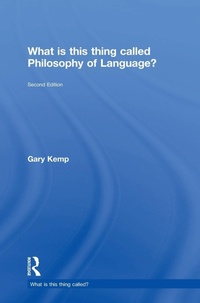
What is this thing called Philosophy of Language?
2nd Edition
Published on 22. December 2017
Book
Hardback
242 pages
978-1-138-22581-7 (ISBN)
Description
Philosophy of language explores some of the most abstract yet most fundamental questions in philosophy. The ideas of some of the subject's great founding figures, such as Gottlob Frege, Ludwig Wittgenstein and Bertrand Russell, as well as of more recent figures such as Saul Kripke and Hilary Putnam, are central to a great many philosophical debates to this day.
In this clear and carefully structured introduction to the subject Gary Kemp explains the following key topics:
the basic nature of philosophy of language, its concepts, and its historical development
Frege's theory of sense and reference; Russell's theory of definite descriptions
Wittgenstein's Tractatus, Ayer, and the Logical Positivists
recent perspectives including Kripke, Kaplan and Putnam; arguments concerning necessity, indexicals, rigid designation and natural kinds
The pragmatics of language, including speech-acts, presupposition and conversational implicature
Davidson's theory of language, the 'principle of charity', and the indeterminacy of interpretation
puzzles surrounding the propositional attitudes (sentences which ascribe beliefs to people)
Quine's naturalism and its consequences for philosophy of language.
The challenges presented by the later Wittgenstein
Contemporary directions, including contextualism, fictional objects and the phenomenon of slurs
This second edition has been thoroughly revised to include new key topics and updated material. Chapter summaries, annotated further reading and a glossary make this an indispensable introduction to those teaching philosophy of language and will be particularly useful for students coming to the subject for the first time.
In this clear and carefully structured introduction to the subject Gary Kemp explains the following key topics:
the basic nature of philosophy of language, its concepts, and its historical development
Frege's theory of sense and reference; Russell's theory of definite descriptions
Wittgenstein's Tractatus, Ayer, and the Logical Positivists
recent perspectives including Kripke, Kaplan and Putnam; arguments concerning necessity, indexicals, rigid designation and natural kinds
The pragmatics of language, including speech-acts, presupposition and conversational implicature
Davidson's theory of language, the 'principle of charity', and the indeterminacy of interpretation
puzzles surrounding the propositional attitudes (sentences which ascribe beliefs to people)
Quine's naturalism and its consequences for philosophy of language.
The challenges presented by the later Wittgenstein
Contemporary directions, including contextualism, fictional objects and the phenomenon of slurs
This second edition has been thoroughly revised to include new key topics and updated material. Chapter summaries, annotated further reading and a glossary make this an indispensable introduction to those teaching philosophy of language and will be particularly useful for students coming to the subject for the first time.
Reviews / Votes
'This book is an outstanding pedagogical tool, which will be useful to anyone looking to gain a foothold in the subject. The second edition, which features new chapters on key figures, prominent topics, and recent developments in the field, is a substantial and welcome development of the excellent first edition.'Brett Sherman, University of South Carolina, USA.
'Will become the standard textbook for survey courses in the philosophy of language'.
Ernest Lepore, Rutgers University, USA.
Praise for the first edition:
'To my mind this is the best introductory textbook for undergraduates looking to get a feel for the subject, without getting bogged down in advanced technical details. Gary Kemp covers all the traditional topics in the field and presents them in an accessible, engaging, and always rigorous style. Appended to each chapter are useful historical notes, a summary, a few questions, and some bibliographical recommendations for further research - a complete set of study aids that ought to be welcomed by students and teachers alike.' - Stefano Predelli, University of Nottingham, UK
'An easy, step by step journey through the classic themes of twentieth-century philosophy of language.' - Francois Recanati, Institut Jean Nicod, France
'Kemp has written a genuine introduction to the philosophy of language with beginning students in mind. Focusing on the issue of the meaning of natural language, he begins with a naive and, for students, very natural view of linguistic meaning. He then motivates and explains the distinctions, problems, solutions and development of the philosophy of language with the patience and understanding of a master teacher.' - Michael Losonsky, Colorado State University, USA
More details
Series
Edition
2nd edition
Language
English
Place of publication
London
United Kingdom
Publishing group
Taylor & Francis Ltd
Target group
College/higher education
Edition type
Annotated edition
Product notice
sewn/stitched
Cloth over boards
Illustrations
7 s/w Tabellen
7 Tables, black and white
Dimensions
Height: 250 mm
Width: 175 mm
Thickness: 19 mm
Weight
636 gr
ISBN-13
978-1-138-22581-7 (9781138225817)
Copyright in bibliographic data and cover images is held by Nielsen Book Services Limited or by the publishers or by their respective licensors: all rights reserved.
Schweitzer Classification
Other editions
New editions
Book
03/2024
3rd Edition
Routledge
€205.10
Shipment within 10-20 days
Additional editions
Book
12/2017
2nd Edition
Routledge
€65.87
Article exhausted; check for reprint
Previous edition
Book
02/2013
1st Edition
Routledge
€126.48
Article exhausted; check for reprint
Person
Gary Kemp is Senior Lecturer in Philosophy at the University of Glasgow, UK. He has authored or edited various books and articles in the Philosophy of language, including Quine versus Davidson: Truth, Reference and Meaning.
Content
List of figures and tables. Preface. Introduction. 1 Naive semantics and the language of logic. 2 Fregean semantics. 3 Russellian semantics. 4 Russell's Theory of Judgement, The Early Wittgenstein, and Logical Positivism. 5 Kripke on naming and necessity. 6 Context dependence, indexicality and natural kinds. 7 Pragmatics. 8 The propositional attitudes. 9 Davidson's philosophy of language. 10 Quine's philosophy of language. 11 The Late Wittgenstein. 12 Modern directions. Glossary. Bibliography. Index