

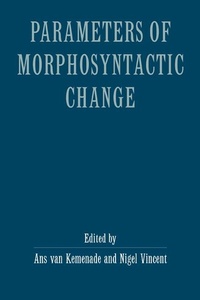
Parameters of Morphosyntactic Change
Published on 1. May 1997
Book
Hardback
558 pages
978-0-521-58402-9 (ISBN)
Description
The relationship between changes in (inflectional) morphology and the consequences of these changes in syntax has been a perennial issue in historical linguistics. The contributors to this 1997 volume address the issue of how to model the phenomena of syntactic and morphological change within recent frameworks, in particular the Minimalist Program. A special concern is the way different criteria for the selection of argument structure - especially aspect and mood - interact over time with various types of argument marking: case, word order, clitics, agreement. The volume contains papers by many of the leading scholars in the field. There is a substantial introduction which reviews the development of ideas in generative historical syntax, and assesses the distinctive properties of the generative position.
More details
Language
English
Place of publication
Cambridge
United Kingdom
Target group
Professional and scholarly
Dimensions
Height: 235 mm
Width: 157 mm
Thickness: 34 mm
Weight
949 gr
ISBN-13
978-0-521-58402-9 (9780521584029)
Copyright in bibliographic data and cover images is held by Nielsen Book Services Limited or by the publishers or by their respective licensors: all rights reserved.
Schweitzer Classification
Other editions
New editions
Ans van Kemenade | Nigel Vincent
Parameters of Morphosyntactic Change
Book
05/1997
Cambridge University Press
€72.70
Shipment within 15-20 days
Persons
Content
Introduction: parameters and morphosyntactic change Ans van Kemenade and Nigel Vincent; Part I. Aspect, Argument Structure and Case Selection: 1. The interdependence of case, aspect and referentiality in the history of German Werner Abraham; 2. The rise of the article in the Germanic languages Julia Philippi; 3. The diachronic development of a modal verb of necessity Paola BenincA and Cecilia Poletto; 4. Auxiliary verbs in Old and Middle French Philip H. Miller; 5. Commentary on part I: aspect, argument structure and case selection Alessandra Tomaselli; Part II. Clitics: 6. The emergence of the D-system in Romance Nigel Vincent; 7. On two locations for complement clitic pronouns Maria Luisa Rivero; 8. On the integration of second position phenomena Josep M. Fontana; Part III. Verb Second and Comp: 9. Shifting triggers and diachronic reanalyses David Lightfoot; 10. Viewing change in progress Alison Henry; 11. Verb movement in Old and Middle English Anthony Kroch and Ann Taylor; 12. V2 and embedded topicalization in Old and Middle English Ans van Kemenade; 13. Qu'est-ce que ce que: the diachronic evolution of a French complementizer Laurie Zaring and Paul Hirschbuehler; 14. The structure of parametric change, and V-movement in the history of English Anthony Warner; Part IV. Scrambling and Morphological Change: 15. Directionality and word order change in the history of English Ian Roberts; 16. On the relation between morphological and syntactic case Fred Weerman; 17. The rise of positional licensing Paul Kiparsky; The papers by Kiparsky, Roberts and Weerman: an epilogue Hoeskuldur Thrainsson; References; Index.