

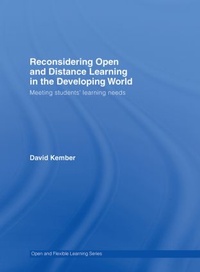
Reconsidering Open and Distance Learning in the Developing World
Meeting Students' Learning Needs
1st Edition
Published on 14. June 2007
Book
Hardback
220 pages
978-0-415-40139-5 (ISBN)
Description
Distance learning is now more prevalent in the developing world than ever before. This book reconsiders the suitability and success of established modes of distance learning for current contexts in the developing world. It examines what adaptations are necessary to suit shifting needs including:
the move from elite to mass higher education
increased emphasis on knowledge base economies
greater demand for lifelong learning and professional development
the effects of technical and societal changes
demand for post-secondary education.
Drawing upon research into students' conceptions of, and approaches to learning, this critical analysis of the state of open and flexible learning examines the characteristics, needs and learning approaches of students, considering whether or not current provision is successful, what changes are necessary, and, crucially, how student retention can be improved.
the move from elite to mass higher education
increased emphasis on knowledge base economies
greater demand for lifelong learning and professional development
the effects of technical and societal changes
demand for post-secondary education.
Drawing upon research into students' conceptions of, and approaches to learning, this critical analysis of the state of open and flexible learning examines the characteristics, needs and learning approaches of students, considering whether or not current provision is successful, what changes are necessary, and, crucially, how student retention can be improved.
Reviews / Votes
'This book would be of interest to higher education researchers as well as adult learners who are interested in understanding more about learning in distance education. Moreover, it details some of the lessons learned from students themselves and the kinds of support needed to make transition to independent learner.' - Journal of Adult and Continuing EducationMore details
Series
Language
English
Place of publication
London
United Kingdom
Publishing group
Taylor & Francis Ltd
Target group
College/higher education
Professional and scholarly
Postgraduate and Professional
Illustrations
12 s/w Zeichnungen, 10 s/w Tabellen
10 Tables, black and white; 12 Line drawings, black and white
Dimensions
Height: 234 mm
Width: 156 mm
Weight
570 gr
ISBN-13
978-0-415-40139-5 (9780415401395)
Copyright in bibliographic data and cover images is held by Nielsen Book Services Limited or by the publishers or by their respective licensors: all rights reserved.
Schweitzer Classification
Other editions
Additional editions
David Kember
Reconsidering Open and Distance Learning in the Developing World
Meeting Students' Learning Needs
E-Book
06/2007
Routledge
€45.99
Available for download
David Kember
Reconsidering Open and Distance Learning in the Developing World
Meeting Students' Learning Needs
E-Book
06/2007
Routledge
€45.99
Available for download
David Kember
Reconsidering Open and Distance Learning in the Developing World
Meeting Students' Learning Needs
Book
06/2007
1st Edition
Routledge
€60.84
Shipment within 15-20 days
Person
David Kember is Professor of Learning Enhacement in the Centre for Learning Enhancement and Research, at the Chinese University of Hong Kong.He has held previous educational development positions on Australia and Papua New Guinea, and teaching positions at the University of the South Pacific and in the UK.
Content
Introduction 1. Modes of Learning in Post-Secondary Education 2. Major Themes in Student Learning 3. Open Access 4. Need for Open Entry in Developing Countries 5. Other Elements of Openness 6. Pedagogy and Andragogy 7. Open Universities Expect Andragogy but Schools Teach Pedagogy 8. The UKOU Model: How Appropriate is it for the Developing World? 9. Dual Mode: The Separation of the Modes 10. The US Model: Transmissive Teaching by Another Medium 11. The Loneliness of the Distance Learner 12. E-Learning Course Management Systems 13. Flexible Learning: But How Flexible? 14. Conclusion