

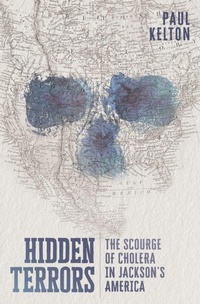
Hidden Terrors
The Scourge of Cholera in Jackson's America
Will be published approx. on 14. January 2027
Book
Hardback
360 pages
978-0-19-777208-9 (ISBN)
Description
Drawing on accounts of ordinary Americans, Hidden Terrors offers the first comprehensive history of the enigmatic illness behind the 1830s cholera pandemic--and its profound consequences for the nation.
From 1832 to 1836, cholera erupted across US cities as well as in small towns, rural farms, prisons, and plantations. Its victims experienced ghastly symptoms--vomiting, explosive diarrhea, painful spasms, turning blue, and collapsing into comas--and often perished within hours of first becoming sick. They frequently woke up healthy, began to feel ill by nightfall, and did not live to see another day. Cholera killed people much more quickly than other diseases with which Americans were familiar, and its causes would not be discovered until the later development of bacteriology. It afflicted rich and poor, people of every race, religion, and region.
As Hidden Terrors reveals, many powerful people in the 1830s wanted their contemporaries to understand cholera as anything but a frightful and unknowable predator that took its prey indiscriminately. American moral reformers and medical authorities, among others, attributed the deaths of the impoverished, enslaved, and exploited to individual failings--eating rotten foods, drinking alcohol, neglecting to seek treatment, and living in filth. The experience of these victims, in their view, was a natural consequence of immorality and called for minimal sympathy. Authorities ignored and even covered up the deaths of enslaved African Americans, Indigenous peoples, and Irish immigrants. The disease particularly exploded in crowded housing, work camps, poor houses, hospitals, prisons, along the routes Indigenous people were forced to travel on the Trail of Tears, and within slave coffles. However, the universal nature of the pandemic became more apparent as deaths of supposedly respectable people became shockingly numerous, apparent, and undeniable. It was that terror--the idea of everyone being equally subject to an invisible and mysterious killer--that elites struggled most to keep hidden.
Drawing on family papers, letters, and newspaper accounts written during the pandemic, Hidden Terrors tells the comprehensive story of the first cholera pandemic in the United States. Paul Kelton humanely captures the experiences of ordinary Americans living in fear of a mysterious disease and exposes the disastrous consequences of a deadly germ intersecting with the great injustices of Jacksonian America.
From 1832 to 1836, cholera erupted across US cities as well as in small towns, rural farms, prisons, and plantations. Its victims experienced ghastly symptoms--vomiting, explosive diarrhea, painful spasms, turning blue, and collapsing into comas--and often perished within hours of first becoming sick. They frequently woke up healthy, began to feel ill by nightfall, and did not live to see another day. Cholera killed people much more quickly than other diseases with which Americans were familiar, and its causes would not be discovered until the later development of bacteriology. It afflicted rich and poor, people of every race, religion, and region.
As Hidden Terrors reveals, many powerful people in the 1830s wanted their contemporaries to understand cholera as anything but a frightful and unknowable predator that took its prey indiscriminately. American moral reformers and medical authorities, among others, attributed the deaths of the impoverished, enslaved, and exploited to individual failings--eating rotten foods, drinking alcohol, neglecting to seek treatment, and living in filth. The experience of these victims, in their view, was a natural consequence of immorality and called for minimal sympathy. Authorities ignored and even covered up the deaths of enslaved African Americans, Indigenous peoples, and Irish immigrants. The disease particularly exploded in crowded housing, work camps, poor houses, hospitals, prisons, along the routes Indigenous people were forced to travel on the Trail of Tears, and within slave coffles. However, the universal nature of the pandemic became more apparent as deaths of supposedly respectable people became shockingly numerous, apparent, and undeniable. It was that terror--the idea of everyone being equally subject to an invisible and mysterious killer--that elites struggled most to keep hidden.
Drawing on family papers, letters, and newspaper accounts written during the pandemic, Hidden Terrors tells the comprehensive story of the first cholera pandemic in the United States. Paul Kelton humanely captures the experiences of ordinary Americans living in fear of a mysterious disease and exposes the disastrous consequences of a deadly germ intersecting with the great injustices of Jacksonian America.
More details
Language
English
Place of publication
New York
United States
Illustrations
30 black and white halftones
Dimensions
Height: 235 mm
Width: 156 mm
ISBN-13
978-0-19-777208-9 (9780197772089)
Copyright in bibliographic data and cover images is held by Nielsen Book Services Limited or by the publishers or by their respective licensors: all rights reserved.
Schweitzer Classification
Person
Paul Kelton is the Robert David Lion Gardiner Chair in American History at Stony Brook University. He is the author of Cherokee Medicine, Colonial Germs: An Indigenous Nation's Fight Against Smallpox, 1518-1824 and Epidemics and Enslavement: Biological Catastrophe in the Native Southeast, 1492-1715.
Content
- Acknowledgments
- Introduction
- 1. Entertaining Fear: A Distant Pandemic Stokes American Imaginations
- 2. "An Irish immigrant died at Montpelier": Cholera Arrives in North America
- 3. "It is all a humbug": Mortality Peaks in New York City
- 4. Terror on Arch Street: Incarceration's Fatal Consequences in the Northeast
- 5. A Preacher, a Banker, a Judge, and a Quaker: Convincing the Northeastern Elite
- 6. Ms. Maury's Prophecy: Virginia in the Pandemic's Grip
- 7. "Poor Exiles of Erin": Irish Laborers in Mid-Atlantic Work Zones
- 8. "So Much for Freedom": Dismissiveness and Death in Baltimore
- 9. What Happened in New Orleans: The First Wave in the West
- 10. "They just covered it up": Cholera Strikes Choctaws on the Trail of Tears
- 11. Isaac Franklin's Dark Deeds: Trafficking Enslaved People into the Hot Zone
- 12. Noise Over Troubled Waters: The Deafening Consequences of Temperance
- 13. The Lessons of Lexington: The Second Wave, 1833
- 14. Back to Charleston: The Pandemic Ends, 1834, 1835, and 1836
- Conclusion
- Notes
- Bibliography
- Index