

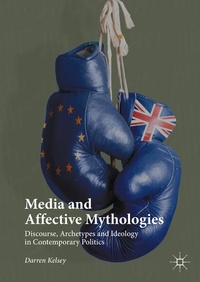
Media and Affective Mythologies
Description
This book provides a timely political insight to show how mythology plays an affective role in our lives. Brexit, bankers, institutional scandals, the far right, and Russell Brand's "revolution" are just some of the issues tackled through this innovative and interdisciplinary discourse analysis. Through multimedia case studies, Kelsey explores the psychological dimensions of archetypes and mythologies and how they function ideologically in contemporary politics. By synergising approaches to critical discourse studies with the work of Carl Jung, Joseph Campbell and other mythologists, Kelsey's psychodiscursive approach explores the depths of the human psyche to analyse the affective qualities of storytelling. Kelsey makes a compelling case for our need to understand more about the power of mythology in modern society. Whilst mythology might be part of who we are, societies are responsible for its ideological substance and implications. Media and Affective Mythologies shows howwe can begin to engage with this principle.
Reviews / Votes
"This highly original, interdisciplinary work is daring and fascinating. The author succeeds in outlining a 'psychodiscursive' approach to Critical Discourse Studies which combines semiotic approaches to myth with aspects of Jungian psychoanalysis to reveal the ideological and affective properties of media texts in a range of contemporary political contexts." (Christopher Hart, Lancaster University, UK)More details
Other editions
Additional editions
Person
Darren Kelsey is Head of Media, Culture, Heritage and co-convener of the Newcastle Critical Discourse Group at Newcastle University, UK. Darren's publications have focused on media mythologies and ideology, war and terrorism, moral storytelling, the banking crisis, right wing populism, journalism ethics, social media, and surveillance and affect theory.
Content
1. Why study mythology and how is it affective?.- 2. Affective apparatus: collective unconscious, archetypes and the transpersonal.- 3. Hero's journey: Nigel Farage, the EU and Brexit.- 4. The city Trickster: Bankers, moral tales and contemporary capitalism.- 5. Children, shadows and scapegoats: The child abuse scandals of Rotherham Council and Jimmy Savile.- 6. Collective individuation as spiritual revolution: the affective mythology of Russell Brand.- 7. Affective mythologies: Where do we go from here?