

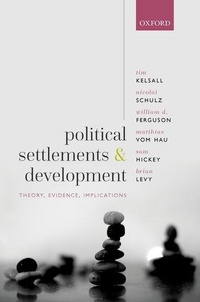
Political Settlements and Development
Theory, Evidence, Implications
Published on 19. May 2022
Book
Hardback
270 pages
978-0-19-284893-2 (ISBN)
Description
Few concepts have captured the imagination of the conflict and development community in recent years as powerfully as the idea of a 'political settlement'. At its most ambitious, 'political settlements analysis' (PSA) promises to explain why conflicts occur and states collapse, the conditions for their successful rehabilitation, different developmental pathways from peace, and how to better fit development policy to country context. Yet not all is well in the world of PSA. Rival definitions of the term abound, there are disagreements about its scope and the way it should be used, a growing schism between conflict specialists and economists, basic concepts are ambiguous and little progress has been made on measurement. Political Settlements and Development consequently has three main aims: to argue for a revised definition of a political settlement, capable of unifying its diverse strands, and opening new opportunities for the analysis of conflict and development; to put the concept on a more solid theoretical and scientific footing, providing a method for measuring and categorising political settlements, while using new data to analyse the relationship between political settlements and development; and finally, to examine the implications for policymakers.
This is an open access title available under the terms of a CC BY-NC-ND 4.0 International licence. It is free to read at Oxford Scholarship Online and offered as a free PDF download from OUP and selected open access locations.
This is an open access title available under the terms of a CC BY-NC-ND 4.0 International licence. It is free to read at Oxford Scholarship Online and offered as a free PDF download from OUP and selected open access locations.
Reviews / Votes
It is likely that further fruitful academic debates will spring from this new contribution and lead to a further honing of the PS approach that has proven to be so valuable for answering the big development questions. * Sebastian Heinen, International Centre for Sustainable Development, Bonn-Rhein-Sieg University of Applied Sciences *More details
Language
English
Place of publication
Oxford
United Kingdom
Target group
Professional and scholarly
Product notice
sewn/stitched
Cloth over boards
Dimensions
Height: 239 mm
Width: 164 mm
Thickness: 21 mm
Weight
558 gr
ISBN-13
978-0-19-284893-2 (9780192848932)
Copyright in bibliographic data and cover images is held by Nielsen Book Services Limited or by the publishers or by their respective licensors: all rights reserved.
Schweitzer Classification
Other editions
Additional editions
Tim Kelsall | Nicolai Schulz | William D. Ferguson
Political Settlements and Development
Theory, Evidence, Implications
E-Book
07/2022
1st Edition
OUP eBook
€71.49
Available for download
Tim Kelsall | Nicolai Schulz | William D. Ferguson
Political Settlements and Development
Theory, Evidence, Implications
E-Book
05/2022
1st Edition
OUP eBook
€80.49
Available for download
Persons
Tim Kelsall is a Senior Research Fellow at the Overseas Development Institute in London, a former co-Director of Research for the Effective States and Inclusive Development (ESID) research centre, and currently Political Settlements Research Director for the African Cities Research Consortium at the University of Manchester. He specialises in political anthropology and political economy analysis and has interests in governance, democracy, transitional justice, economic growth, education, and health. Previously, he taught politics and development at the Universities of Oxford and Newcastle and was an editor of the journal, African Affairs.
Nicolai Schulz is a postdoctoral researcher at the Humboldt-Universitaet zu Berlin. His research triangulates quantitative with qualitative methods to study the political economy of development. Until recently, he worked as a research associate at the University of Manchester together with Tim Kelsall leading the effort to quantify political settlements through a large-scale expert survey. He received a PhD from LSE's Department of International Development for his thesis on the political economy of export bans and commodity processing in Africa, which won the second place in the 2020 UK Doctoral Researcher Awards.
William D. Ferguson is the Gertrude B. Austin Professor of Economics at Grinnell College. His current research focuses on institutional political economy of development, with attention to collective-action problems as an analytical lens, using game-theoretic logic. He discussed the manuscript for his 2013 book with the late Elinor Ostrom, while visiting the IU Ostrom workshop. Prior research concerns theory of implicit bargaining power in employment relationships. His current classes include political economy, applied game theory, labour economics, and policy analysis. He is past Secretary-Treasurer of the Midwest Economics Association and chair and (key) founder of Grinnell's Policy Studies Concentration.
Matthias vom Hau is an associate professor at the Institut Barcelona d'Estudis Internacionals (IBEI). A sociologist by training, he has a PhD from Brown University and previously held a postdoctoral fellowship at the University of Manchester. Matthias has published widely on how the intersection between ethnic politics and development. He has recently received a Consolidator Grant from the European Research Council (ERC) to study the supposedly negative relationship between ethnic diversity and public goods provision.
Sam Hickey is Professor of Politics and Development at the Global Development Institute, University of Manchester. As Research Director of the Effective States and Inclusive Development (ESID) research centre (2011-2020), he worked collaboratively on the links between politics and development, with particular reference to state capacity, natural resource governance, social protection, education, and gender equity. ESID's multiple books and papers on these topics are available at www.effective-states.org. He is currently Deputy CEO for the African Cities Research Consortium at the University of Manchester.
Brian Levy teaches at the School of Advanced International Studies, Johns Hopkins University; and was the founding Academic Director of the Nelson Mandela School of Public Governance, University of Cape Town. He worked at the World Bank from 1989 to 2012. He has published widely on governance and development, including Working with the Grain (OUP, 2014) and (as editor and lead author) The Politics and Governance of Basic Education: A Tale of Two South African Provinces (OUP, 2018).
Nicolai Schulz is a postdoctoral researcher at the Humboldt-Universitaet zu Berlin. His research triangulates quantitative with qualitative methods to study the political economy of development. Until recently, he worked as a research associate at the University of Manchester together with Tim Kelsall leading the effort to quantify political settlements through a large-scale expert survey. He received a PhD from LSE's Department of International Development for his thesis on the political economy of export bans and commodity processing in Africa, which won the second place in the 2020 UK Doctoral Researcher Awards.
William D. Ferguson is the Gertrude B. Austin Professor of Economics at Grinnell College. His current research focuses on institutional political economy of development, with attention to collective-action problems as an analytical lens, using game-theoretic logic. He discussed the manuscript for his 2013 book with the late Elinor Ostrom, while visiting the IU Ostrom workshop. Prior research concerns theory of implicit bargaining power in employment relationships. His current classes include political economy, applied game theory, labour economics, and policy analysis. He is past Secretary-Treasurer of the Midwest Economics Association and chair and (key) founder of Grinnell's Policy Studies Concentration.
Matthias vom Hau is an associate professor at the Institut Barcelona d'Estudis Internacionals (IBEI). A sociologist by training, he has a PhD from Brown University and previously held a postdoctoral fellowship at the University of Manchester. Matthias has published widely on how the intersection between ethnic politics and development. He has recently received a Consolidator Grant from the European Research Council (ERC) to study the supposedly negative relationship between ethnic diversity and public goods provision.
Sam Hickey is Professor of Politics and Development at the Global Development Institute, University of Manchester. As Research Director of the Effective States and Inclusive Development (ESID) research centre (2011-2020), he worked collaboratively on the links between politics and development, with particular reference to state capacity, natural resource governance, social protection, education, and gender equity. ESID's multiple books and papers on these topics are available at www.effective-states.org. He is currently Deputy CEO for the African Cities Research Consortium at the University of Manchester.
Brian Levy teaches at the School of Advanced International Studies, Johns Hopkins University; and was the founding Academic Director of the Nelson Mandela School of Public Governance, University of Cape Town. He worked at the World Bank from 1989 to 2012. He has published widely on governance and development, including Working with the Grain (OUP, 2014) and (as editor and lead author) The Politics and Governance of Basic Education: A Tale of Two South African Provinces (OUP, 2018).
Author
Senior Research FellowSenior Research Fellow, Overseas Development Institute in London
Postdoctoral Research AssociatePostdoctoral Research Associate, Humboldt-Universitaet zu Berlin
Gertrude B. Austin Professor of EconomicsGertrude B. Austin Professor of Economics, Grinnell College
Associate ProfessorAssociate Professor, Institut Barcelona d'Estudis Internacionals (IBEI)
Professor of Politics and DevelopmentProfessor of Politics and Development, Global Development Institute, University of Manchester
teaches at the School of Advanced International Studiesteaches at the School of Advanced International Studies, Johns Hopkins University
Content
PART ONE: CONCEPTS AND THEORY
1: The promise of political settlements analysis
2: The idea of a political settlement
3: Collective action problems and development: a typological theory of political settlements
PART TWO - MEASUREMENT AND TESTING
4: Measuring political settlements: constructing the PolSett dataset
5: Describing political settlement evolution in a single country: the case of South Africa
6: Analysing political settlements and development in four countries: Ghana, Guinea, Cambodia, and Rwanda
7: Testing the relations between political settlements, conflict, and development: a large-n analysis
PART THREE: IMPLICATIONS
8: Summary, policy implications, and future research
Appendices
1: The promise of political settlements analysis
2: The idea of a political settlement
3: Collective action problems and development: a typological theory of political settlements
PART TWO - MEASUREMENT AND TESTING
4: Measuring political settlements: constructing the PolSett dataset
5: Describing political settlement evolution in a single country: the case of South Africa
6: Analysing political settlements and development in four countries: Ghana, Guinea, Cambodia, and Rwanda
7: Testing the relations between political settlements, conflict, and development: a large-n analysis
PART THREE: IMPLICATIONS
8: Summary, policy implications, and future research
Appendices