

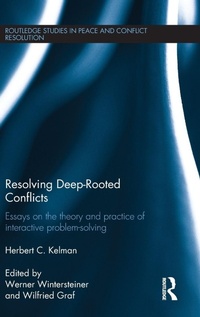
Resolving Deep-Rooted Conflicts
Essays on the Theory and Practice of Interactive Problem-Solving
1st Edition
Published on 18. July 2016
Book
Hardback
228 pages
978-1-138-96163-0 (ISBN)
Description
This book is a collection of articles and essays by Professor Herbert C. Kelman, a leading figure in the conflict resolution community and one of the most influential peace researchers.
Professor Kelman, a social psychologist, has been a pioneer of conflict resolution and peace research, and his work in conflict resolution has included a decades-long action research program on the Arab-Israeli conflict which has seen the development of Interactive Problem-Solving Workshops, an approach which has had a deep impact not only on research, but also on the practice of conflict resolution around the world, and especially in the Middle East. Focusing on Kelman's conflict resolution-related work, this volume comprises an important collection of articles written by Kelman across his career as academic and practitioner. By bringing together these carefully selected articles the book offers a concise overview of the body of Kelman's work and his intellectual biography. It traces the origins of the field of conflict resolution, the development of the study and practice of Interactive Problem Solving Workshops, and the wider challenges faced by conflict resolution research and practice.
This book will be of much interest to students of peace and conflict studies, conflict resolution, psychology and IR in general.
Professor Kelman, a social psychologist, has been a pioneer of conflict resolution and peace research, and his work in conflict resolution has included a decades-long action research program on the Arab-Israeli conflict which has seen the development of Interactive Problem-Solving Workshops, an approach which has had a deep impact not only on research, but also on the practice of conflict resolution around the world, and especially in the Middle East. Focusing on Kelman's conflict resolution-related work, this volume comprises an important collection of articles written by Kelman across his career as academic and practitioner. By bringing together these carefully selected articles the book offers a concise overview of the body of Kelman's work and his intellectual biography. It traces the origins of the field of conflict resolution, the development of the study and practice of Interactive Problem Solving Workshops, and the wider challenges faced by conflict resolution research and practice.
This book will be of much interest to students of peace and conflict studies, conflict resolution, psychology and IR in general.
Reviews / Votes
'There are few true scholar-practitioners in the field of peace-building who have contributed significantly to both sides of the scholar-practice equation. Herbert Kelman is indeed one of the few and one of the best. This compendium of his writings - both classic and contemporary - is a must-read for any serious peace-builder working today. Professor Kelman's thinking, research, practice, and writing have provided a basic scaffolding for the work of peacemakers and peace-builders for half a century, and finally his work is presented to us in one thoughtful and coherent volume. His work on peace has been masterful, and this volume helps to shine his light'. -- Peter T. Coleman, Columbia University, USA'This comprehensive yet accessible volume captures the themes and essence of Kelman's legacy for understanding and addressing intergroup conflict and cultivating peace. It brings us full circle by locating Kelman's intellectual contributions in the context of his life experiences and work for change, and it reveals the intellectual debt we owe to his conceptions and frameworks for grounding our current peace practices'. -- Tamra Pearson d'Estree, University of Denver, USA
'The volume contains a variety of Herbert Kelman's seminal articles that trace the development of informal, problem solving approaches to intractable conflicts. These are not merely the result of hard thinking and clear analysis, but of the author's direct, practical experience of working as a facilitator of processes involving hostile and mistrustful parties, often unwilling initially even to speak with one another'. -- Christopher Mitchell, Emeritus Professor, George Mason University, USA
More details
Series
Language
English
Place of publication
London
United Kingdom
Publishing group
Taylor & Francis Ltd
Target group
College/higher education
Illustrations
6 s/w Tabellen
6 Tables, black and white
Dimensions
Height: 240 mm
Width: 161 mm
Thickness: 18 mm
Weight
529 gr
ISBN-13
978-1-138-96163-0 (9781138961630)
Copyright in bibliographic data and cover images is held by Nielsen Book Services Limited or by the publishers or by their respective licensors: all rights reserved.
Schweitzer Classification
Other editions
Additional editions
Herbert C. Kelman | Werner Wintersteiner | Wilfried Graf
Resolving Deep-Rooted Conflicts
Essays on the Theory and Practice of Interactive Problem-Solving
Book
06/2020
1st Edition
Routledge
€51.98
Shipment within 15-20 days
Herbert C. Kelman | Werner Wintersteiner | Wilfried Graf
Resolving Deep-Rooted Conflicts
Essays on the Theory and Practice of Interactive Problem-Solving
E-Book
07/2016
Routledge
€59.49
Available for download
Herbert C. Kelman | Werner Wintersteiner | Wilfried Graf
Resolving Deep-Rooted Conflicts
Essays on the Theory and Practice of Interactive Problem-Solving
E-Book
07/2016
Routledge
€59.49
Available for download
Persons
Herbert C. Kelman is Richard Clarke Cabot Professor of Social Ethics, Emeritus, at Harvard University, USA, and author of several books on social psychology, social ethics, and international relations.
Werner Wintersteiner is Professor and founding director of the Centre for Peace Research and Peace Education, Klagenfurt University, Austria.
Wilfried Graf, is Co-Founder of the Herbert C. Kelman Institute for Interactive Conflict Transformation (HKI) Vienna, and Senior Research Affiliate at the Centre for Peace Research and Peace Education, Klagenfurt University, Austria.
Werner Wintersteiner is Professor and founding director of the Centre for Peace Research and Peace Education, Klagenfurt University, Austria.
Wilfried Graf, is Co-Founder of the Herbert C. Kelman Institute for Interactive Conflict Transformation (HKI) Vienna, and Senior Research Affiliate at the Centre for Peace Research and Peace Education, Klagenfurt University, Austria.
Content
Introduction: 'Seek Peace and Pursue It', Werner Wintersteiner and Wilfried Graf
Essays on the Theory and Practice of Interactive Problem-Solving, Herbert C. Kelman
Part I: Peace Research: Historical Facts and Personal Experiences
1. Reflections on the History and Status of Peace Research
2. Dignity and Dehumanization: The Impact of the Holocaust on Central Themes of My Work
3. Violence without Moral Restraint: Reflections on the Dehumanization of Victims and Victimizers
Part II: Interactive Problem-Solving: Philosophy, History and Methodology
4. The Problem Solving Workshop in Conflict Resolution
5. Interactive Problem Solving: Changing Political Culture in the Pursuit of Conflict Resolution
6. Evaluating the Contributions of Interactive Problem Solving to the Resolution of Ethnonational Conflicts
Part III: Towards a Sustainable Peace
7. Building Trust Among Enemies: The Central Challenge for International Conflict Resolution
8. Coalitions Across Conflict Lines: The Interplay of Conflicts Within and Between the Israeli and Palestinian Communities
9. Reconciliation from A Social-Psychological Perspective
Essays on the Theory and Practice of Interactive Problem-Solving, Herbert C. Kelman
Part I: Peace Research: Historical Facts and Personal Experiences
1. Reflections on the History and Status of Peace Research
2. Dignity and Dehumanization: The Impact of the Holocaust on Central Themes of My Work
3. Violence without Moral Restraint: Reflections on the Dehumanization of Victims and Victimizers
Part II: Interactive Problem-Solving: Philosophy, History and Methodology
4. The Problem Solving Workshop in Conflict Resolution
5. Interactive Problem Solving: Changing Political Culture in the Pursuit of Conflict Resolution
6. Evaluating the Contributions of Interactive Problem Solving to the Resolution of Ethnonational Conflicts
Part III: Towards a Sustainable Peace
7. Building Trust Among Enemies: The Central Challenge for International Conflict Resolution
8. Coalitions Across Conflict Lines: The Interplay of Conflicts Within and Between the Israeli and Palestinian Communities
9. Reconciliation from A Social-Psychological Perspective