

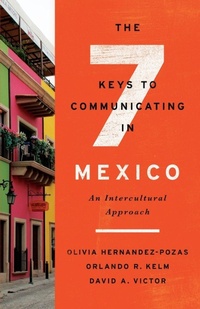
The Seven Keys to Communicating in Mexico
An Intercultural Approach
Published on 3. February 2020
Book
Paperback/Softback
296 pages
978-1-62616-723-0 (ISBN)
Description
How do you build successful professional connections with colleagues from Mexico? While most books focus simply on how to avoid common communication mistakes, this book leads its readers to an understanding of how to succeed and thrive within the three cultures, Mexico, the US, and Canada. Kelm, Hernandez-Pozas and Victor present a set of practical guidelines for communicating professionally with Mexicans, both in Mexico and abroad, providing many photographs as examples. The Seven Keys to Communicating in Mexico follows the model of presenting key cultural concepts used in the earlier books by Kelm and Victor on Brazil and (with Haru Yamada) on Japan. Olivia Hernandez-Pozas, Orlando Kelm, and David Victor, well-respected research professors and seasoned cross-cultural trainers for businesspeople, guide readers through Mexican culture using Victor's LESCANT Model (an acronym representing seven key cross-cultural communication areas: Language, Environment, Social Organization, Contexting, Authority, Nonverbal Behavior, and Time). Each chapter addresses one of these topics and demonstrates how to evaluate the differences among Mexican, US, and Canadian cultures. In the final chapter the authors bring all of these cultural interactions together with a sample case study about business interactions between Mexicans and North Americans. The case study includes additional observations from North American and Mexican business professionals who offer related suggestions and recommendations.
Reviews / Votes
The authors deliver an immediately useful tool to those seeking to teach and learn intercultural skills. * Hispania *More details
Language
English
Place of publication
Washington, DC
United States
Target group
Professional and scholarly
US School Grade: College Graduate Student and over
Product notice
Paperback (trade)
Illustrations
Not illustrated
Dimensions
Height: 216 mm
Width: 140 mm
Thickness: 10 mm
Weight
363 gr
ISBN-13
978-1-62616-723-0 (9781626167230)
Copyright in bibliographic data and cover images is held by Nielsen Book Services Limited or by the publishers or by their respective licensors: all rights reserved.
Schweitzer Classification
Other editions
Additional editions
Orlando R. Kelm | Olivia Hernandez-Pozas | David A. Victor
The Seven Keys to Communicating in Mexico
An Intercultural Approach
E-Book
02/2020
Georgetown University Press
€28.99
Available for download
Persons
Orlando R. Kelm, PhD, is an associate professor of Hispanic linguistics at the University of Texas at Austin, where he teaches courses in Portuguese and Spanish, focusing mainly on business language and the cultural aspects of international business communication. He also serves as the Director of the UT Portuguese Language Flagship. His research and publications center on the cultural aspects of international business and pedagogical applications of innovative technologies in language learning, focusing mainly on Latin America and Brazil. Together with coauthor David A. Victor, he published the first volume in this series, The Seven Keys To Communicating in Brazil: An Intercultural Approach (Georgetown University Press, 2016). With coauthors David A. Victor and Haru Yamada, he published the second volume in this series, The Seven Keys To Communicating in Japan: An Intercultural Approach (Georgetown University Press, 2017).
Olivia Hernandez-Pozas is associate professor at Tecnologico de Monterrey in Monterrey, Mexico, and author of works in International Business, Cultural Intelligence, and Management Education. She teaches classes of Negotiation and Intercultural communication. She is also member of the National Research System of Mexico. She is certified as advanced cultural intelligence facilitator by the Cultural Intelligence Center. She is member of the Academy of Management, and has served as member of the board, of its Management Education and Development Division.
David A. Victor, PhD, is a tenured professor of management and international business at Eastern Michigan University, as well as a consultant, author, and editor. He teaches courses on managing world business communication, international management, and international business and offers a series of seminars on doing business in various countries, including Brazil. As a consultant, he has run training programs and coached the leaders of more than 200 companies and organizations, ranging from global 500 companies to governments and nongovernmental organizations. He is also Editor-in-Chief of the Global Advances in Business Communication Journal. Among his many publications is the groundbreaking International Business Communication (HarperCollins, 1992), which introduced the LESCANT Model used as the framework for this book.
Olivia Hernandez-Pozas is associate professor at Tecnologico de Monterrey in Monterrey, Mexico, and author of works in International Business, Cultural Intelligence, and Management Education. She teaches classes of Negotiation and Intercultural communication. She is also member of the National Research System of Mexico. She is certified as advanced cultural intelligence facilitator by the Cultural Intelligence Center. She is member of the Academy of Management, and has served as member of the board, of its Management Education and Development Division.
David A. Victor, PhD, is a tenured professor of management and international business at Eastern Michigan University, as well as a consultant, author, and editor. He teaches courses on managing world business communication, international management, and international business and offers a series of seminars on doing business in various countries, including Brazil. As a consultant, he has run training programs and coached the leaders of more than 200 companies and organizations, ranging from global 500 companies to governments and nongovernmental organizations. He is also Editor-in-Chief of the Global Advances in Business Communication Journal. Among his many publications is the groundbreaking International Business Communication (HarperCollins, 1992), which introduced the LESCANT Model used as the framework for this book.
Content
Introduction
1. The Spanish Language:
A Beautiful Mixture That Defines Mexico
2. The Mexican Environment:
A Cornucopia
3. Mexican Social Organization:
Mestizaje, Mosaic, or Melting Pot?
4. Mexican Contexting:
The Hidden Wisdom of the Proverb
5. The Mexican Authority Conception:
Power Is Always Personalized
6. Mexican Nonverbal Communication:
Colorful, Bold, and Making a Statement!
7. The Mexican Temporal Conception:
All Our Pasts Are Our Present
8. Case Study:
When Being Bicultural Is More than Being Bilingual
Notes
Index
About the Authors
1. The Spanish Language:
A Beautiful Mixture That Defines Mexico
2. The Mexican Environment:
A Cornucopia
3. Mexican Social Organization:
Mestizaje, Mosaic, or Melting Pot?
4. Mexican Contexting:
The Hidden Wisdom of the Proverb
5. The Mexican Authority Conception:
Power Is Always Personalized
6. Mexican Nonverbal Communication:
Colorful, Bold, and Making a Statement!
7. The Mexican Temporal Conception:
All Our Pasts Are Our Present
8. Case Study:
When Being Bicultural Is More than Being Bilingual
Notes
Index
About the Authors