

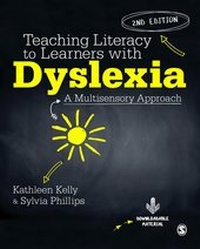
Teaching Literacy to Learners with Dyslexia
A Multi-sensory Approach
2nd Edition
Published on 30. March 2016
Book
Paperback/Softback
488 pages
978-1-4129-6218-6 (ISBN)
Description
The Second Edition of this bestselling book provides a structured multi-sensory programme for teaching literacy to children and young people from 5-18 with dyslexia and other specific literacy difficulties.
Supported by a wealth of resources available online and updated throughout, the new edition now includes a brand new section on Implementing the Accelerated Programme for learners who have already acquired some literacy skills. This includes:
A placement test to indicate whether the programme is appropriate
A diagnostic assessment procedure to determine where the learner should begin on the Accelerated Programme
Examples of lesson plans, reading cards and spelling cards to help teachers prepare resources for their students
With tried and tested strategies and activities this book continues to provide everything you need to help improve and develop the literacy skills of learners in your setting including;
the rationale for a structured multi-sensory approach
the development of phonological, reading, writing and spelling skills
working with learners who have English as an Additional Language (EAL)
lesson structure and lesson-planning
alphabet and dictionary skills
memory work and study skills
teaching the programme to groups
ideas for working with young children.
Supported by a wealth of resources available online and updated throughout, the new edition now includes a brand new section on Implementing the Accelerated Programme for learners who have already acquired some literacy skills. This includes:
A placement test to indicate whether the programme is appropriate
A diagnostic assessment procedure to determine where the learner should begin on the Accelerated Programme
Examples of lesson plans, reading cards and spelling cards to help teachers prepare resources for their students
With tried and tested strategies and activities this book continues to provide everything you need to help improve and develop the literacy skills of learners in your setting including;
the rationale for a structured multi-sensory approach
the development of phonological, reading, writing and spelling skills
working with learners who have English as an Additional Language (EAL)
lesson structure and lesson-planning
alphabet and dictionary skills
memory work and study skills
teaching the programme to groups
ideas for working with young children.
Reviews / Votes
'Teaching Literacy to Learners with Dyslexia should be available in every classroom in the country!This new updated edition is grounded in solid research combining best practice in literacy learning with practical skills essential for competent literacy acquisition.
Kelly and Phillips have utilised their vast knowledge and unquestionable experience to provide the reader with a "ready guide" for practice. This is an essential book for all teachers and those undergoing teacher training. ' -- Dr. Gavin Reid The book will be of interest and value to teachers working with learners aged 5-18 and supports them in providing an evidence based and comprehensive programme. With over 150 teaching points, this book is excellent value for money and would form a useful core resource for staff. -- Mary Mountstephen Candidates on either an OCR type level Five or Level Seven programme should study this book as the mixture of practical teaching approaches, as well as study skills, are all essential competencies that need to be mastered. It also explains clearly how to teach language in a multisensory, cumulative and structured way. It contains ideas that even experienced practitioners should review constantly to make sure they are following good practice. -- Kevin Smith
More details
Edition
2nd Revised edition
Language
English
Place of publication
Thousand Oaks
United States
Target group
Professional and scholarly
Edition type
Revised edition
Dimensions
Height: 232 mm
Width: 186 mm
Weight
855 gr
ISBN-13
978-1-4129-6218-6 (9781412962186)
Copyright in bibliographic data and cover images is held by Nielsen Book Services Limited or by the publishers or by their respective licensors: all rights reserved.
Schweitzer Classification
Other editions
New editions
Book
05/2022
3rd Edition
SAGE Publications Ltd
€55.00
Shipment within 15-20 days
Previous edition
Kathleen Kelly | Sylvia Phillips
Teaching Literacy to Learners with Dyslexia
A Multi-sensory Approach
Book
09/2011
1st Edition
SAGE Publications Ltd
€63.39
Article exhausted; check for reprint
Persons
Dr Kathleen Kelly PhD, MA (SEN), Dip TESL, AMBDA, is an independent consultant and trainer in the field of specific learning difficulties. For many years she was a Senior Lecturer at Manchester Metropolitan University in the Centre for Inclusion and Disability Studies where she was Programme Leader for the MA in Specific Learning Difficulties and the Post Graduate Certificate in Dyscalculia. For several years she has taught courses on specific learning difficulties as part of the initial teacher training programme in addition to postgraduate awards. She has presented papers in this area at a number of international conferences and was part of the MMU research team that evaluated the Department for Education funded project 'Teaching for neurodiversity' led and coordinated by the British Dyslexia Association (2017). She has considerable experience in delivering courses to meet the criteria set out by the British Dyslexia Association for Approved Teacher Status (ATS) and is an Associate Member of the British Dyslexia Association (AMBDA). She was a member of the SASC/BDA working party (2019) which was set up to develop a new definition of dyscalculia and to produce guidance on identification and assessment.
Kathleen has taught a wide range of learners with dyslexia, from children as young as 4 years to 16 years. She has worked in both mainstream and special schools, for language support and learning support services, as a SENCO in a primary school, and as Head of Sixth Form in a special school. She has many years of experience in supporting multilingual children with special educational needs (including specific learning difficulties). Multilingualism and dyslexia is a particular area of interest, and her doctorate was also in this area. She is co-author of Phillips and Kelly (2018) Assessment of Learners with Dyslexic-Type Difficulties, 2nd edition and author of Kelly (2020) Identifying, Assessing and Supporting Learners with Dyscalculia.
Sylvia Phillips, BA, DASE, MEd (SEN), AMBDA, Cert. TESL, began her career as a teacher of English in secondary schools where she first became interested in why some learners had severe literacy difficulties. She later joined Manchester Metropolitan University where she was a Principal Lecturer, Head of SEN, and then Head of Continuing Professional Development. At MMU she developed the first courses for specialist teachers of learners with dyslexia at both undergraduate and postgraduate levels. During that time she worked in primary, secondary and special schools both with teachers and directly with pupils. She taught on several SEND courses for teachers (particularly training SENDCos) and was the UK partner (with Italy, Belgium and Spain) developing and teaching courses on 'Inclusion and SEN' for European educationalists. She has served on the Accreditation Board of the British Dyslexia Association but left when she became a specialist member of the SEND Tribunal service. She has been involved in several dyslexia research projects developing teaching materials. In recent years she led the AMBDA courses for Wrexham Glyndwr University and was a part-time tutor to the AMBDA course at Stanmillis University College, Belfast. She is co-author of Phillips and Kelly (2018) Assessment of Learners with Dyslexic- Type Difficulties, 2nd edition.
Kathleen has taught a wide range of learners with dyslexia, from children as young as 4 years to 16 years. She has worked in both mainstream and special schools, for language support and learning support services, as a SENCO in a primary school, and as Head of Sixth Form in a special school. She has many years of experience in supporting multilingual children with special educational needs (including specific learning difficulties). Multilingualism and dyslexia is a particular area of interest, and her doctorate was also in this area. She is co-author of Phillips and Kelly (2018) Assessment of Learners with Dyslexic-Type Difficulties, 2nd edition and author of Kelly (2020) Identifying, Assessing and Supporting Learners with Dyscalculia.
Sylvia Phillips, BA, DASE, MEd (SEN), AMBDA, Cert. TESL, began her career as a teacher of English in secondary schools where she first became interested in why some learners had severe literacy difficulties. She later joined Manchester Metropolitan University where she was a Principal Lecturer, Head of SEN, and then Head of Continuing Professional Development. At MMU she developed the first courses for specialist teachers of learners with dyslexia at both undergraduate and postgraduate levels. During that time she worked in primary, secondary and special schools both with teachers and directly with pupils. She taught on several SEND courses for teachers (particularly training SENDCos) and was the UK partner (with Italy, Belgium and Spain) developing and teaching courses on 'Inclusion and SEN' for European educationalists. She has served on the Accreditation Board of the British Dyslexia Association but left when she became a specialist member of the SEND Tribunal service. She has been involved in several dyslexia research projects developing teaching materials. In recent years she led the AMBDA courses for Wrexham Glyndwr University and was a part-time tutor to the AMBDA course at Stanmillis University College, Belfast. She is co-author of Phillips and Kelly (2018) Assessment of Learners with Dyslexic- Type Difficulties, 2nd edition.
Content
Introduction
Part I: Teaching Learners with Dyslexia: Theory and Context
Chapter 1: The Contribution of Theories of Causation to the Development of a Multisensory Teaching Programme
Chapter 2: The Role of Memory in Acquiring Literacy Skills
Chapter 3: Phonological Skills, Literacy and Dyslexia
Chapter 4: The Development of Reading Skills
Chapter 5: Spelling Development and Dyslexia
Chapter 6: Teaching Handwriting
Chapter 7: Dyslexia and Learners for whom English is an Additional Language
Part II: Conquering Literacy: A Multisensory Programme for Teaching Learners with Dyslexia - Teaching Strategies
Chapter 8: Principles, Teaching Strategies, and Programme Structure
Chapter 9: Lesson Planning
Chapter 10: Alphabet and Dictionary Work
Chapter 11: Introducing the New Teaching Point in a Lesson
Chapter 12: The Role of Memory in the Programme
Chapter 13: Study Skills within the Programme
Part III: Conquering Literacy - A Multisensory Programme
The Conquering Literacy Programme: Examples of Activities
Appendix A: Ideas for Working with Young Children
Appendix B: Teaching the Programme to Groups
Part IV: The Accelerated Programme
Section A: Conquering Literacy: Accelerated Programme and Placement Tests
Conquering Literacy: Accelerated Programme Placement Test
Conquering Literacy: Placement Test
Conquering Literacy Accelerated Programme Skills Assessment Procedure (CLAPSAP)
Section B: Implementing the Accelerated Programme
Part V: Resources
Glossary
Part I: Teaching Learners with Dyslexia: Theory and Context
Chapter 1: The Contribution of Theories of Causation to the Development of a Multisensory Teaching Programme
Chapter 2: The Role of Memory in Acquiring Literacy Skills
Chapter 3: Phonological Skills, Literacy and Dyslexia
Chapter 4: The Development of Reading Skills
Chapter 5: Spelling Development and Dyslexia
Chapter 6: Teaching Handwriting
Chapter 7: Dyslexia and Learners for whom English is an Additional Language
Part II: Conquering Literacy: A Multisensory Programme for Teaching Learners with Dyslexia - Teaching Strategies
Chapter 8: Principles, Teaching Strategies, and Programme Structure
Chapter 9: Lesson Planning
Chapter 10: Alphabet and Dictionary Work
Chapter 11: Introducing the New Teaching Point in a Lesson
Chapter 12: The Role of Memory in the Programme
Chapter 13: Study Skills within the Programme
Part III: Conquering Literacy - A Multisensory Programme
The Conquering Literacy Programme: Examples of Activities
Appendix A: Ideas for Working with Young Children
Appendix B: Teaching the Programme to Groups
Part IV: The Accelerated Programme
Section A: Conquering Literacy: Accelerated Programme and Placement Tests
Conquering Literacy: Accelerated Programme Placement Test
Conquering Literacy: Placement Test
Conquering Literacy Accelerated Programme Skills Assessment Procedure (CLAPSAP)
Section B: Implementing the Accelerated Programme
Part V: Resources
Glossary