

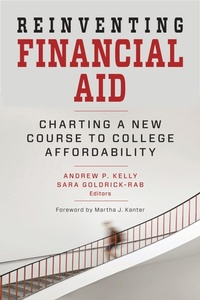
Reinventing Financial Aid
Charting a New Course to College Affordability
Will be published approx. on 30. October 2014
Book
Paperback/Softback
272 pages
978-1-61250-714-9 (ISBN)
Description
In this provocative volume, two experts with very different points of view address the growing concern that student loan programs are not a sustainable solution to the problem of mounting college costs. They argue that the time has come to reform the financial aid system so that it is more effective in promoting college affordability, access, and completion.
Reinventing Financial Aid provides a thorough critique of the existing financial aid system and identifies the challenges of reform. It presents a host of innovations designed to improve grant and loan programs and the processes by which students access them. Pushing past current debates, it also challenges leaders to think more boldly about policy design, examine the assumptions and incentives embedded in the current system, and lay the groundwork for a fundamental rethinking of student aid programs.
While the editors agree that bold new thinking on financial aid policy is needed, they do not aim for consensus. Instead, they have leveraged their differences to flesh out important tensions, trade-offs, and areas of common ground that emerge from innovative approaches to reform. The result is a volume that serves as a counterpoint to the incremental approach to financial aid reform that has led to record tuition levels, growing student debt, and increasing doubts about the value of a college education.
Reinventing Financial Aid provides a thorough critique of the existing financial aid system and identifies the challenges of reform. It presents a host of innovations designed to improve grant and loan programs and the processes by which students access them. Pushing past current debates, it also challenges leaders to think more boldly about policy design, examine the assumptions and incentives embedded in the current system, and lay the groundwork for a fundamental rethinking of student aid programs.
While the editors agree that bold new thinking on financial aid policy is needed, they do not aim for consensus. Instead, they have leveraged their differences to flesh out important tensions, trade-offs, and areas of common ground that emerge from innovative approaches to reform. The result is a volume that serves as a counterpoint to the incremental approach to financial aid reform that has led to record tuition levels, growing student debt, and increasing doubts about the value of a college education.
More details
Series
Language
English
Place of publication
Cambridge
United States
Target group
Professional and scholarly
Product notice
Paperback (trade)
Unsewn / adhesive bound
Dimensions
Height: 229 mm
Width: 155 mm
Thickness: 13 mm
Weight
363 gr
ISBN-13
978-1-61250-714-9 (9781612507149)
Copyright in bibliographic data and cover images is held by Nielsen Book Services Limited or by the publishers or by their respective licensors: all rights reserved.
Schweitzer Classification
Persons
Andrew P. Kelly is a resident scholar in education policy studies and director of the Center on Higher Education Reform at the American Enterprise Institute.
Sara Goldrick-Rab is a professor of educational policy studies and sociology at the University of Wisconsin-Madison, USA.
Sara Goldrick-Rab is a professor of educational policy studies and sociology at the University of Wisconsin-Madison, USA.
Content
CONTENTS
Foreword vii
Martha J. Kanter
Introduction 1
Andrew P. Kelly and Sara Goldrick-Rab
1 Designing Research to Provide the "Actionable Knowledge" Needed to Improve Student Aid Program PerformanceD 13
David S. Mundel
2 The Politics of Student Aid 33
Daniel Madzelan
3 The Promise of "Promise" Programs 55
Rodney J. Andrews
4 From FAFSA to Facebook 75
The Role of Technology in Navigating the Financial Aid Process
Regina Deil-Amen and Cecilia Rios-Aguilar
5 Incentivizing Success 101
Lessons from Experimenting with Incentive-Based Grants
Lashawn Richburg-Hayes
6 Reforming Repayment 127
Using Income-Related Loans to Reduce Default
Nicholas W. Hillman
7 Rethinking Institutional Aid 149
Implications for Affordability, Access, and the Effectiveness of Federal Student Aid
Lesley J. Turner
8 Managing Risk, Reaping Reward 171
The Case for a Comprehensive Income-Based Student Loan System
Stephen Crawford and Robert Sheets
9 Making College Affordable 191
The Case for an Institution-Focused Approach to Federal Student Aid
Sara Goldrick-Rab, Lauren Schudde, and Jacob Stampen
Conclusion 207
Andrew P. Kelly and Sara Goldrick-Rab
Notes 225
Acknowledgments 257
About the Editors 259
About the Contributors 261
Index 267
Foreword vii
Martha J. Kanter
Introduction 1
Andrew P. Kelly and Sara Goldrick-Rab
1 Designing Research to Provide the "Actionable Knowledge" Needed to Improve Student Aid Program PerformanceD 13
David S. Mundel
2 The Politics of Student Aid 33
Daniel Madzelan
3 The Promise of "Promise" Programs 55
Rodney J. Andrews
4 From FAFSA to Facebook 75
The Role of Technology in Navigating the Financial Aid Process
Regina Deil-Amen and Cecilia Rios-Aguilar
5 Incentivizing Success 101
Lessons from Experimenting with Incentive-Based Grants
Lashawn Richburg-Hayes
6 Reforming Repayment 127
Using Income-Related Loans to Reduce Default
Nicholas W. Hillman
7 Rethinking Institutional Aid 149
Implications for Affordability, Access, and the Effectiveness of Federal Student Aid
Lesley J. Turner
8 Managing Risk, Reaping Reward 171
The Case for a Comprehensive Income-Based Student Loan System
Stephen Crawford and Robert Sheets
9 Making College Affordable 191
The Case for an Institution-Focused Approach to Federal Student Aid
Sara Goldrick-Rab, Lauren Schudde, and Jacob Stampen
Conclusion 207
Andrew P. Kelly and Sara Goldrick-Rab
Notes 225
Acknowledgments 257
About the Editors 259
About the Contributors 261
Index 267