

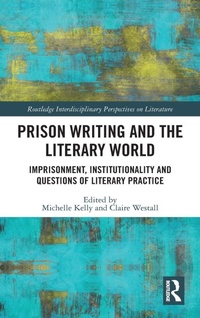
Prison Writing and the Literary World
Imprisonment, Institutionality and Questions of Literary Practice
1st Edition
Published on 28. October 2020
Book
Hardback
266 pages
978-0-367-61623-6 (ISBN)
Description
Prison Writing and the Literary World tackles international prison writing
and writing about imprisonment in relation to questions of literary representation
and formal aesthetics, the "value" or "values" of literature,
textual censorship and circulation, institutional networks and literary-critical
methodologies. It offers scholarly essays exploring prison writing
in relation to wartime internment, political imprisonment, resistance and
independence creation, regimes of terror, and personal narratives of development
and awakening that grapple with race, class and gender. Cutting
across geospatial divides while drawing on nation- and region-specific expertise,
it asks readers to connect the questions, examples and challenges
arising from prison writing and writing about imprisonment within the
UK and the USA, but also across continental Europe, Stalinist Russia, the
Americas, Africa and the Middle East. It also includes critical reflection
pieces from authors, editors, educators and theatre practitioners with experience
of the fraught, testing and potentially inspiring links between prison
and the literary world.
and writing about imprisonment in relation to questions of literary representation
and formal aesthetics, the "value" or "values" of literature,
textual censorship and circulation, institutional networks and literary-critical
methodologies. It offers scholarly essays exploring prison writing
in relation to wartime internment, political imprisonment, resistance and
independence creation, regimes of terror, and personal narratives of development
and awakening that grapple with race, class and gender. Cutting
across geospatial divides while drawing on nation- and region-specific expertise,
it asks readers to connect the questions, examples and challenges
arising from prison writing and writing about imprisonment within the
UK and the USA, but also across continental Europe, Stalinist Russia, the
Americas, Africa and the Middle East. It also includes critical reflection
pieces from authors, editors, educators and theatre practitioners with experience
of the fraught, testing and potentially inspiring links between prison
and the literary world.
Reviews / Votes
This is a collection of lively and interesting contributions to the field of prison writing, with an ambitious spread across geographies and eras. It enables us to chart the connections (or dissimilarities) of prison writing, which is exposed as an unstable practice of discontinuities. -- Dr Aylwyn Walsh, University of LeedsMore details
Series
Language
English
Place of publication
London
United Kingdom
Publishing group
Taylor & Francis Ltd
Target group
College/higher education
Dimensions
Height: 235 mm
Width: 157 mm
Thickness: 20 mm
Weight
568 gr
ISBN-13
978-0-367-61623-6 (9780367616236)
Copyright in bibliographic data and cover images is held by Nielsen Book Services Limited or by the publishers or by their respective licensors: all rights reserved.
Schweitzer Classification
Other editions
Additional editions
Michelle Kelly | Claire Westall
Prison Writing and the Literary World
Imprisonment, Institutionality and Questions of Literary Practice
Book
05/2023
1st Edition
Routledge
€65.60
Shipment within 15-20 days
Michelle Kelly | Claire Westall
Prison Writing and the Literary World
Imprisonment, Institutionality and Questions of Literary Practice
E-Book
10/2020
1st Edition
Routledge
€59.49
Available for download
Michelle Kelly | Claire Westall
Prison Writing and the Literary World
Imprisonment, Institutionality and Questions of Literary Practice
E-Book
10/2020
1st Edition
Routledge
€59.49
Available for download
Persons
Michelle Kelly is a Departmental Lecturer in World Literature in English
at the Faculty of English Language and Literature, University of Oxford.
Her research focuses on South African and world literature, confessional
narrative forms, the intersections between law and literature, and literature
and other art forms. She has published several articles on J.M.Coetzee,
and is completing a monograph on Coetzee and confession.
Claire Westall is a Senior Lecturer in the Department of English and Related
Literature at the University of York. Her forthcoming book is The
Rites of Cricket and Caribbean Literature. She is also co-author of The
Public on the Public (2015), and co-editor of both Cross-Gendered Literary
Voices (2012) and Literature of an Independent England (2013).
at the Faculty of English Language and Literature, University of Oxford.
Her research focuses on South African and world literature, confessional
narrative forms, the intersections between law and literature, and literature
and other art forms. She has published several articles on J.M.Coetzee,
and is completing a monograph on Coetzee and confession.
Claire Westall is a Senior Lecturer in the Department of English and Related
Literature at the University of York. Her forthcoming book is The
Rites of Cricket and Caribbean Literature. She is also co-author of The
Public on the Public (2015), and co-editor of both Cross-Gendered Literary
Voices (2012) and Literature of an Independent England (2013).
Content
Notes on Contributors ix
Acknowledgements xv
Introduction: A Wide and Worlded Vision of Prison Writing 1
CLAIRE WESTALL
Problems and Silences 19
1 The Credibility of Elves?: Narrative Exclusion and Prison
Writing 21
SARAH COLVIN
PoWs and Purges 39
2 German Military Internees Writing the First
World War: Gender, Irony and Humour in the Camp
Newspaper Stobsiade 41
ANNE SCHWAN
3 The Prison Writings of Nikolai Bukharin 58
HOWARD CAYGILL
Prison Spaces and Nation (Re)Making 75
4 Prison Writing and the Algerian War of Independence 77
EMILIE MORIN
5 Writing from Robben Island: National Identity and the
Apartheid Prison in South Africa 93
DANIEL ROUX6 Writing South Africa's Prisons into History 110
JONNY STEINBERG
Censorship, Advocacy and Text Creation 121
7 "His Enemy's Language": African American Prison Life
Writing, the Literary Forms of Institutional Power and
George Jackson's Soledad Brother 123
SIMON ROLSTON
8 PEN and the Writer as Prisoner 139
MICHELLE KELLY
9 Scribo Ergo Sum: Creating and Publishing
Guantanamo Diary 156
MOHAMEDOU OULD SLAHI AND LARRY SIEMS
From Life to Fiction 171
10 Writing Against the Regime: Metafiction in the Arabic
Prison Novel 173
R. SHAREAH TALEGHANI
11 Anarcha-Feminism, Prison and Utopia: The Abolitionist
Politics of Alison Spedding's De cuando en cuando
Saturnina and La segunda vez como farsa 189
JOEY WHITFIELD
Women, Theatre and Clean Break 207
12 Something About Us: Clean Break's Theatre of Necessity 209
CAOIMHE MCAVINCHEY
13 Unlocking Potential: The Role of Theatre Writing in
Prisons in the Work of Clean Break 227
ANNA HERRMANN, DEBORAH BRUCE AND CLARE BARSTOW
Literary Workshops 237
14 Literary Studies and the Teaching of Prison Texts 239
CLAIRE WESTALL
15 Folsom Prison Writing Workshop 256
ROGER ROBINSON
Index 257
Acknowledgements xv
Introduction: A Wide and Worlded Vision of Prison Writing 1
CLAIRE WESTALL
Problems and Silences 19
1 The Credibility of Elves?: Narrative Exclusion and Prison
Writing 21
SARAH COLVIN
PoWs and Purges 39
2 German Military Internees Writing the First
World War: Gender, Irony and Humour in the Camp
Newspaper Stobsiade 41
ANNE SCHWAN
3 The Prison Writings of Nikolai Bukharin 58
HOWARD CAYGILL
Prison Spaces and Nation (Re)Making 75
4 Prison Writing and the Algerian War of Independence 77
EMILIE MORIN
5 Writing from Robben Island: National Identity and the
Apartheid Prison in South Africa 93
DANIEL ROUX6 Writing South Africa's Prisons into History 110
JONNY STEINBERG
Censorship, Advocacy and Text Creation 121
7 "His Enemy's Language": African American Prison Life
Writing, the Literary Forms of Institutional Power and
George Jackson's Soledad Brother 123
SIMON ROLSTON
8 PEN and the Writer as Prisoner 139
MICHELLE KELLY
9 Scribo Ergo Sum: Creating and Publishing
Guantanamo Diary 156
MOHAMEDOU OULD SLAHI AND LARRY SIEMS
From Life to Fiction 171
10 Writing Against the Regime: Metafiction in the Arabic
Prison Novel 173
R. SHAREAH TALEGHANI
11 Anarcha-Feminism, Prison and Utopia: The Abolitionist
Politics of Alison Spedding's De cuando en cuando
Saturnina and La segunda vez como farsa 189
JOEY WHITFIELD
Women, Theatre and Clean Break 207
12 Something About Us: Clean Break's Theatre of Necessity 209
CAOIMHE MCAVINCHEY
13 Unlocking Potential: The Role of Theatre Writing in
Prisons in the Work of Clean Break 227
ANNA HERRMANN, DEBORAH BRUCE AND CLARE BARSTOW
Literary Workshops 237
14 Literary Studies and the Teaching of Prison Texts 239
CLAIRE WESTALL
15 Folsom Prison Writing Workshop 256
ROGER ROBINSON
Index 257