

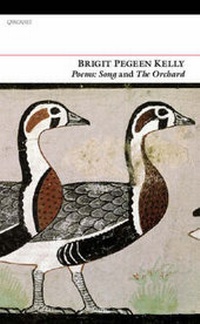
Poems
Song and The Orchard
Published on 28. February 2008
Book
Paperback/Softback
128 pages
978-1-85754-979-9 (ISBN)
Description
Brigit Pegeen Kelly creates a magical landscape of sound-patterns, myths and surreal encounters, celebrating the mystery and surprise of creation. She is one of the best-loved poets writing in the United States today, a finalist for the Pulitzer Prize, the National Book Critics Circle Award and for the Los Angeles Times Book Prize in Poetry.
Reviews / Votes
Brigit Pegeen Kelly's poems take place in strange places. The first poem in this, her first British publication (also the first, eponymous poem in her 1994 American book, Song) begins with a "goat's head hanging by ropes in a tree. / All night it hung there and sang". Her caprine version of the dismembered Orpheus becomes an emblem of the modern poet, whose song reflects mortality and rural fecundity as it strains to reanimate the dead. The goat-in-a-tree also introduces Kelly's locales, at once rural, American, Midwestern ("the moonlight shone on the train track miles away") and allegorical, sanguinary, neo-pastoral.The second of two American books gathered here, The Orchard (2004), begins "in a strange garden, a place / So old it seemed to exist outside of time". Nearly half of her poems include such spaces, at once ferocious and artful, with grotesques that cry, or bleed, or speak: a "headless goat man" carved in sandstone, a four-headed lion "made of hollowed steel", a "Lady of Strange Shape / That the hand of Anonymous hammered from the stone". The wider world, for Kelly, nearly replicates the allegories - red in tooth and claw or bloody from childbirth - that her crowded grottoes contain: on roads, on farms, beside her ponds or fields, she seeks out real or mythic animals, almost all of which stand (as the statues do too) for the vulnerability of flesh: a dead doe at a school bus stop, a dog in another poem "chewing on a dead doe", "a small / Black goat, who pounded his head against a tree / Until he was dead", or "Wild Turkeys" whose "convicts' shaved skulls" suggest prisoners of war.
Kelly's line and syntax can become almost as disconcerting as her settings and props: her long sentences and heavy enjambments strive for visual and emotional, rather than for purely acoustic, effects. "Moonlight is dirty lamb's wool. Something a child // Sucked on and then dropped behind her on the tracks", one poem from Song decides. In another, Kelly remembers how she dreamed that some boys
Knocked down all the stones in the cemetery
And then it happened. It was six months later
In early December. Dead cold. Just before
Dawn.
Who else would combine such extreme enjambment with such short sentences and multiple caesurae? (On the other hand, who else would want to?)
When Kelly wants to use (rather than working against) the motive power in a pentameter norm, she does so with relish, even masterfully: "The nursling cries for milk. For milkiness. / The crow cries for his own poor behavior. // The fledged effort stumbles on the air". Song had some poems with shorter, more erratic, less original line shapes; The Orchard mixes in, to better effect, a few urgent, clenched prose poems, and a seven-foot line imported (since Kelly, too, chronicles supernatural goings-on) from William Blake's prophetic books: "The wretched body of the dog, if it could be called that, body or dog, / A shaking thing, a ghostly thing, like a trembling lilac bush". Like almost everything else in Kelly's work, her long, rough lines evoke a chthonic power that almost necessarily excludes most social and musical niceties. She may remind British readers not of Blake, but of Ted Hughes - there are even iconic crows: "A hundred crows, a thousand, day after day, too many / To count . . . set up house in the elms by the bog". Her best poems, like his, can work both as homely descriptions of plants, animals and rural life, and as allegories of brutality: "the fetid smell of bone meal", for example, belongs in "Petition" because bone meal is really used in greenhouses, and because the greenhouses are like above-ground tombs.
To read this long volume straight through is to immerse oneself in a poetry that deserves that overused label "visionary": "I lost the power to tell the figures / In my dreams", Kelly admits, "from those we call real". Her poems show us how it feels to lose that power, and what evocative force those dreams retain. Sometimes they exercise that same force over and over, as in our anxiety dreams: the first time in The Orchard that a sick animal gives birth to a human being, we may recoil in shock or wonder, but what about the third?
Yet Kelly's obsessions - repetitive though they may get - are inseparable from her authentic strangeness. Yeats advised poets to pursue "those images / That constitute the wild", and Kelly seems to have heeded - or never to have needed - that advice: for Yeats, as for Kelly, those obsessive images include "the lion and the virgin, / The harlot and the child", though Kelly would have to add a wounded deer, dogs, goats, a manticore and a crow. (Given the number of dead or ghostly children in The Orchard, and given the few poems set among graves, it may be that the poems commemorate a real dead child; though their often hallucinatory quality makes it - and the poems are certainly better this way - hard to know.) Kelly's taste in iconography - grisly deaths, grisly births, paradoxical redemptions - is not so much Byzantine (like Yeats's) nor pagan-archaic (like Hughes's) as Counter- Reformation Baroque: "A rabbit carcass the dog dragged into the ravine", obscured by "goldenrod . . . the color // Of beaten skin", inspires Kelly to "Say: Blessed are those who stand still / In their confusion. Blessed is the field as it burns". Kelly's poems can even seem like American answers to the Baroque art they recall: full of statues, animals, foliage, and religious figures (e.g. Saint Sebastian); dominated by blood-reds, deep greens, jewel tones, with plenty of force and intellect, but little subtlety; plenty of violence and maternal devotion, but not much friendship; rarely calm, never urbane; plenty of motion, but not much sense of change. She can seem programmatic, and melodramatic; she can repeat herself, within her poems and among them. Yet she depicts, powerfully enough, one view of the nature and purpose of art, an art (Orphic, and even hermetic) that breathes life into inanimate objects (words, statues) and thus renders an always plaintive, always inadequate, response to the fact that we die. Kelly's poems may sound too much like one another, but she never sounds like anyone else. Fiona Sampson is moved by the mythic and lyrical imagination at work in Brigit Pegeen Kelly's Poems.
Brigit Pegeen Kelly seems to typify the distinguished American poet. Her first book, To the Place of Trumpets (1987), won the Yale Younger Poet series; her second and third, published here as a single volume, led to a whole array of fellowships and awards, including a Pulitzer prize short-listing; she teaches creative writing at the University of Illinois. Her poems are as unmistakeable as they are self-contained: the writing displays a striking coherence of project from book to book. And yet Song and The Orchard were first published 10 years apart, in 1994 and 2004 respectively. There is something profoundly inexpedient about this; a whiff of the unilateralism essential to a truly original poetry.
'painstakingly created'
For this is what Kelly gives us. Despite its unquestionable technical accomplishment, everything about her imaginative world is the opposite of slick. It has been painstakingly created. Meditations on the two great transformations - birth and death - emerge from the surrounding landscape. The recurring figure of a 'Dead Doe' is banal in the hunting country Kelly writes about: 'The doe lay dead on her back in a field of asters: no. // The doe lay dead on her back beside the school bus stop: yes.' A lesser writer would make something of this juxtaposition: schools are for the living young. Kelly, though, is uninterested in fortune-cookie platitudes. She moves straight on, into the mystery of metamorphosis. This dead creature '[ ...] tricked // our vision: at a distance she was / for a moment no deer / at all // but two swans: we saw two swans' and 'this is the soul: like it or not'. It is transformation which animates, often beautifully, even in death.
Yet, ambitious as this might seem set against our own poetic norms, it is not enough for Kelly. She returns to the figure of a dead doe - perhaps the same, perhaps a different one - with a poem whose title, 'All Wild Animals Were Once Called Deer', is both unexplained and, we discover, the synopsis of a new myth. This long piece (115 lines, in tercets apart from the solo show-stopping last line) turns the deer, imagined running towards the collision which will kill it, into 'The heart flying into the arms of the one that will kill her'. Now the doe is the White Hart of medieval Christian iconography. She is also a secular beloved, partner of Oscar Wilde's 'For each man kills the thing he loves'. But along the way, this beautifully realised poem has also given us a bank robbery, a man killed by lightning, a flight in a biplane - and that swan metamorphosis once again. This time, there is just one specific bird whose beak 'knifes the children down by his pond on Wasigan road' in the same motion with which 'a hunter slits a deer's belly'. Metamorphosis sustains the poem as it sustains the natural world.
'Kelly's Orchard is the dangerous grove
where transformations happen.'
These are long, complex journeys towards insight. They are also poems full of both the quotidian - 'She must have come out of the woods by Simpson's red trailer - // The one that looks like a faded train car -'; 'We were waiting for the school bus' - and of those concrete specifics which are the hallmark of true imagination. In 'Pipistrelles', bats 'Look like the flung hands of deaf boys, restlessly / Signing the dark'; while 'Beside the hospital the giant flag blows out in soft decorum. / And then folds down like a bush or an abashed bird' ('The Column of Mercury Recording the Temperature of Night'). Metaphysics are earned by thorough-going observation.
The 'pattern in the carpet' is also glimpsed through an almost obsessive revisiting of key images. Goats, lion statues and statuary in general, sick dogs, dead does, dusk and gold are touchstones for this sui generis imagination. They also serve a liturgical function: repetition allows our understanding to move off in new directions. As she revisits these tropes, Kelly doesn't merely rework but transforms the stories they have to tell. 'All Wild Animals ...' provides, with the even longer, incantatory and joyous 'Three Cows and the Moon', a point of arrival for Song. Lucid and lyrical, these two poems also form a centrepiece to this volume.
The Orchard, the second book collected here, reads as a continuation and a deepening of Song. The structure is similar: three parts of eight or nine poems each, followed by a final, single poem which is a sustained act so extraordinary that the reader hardly draws breath for seven pages. At the same time, the diction is thicker, less elegant. The poems are more clearly narrative and populated: the figure of a boy, in particular, recurs. By now it is clear that goat, doe, and all the rest are not merely statuary but animated myths. Kelly's Orchard is the dangerous grove where transformations happen. Now the dead doe - this time, a stump of a body whose legs were hacked-off by the hunter - is a four-headed revenant, dangling the fifth head 'Of a grown child that the doe was trying to deliver / From her breast' ('Pale Rider'). Kelly brings the savage archetype of labour into her cosmogony repeatedly. In 'The Dance', a sick old dog brings up not 'the sickness itself' but a 'newborn man [who] began to wrestle his way / Out of the creature only half his size' while one of Kelly's moving statues flexes his stony muscles in pleasure. Then the dog swallows up the newborn man again, like vomit, and staggers away:
[ ...] She will walk all the way
Around the world, until she comes back to the circle of stone,
And the dance is repeated. Again and again she will do this
This is a pitiless vision of the cycle of continual transformation that this most visceral of lyric poets has made her founding myth. It is also compassionate. Embodiment may be hard-won, sometimes unbearably so: in ceremonialising its beauty, Brigit Pegeen Kelly gives us a shot at meaning.
More details
Language
English
Place of publication
Manchester
United Kingdom
Dimensions
Height: 216 mm
Width: 135 mm
Thickness: 7 mm
ISBN-13
978-1-85754-979-9 (9781857549799)
Copyright in bibliographic data and cover images is held by Nielsen Book Services Limited or by the publishers or by their respective licensors: all rights reserved.
Schweitzer Classification
Person
Brigit Pegeen Kelly taught in the creative writing program at the University of Illinois in Urbana-Champaign. Her first volume of poetry, To the Place of Trumpets, was awarded the Yale Series of Younger Poets Prize in 1987 and published by Yale University Press the following year. Her second book, Song, published by BOA Editions Ltd., was the 1994 Lamont Poetry Selection from the Academy of American Poets. Her third book, The Orchard, also published by BOA Editions Ltd. in 2004, was a finalist for the Pulitzer Prize, the National Book Critics Circle Award and the Los Angeles Times Book Award. Her work appeared widely in journals and anthologies and she was awarded many prizes and fellowships, including a Whiting Award, two fellowships from the National Endowment for the Arts, The Witter Bynner Prize from the Academy of Arts and Letters, and grants from the Illinois Arts Council and the New Jersey State Council on the Arts.