

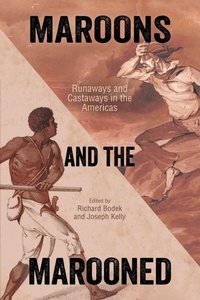
Maroons and the Marooned
Runaways and Castaways in the Americas
Published on 20. April 2020
Book
Paperback/Softback
224 pages
978-1-4968-2719-7 (ISBN)
Description
Contributions by Richard Bodek, Claire P. Curtis, Joseph Kelly, Simon Lewis, Steve Mentz, J. Brent Morris, Peter Sands, Edward Shore, and James O'Neil Spady Commonly, the word maroon refers to someone cast away on an island. One becomes marooned, usually, through a storm at sea or by a captain as a method of punishment. But the term originally denoted escaped slaves. Though being marooned came to be associated mostly with white European castaways, the etymology invites comparison between true maroons (escaped slaves establishing new lives in the wilderness) and people who were marooned (through maritime disaster).
This volume brings together literary scholars with historians, encompassing both literal maroons such as in Brazil and South Carolina as well as metaphoric scenarios in time-travel novels and postapocalyptic narratives. Included are examples from The Tempest; Margaret Atwood's MaddAddam trilogy; A Connecticut Yankee in King Arthur's Court; and Octavia Butler's Kindred.
Both runaways and castaways formed new societies in the wilderness. But true maroons, escaped slaves, were not cast away; they chose to fly towards the uncertainties of the wild in pursuit of freedom. In effect, this volume gives these maroons proper credit, at the very heart of American history.
This volume brings together literary scholars with historians, encompassing both literal maroons such as in Brazil and South Carolina as well as metaphoric scenarios in time-travel novels and postapocalyptic narratives. Included are examples from The Tempest; Margaret Atwood's MaddAddam trilogy; A Connecticut Yankee in King Arthur's Court; and Octavia Butler's Kindred.
Both runaways and castaways formed new societies in the wilderness. But true maroons, escaped slaves, were not cast away; they chose to fly towards the uncertainties of the wild in pursuit of freedom. In effect, this volume gives these maroons proper credit, at the very heart of American history.
More details
Series
Language
English
Place of publication
Jackson
United States
Target group
Professional and scholarly
Product notice
Paperback (trade)
Dimensions
Height: 229 mm
Width: 152 mm
Thickness: 13 mm
Weight
371 gr
ISBN-13
978-1-4968-2719-7 (9781496827197)
Copyright in bibliographic data and cover images is held by Nielsen Book Services Limited or by the publishers or by their respective licensors: all rights reserved.
Schweitzer Classification
Other editions
Additional editions
E-Book
04/2020
Penguin Random House South Africa
€29.49
Available for download
Persons
Joseph Kelly is professor of English at College of Charleston. He is author of America's Longest Siege: Charleston, Slavery, and the Long March to the Civil War. His articles have appeared in James Joyce Quarterly, Journal of Social History, New Hibernia Review, and South Carolina Historical Magazine.
Richard Bodek is professor of history at College of Charleston with an interest in working-class and popular culture. He is author of Proletarian Performance in Weimar Berlin: Agitprop, Chorus, and Brecht and co-editor of The Fruits of Exile: Central European Intellectual Immigration to America in the Age of Fascism.
Richard Bodek is professor of history at College of Charleston with an interest in working-class and popular culture. He is author of Proletarian Performance in Weimar Berlin: Agitprop, Chorus, and Brecht and co-editor of The Fruits of Exile: Central European Intellectual Immigration to America in the Age of Fascism.