

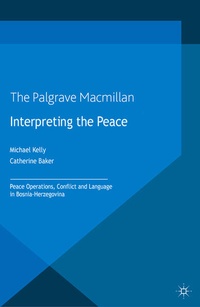
Interpreting the Peace
Peace Operations, Conflict and Language in Bosnia-Herzegovina
Published on 1. January 2013
Book
Paperback/Softback
XI, 237 pages
978-1-349-44025-2 (ISBN)
Description
Analysing the issues of language that faced international forces carrying out peace operations in Bosnia-Herzegovina in the 1990s, this book examines how differences of language were an integral part of the conflicts in the country and in what way the multinational UN and NATO forces faced their own problems of communication and language support.
Reviews / Votes
'Language mediation for peacekeeping forces is an important field, but one that has hitherto attracted little academic scrutiny. This excellent and appealing book helps put that balance right.' - Translation Studies
More details
Series
Edition
1st ed. 2013
Language
English
Place of publication
London
United Kingdom
Target group
Professional and scholarly
Illustrations
XI, 237 p.
Dimensions
Height: 216 mm
Width: 140 mm
Thickness: 14 mm
Weight
322 gr
ISBN-13
978-1-349-44025-2 (9781349440252)
DOI
10.1057/9781137029843
Schweitzer Classification
Other editions
Additional editions
M. Kelly | C. Baker
Interpreting the Peace
Peace Operations, Conflict and Language in Bosnia-Herzegovina
E-Book
11/2012
1st Edition
Palgrave Macmillan
€53.49
Available for download
M. Kelly | C. Baker
Interpreting the Peace
Peace Operations, Conflict and Language in Bosnia-Herzegovina
Book
11/2012
Palgrave Macmillan
€53.49
Shipment within 10-20 days
Persons
Author Michael Kelly: Michael Kelly is Professor of French in the Modern Languages Department, University of Southampton, UK. His research interests include French culture and society and public policy on languages. Mike is Director of the UK Subject Centre for Languages, Linguistics and Area Studies (Southampton), with a remit to support these subjects in higher education across the UK. His previous publications include The Cultural and Intellectual Rebuilding of France after the Second World War, The European Language Teacher (co-authored) and Setting the Agenda for Languages in Higher Education (co-edited).
Content
Preface List of Acronyms Introduction Serving in a Foreign Field The Multiple Roles of Military Interpreters Language Support on the Ground under UNPROFOR Improving Language Support Foreign/Local Encounters in Interpreting Nationality, Ethnicity and Trust Peacebuilding in a Multilingual World Conclusion