

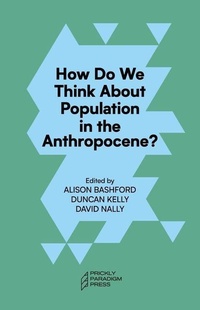
How Do We Think about Population in the Anthropocene?
Description
How do we think about population in the Anthropocene?
The "Great Acceleration" describes a set of interrelated human-driven transformations of Earth's systems, including the eightfold population growth since 1800. Yet ideas about population in the epoch many call the Anthropocene sit uncomfortably in contemporary discussions.
How Do We Think About Population in the Anthropocene? brings together the world's key thinkers in Anthropocene studies from a wide range of disciplines, including geology, geography, demography, history, political theory, and more. How do we think about population in the Anthropocene, or should we even think in terms of population at all? The twelve short essays in this pamphlet offer responses that reimagine how we think about economy, environment, consumption, reproduction, and extinction.
More details
Persons
Alison Bashford is the Scientia Professor of History and director of the Laureate Centre for History and Population at the University of New South Wales in Australia. She is a fellow of the British Academy and an honorary fellow of Jesus College, Cambridge. Duncan Kelly is professor of politics in the Department of Politics and International Studies, at the University of Cambridge, and a fellow of Jesus College, Cambridge. He is coeditor of Modern Intellectual History and the author of Politics and the Anthropocene and Worlds of Wartime: The First World War and the Reconstruction of Modern Politics. David Nally is professor of historical geography at the University of Cambridge and a Fellow of Jesus College. He is the author of Human Encumbrances: Political Violence and the Great Irish Famine and coauthor of Key Concepts in Historical Geography.