

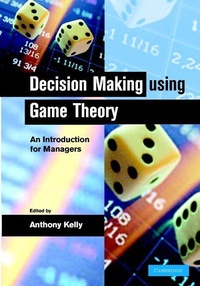
Decision Making Using Game Theory
An Introduction for Managers
Published on 27. March 2003
Book
Hardback
216 pages
978-0-521-81462-1 (ISBN)
Description
Game theory is a key element in most decision-making processes involving two or more people or organisations. This book explains how game theory can predict the outcome of complex decision-making processes, and how it can help you to improve your own negotiation and decision-making skills. It is grounded in well-established theory, yet the wide-ranging international examples used to illustrate its application offer a fresh approach to an essential weapon in the armoury of the informed manager. The book is accessibly written, explaining in simple terms the underlying mathematics behind games of skill, before moving on to more sophisticated topics such as zero-sum games, mixed-motive games, and multi-person games, coalitions and power. Clear examples and helpful diagrams are used throughout, and the mathematics is kept to a minimum. It is written for managers, students and decision makers in any field.
More details
Language
English
Place of publication
Cambridge
United Kingdom
Target group
Professional and scholarly
College/higher education
Illustrations
Worked examples or Exercises
Dimensions
Height: 250 mm
Width: 175 mm
Thickness: 16 mm
Weight
560 gr
ISBN-13
978-0-521-81462-1 (9780521814621)
Copyright in bibliographic data and cover images is held by Nielsen Book Services Limited or by the publishers or by their respective licensors: all rights reserved.
Schweitzer Classification
Other editions
Additional editions
Book
07/2011
1st Edition
Cambridge University Press
€43.00
Shipment within 15-20 days
E-Book
12/2004
1st Edition
Cambridge University Press
€26.49
Available for download
Person
Dr Anthony Kelly is a lecturer at the University of Southampton Research & Graduate School of Education where he teaches game theory and decision making to managers and students.
Content
Preface; 1. Introduction; 2. Games of skill; 3. Games of chance; 4. Sequential decision-making and co-operative; 5. Games of strategy; 6. Two-person mixed-motive games of strategy; 7. Repeated games; 8. Multi-person games, coalitions and power; 9. A critique of game theory; Appendix A. Proof of the minimax theorem; Appendix B. Proof of Bayes' theorem; Bibliography; Index.