

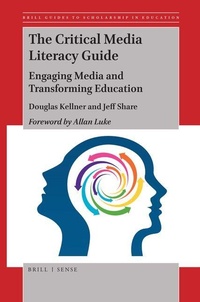
The Critical Media Literacy Guide
Engaging Media and Transforming Education
Published on 9. May 2019
Book
Hardback
144 pages
978-90-04-40451-9 (ISBN)
Description
Over half the world's population is now online, interconnected through a globally-networked media and consumer society. The convergence of information, media, and technology has created the predominant ecosystem of our time. Yet, most educational institutions are still teaching what and how they have for centuries, and are thus increasingly out-of-date and out-of-touch with our current needs. The Critical Media Literacy Guide: Engaging Media and Transforming Education provides a theoretical framework and practical applications for educators and teacher education programs to transform education by putting critical media literacy into action in classrooms with students from kindergarten to university.
Douglas Kellner and Jeff Share lay out the evolution of thinking and development of media and cultural studies, from the Frankfurt School to current intersectional theories about information and power that highlight the importance of race, gender, class, and sexuality. They provide insightful and accessible entry into theorizing education and information communication technologies through linking the politics of representation with critical pedagogy.
The increase in fake news, alternative facts, bots, and trolls, challenge our abilities to judge credibility and recognize bias. Kellner and Share present a critical lens and strategies to contextualize and analyze the dominant ideologies going viral across social media platforms and disseminated globally from enormous transnational corporations. The Critical Media Literacy Guide is a powerful resource to analyze and challenge representations and narratives of multiple forms of identity, privilege, and oppression. Since the struggle for social justice and democracy require new theories and pedagogies to maneuverer the constantly changing terrain, this book is essential for all educators.
Douglas Kellner and Jeff Share lay out the evolution of thinking and development of media and cultural studies, from the Frankfurt School to current intersectional theories about information and power that highlight the importance of race, gender, class, and sexuality. They provide insightful and accessible entry into theorizing education and information communication technologies through linking the politics of representation with critical pedagogy.
The increase in fake news, alternative facts, bots, and trolls, challenge our abilities to judge credibility and recognize bias. Kellner and Share present a critical lens and strategies to contextualize and analyze the dominant ideologies going viral across social media platforms and disseminated globally from enormous transnational corporations. The Critical Media Literacy Guide is a powerful resource to analyze and challenge representations and narratives of multiple forms of identity, privilege, and oppression. Since the struggle for social justice and democracy require new theories and pedagogies to maneuverer the constantly changing terrain, this book is essential for all educators.
More details
Series
Language
English
Place of publication
Leiden
Netherlands
Target group
Professional and scholarly
Product notice
sewn/stitched
Cloth over boards
Dimensions
Height: 239 mm
Width: 160 mm
Thickness: 15 mm
Weight
386 gr
ISBN-13
978-90-04-40451-9 (9789004404519)
Copyright in bibliographic data and cover images is held by Nielsen Book Services Limited or by the publishers or by their respective licensors: all rights reserved.
Schweitzer Classification
Other editions
Additional editions
Douglas Kellner | Jeff Share
The Critical Media Literacy Guide
Engaging Media and Transforming Education
Book
05/2019
Brill
€33.00
Shipment within 10-20 days
Persons
Douglas Kellner, Ph.D. (1973), is George Kneller Chair in the Philosophy of Education at UCLA and is author of many books on social theory, politics, history, and culture. His most recent books are American Nightmare: Donald Trump, Media Spectacle, and Authoritarian Populism (Sense Publishers, 2016); and The American Horror Show: Election 2016 and the Ascendency of Donald J. Trump (Sense Publishers, 2017).
Jeff Share, Ph.D. (2006), University of California, Los Angeles, is a Faculty Advisor in the Teacher Education Program. He has published and taught widely about critical media literacy, including Media Literacy is Elementary: Teaching Youth to Critically Read and Create Media (Peter Lang, 2015).
Jeff Share, Ph.D. (2006), University of California, Los Angeles, is a Faculty Advisor in the Teacher Education Program. He has published and taught widely about critical media literacy, including Media Literacy is Elementary: Teaching Youth to Critically Read and Create Media (Peter Lang, 2015).
Content
Foreword
?Allan Luke
Introduction
1 Towards Critical Digital & Media Literacies
?Media Literacy: An Unfulfilled Challenge
?Overview of Critical Media Literacy
?Pedagogical Antecedents of Critical Media Literacy
?Reconstructing Critical Media Literacy in the 21st Century
?New Technologies/New Literacies
?Media, Power, and Ideology
2 Ideology & the Politics of Representation
?Intersectionality
?Standpoint Epistemologies
?Questioning Power
?Representations of Class
?Looking Closely at Race and Racism
?Problematizing Gender & Sexuality
3 Putting Theory into Practice
?Teaching & Learning in an Image-Based Culture
?Everyone Today Is a Photographer
?Aural Literacy
?Multimodal Literacy
?The Dynamics of Digital and Networked Media
?Learning CML through Media Production & Praxis
?Storytelling
4 Preparing Educators to Teach Critical Media Literacy
?Teaching Teachers CML
?Exploring Identity & Media Representations
?Engaging Race and Gender
?Challenging Advertising and Consumerism
?Creating Critical Media Literacy Lessons
?Social Media and Partnering Pedagogy
?Lights, Sound, and Multimedia Action
?Challenges for Creating Social Justice Educators
5 Environmental Justice Is Social Justice
?News Reporting on Environmental Problems
?Fake News & Climate Change
?Creating Media to Challenge the Problems
?The Power of Visual Imagery
?Fedora Schooler, Middle School English/Social Studies Teacher
?Nick Kello, Elementary School Music Teacher
?Using Digital Media to Participate in Civic Society
6 Concluding Thoughts
?Challenging the Myths of Neutrality and Objectivity
?Fostering Democracy and Global Citizenship
References
Index
?Allan Luke
Introduction
1 Towards Critical Digital & Media Literacies
?Media Literacy: An Unfulfilled Challenge
?Overview of Critical Media Literacy
?Pedagogical Antecedents of Critical Media Literacy
?Reconstructing Critical Media Literacy in the 21st Century
?New Technologies/New Literacies
?Media, Power, and Ideology
2 Ideology & the Politics of Representation
?Intersectionality
?Standpoint Epistemologies
?Questioning Power
?Representations of Class
?Looking Closely at Race and Racism
?Problematizing Gender & Sexuality
3 Putting Theory into Practice
?Teaching & Learning in an Image-Based Culture
?Everyone Today Is a Photographer
?Aural Literacy
?Multimodal Literacy
?The Dynamics of Digital and Networked Media
?Learning CML through Media Production & Praxis
?Storytelling
4 Preparing Educators to Teach Critical Media Literacy
?Teaching Teachers CML
?Exploring Identity & Media Representations
?Engaging Race and Gender
?Challenging Advertising and Consumerism
?Creating Critical Media Literacy Lessons
?Social Media and Partnering Pedagogy
?Lights, Sound, and Multimedia Action
?Challenges for Creating Social Justice Educators
5 Environmental Justice Is Social Justice
?News Reporting on Environmental Problems
?Fake News & Climate Change
?Creating Media to Challenge the Problems
?The Power of Visual Imagery
?Fedora Schooler, Middle School English/Social Studies Teacher
?Nick Kello, Elementary School Music Teacher
?Using Digital Media to Participate in Civic Society
6 Concluding Thoughts
?Challenging the Myths of Neutrality and Objectivity
?Fostering Democracy and Global Citizenship
References
Index