

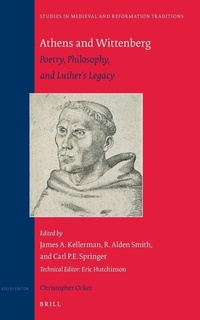
Athens and Wittenberg
Poetry, Philosophy, and Luther's Legacy
Published on 8. December 2022
Book
Hardback
324 pages
978-90-04-20670-0 (ISBN)
Description
Scholarship has tended to assume that Luther was uninterested in the Greek and Latin classics, given his promotion of the German vernacular and his polemic against the reliance upon Aristotle in theology. But as Athens and Wittenberg demonstrates, Luther was shaped by the classical education he had received and integrated it into his writings. He could quote Epicurean poetry to non-Epicurean ends; he could employ Aristotelian logic to prove the limits of philosophy's role in theology. This volume explores how Luther and early Protestantism, especially Lutheranism, continued to draw from the classics in their quest to reform the church. In particular, it examines how early Protestantism made use of the philosophy and poetry from classical antiquity.
Contributors to this volume: Joseph Herl, Jane Schatkin Hettrick, E.J. Hutchinson, Jack D. Kilcrease, E. Christian Kopf, John G. Nordling, Piergiacomo Petrioli, Eric G. Phillips, Richard J. Serina, Jr, R. Alden Smith, Carl P.E. Springer, Manfred Svensson, William P. Weaver, and Daniel Zager.
Contributors to this volume: Joseph Herl, Jane Schatkin Hettrick, E.J. Hutchinson, Jack D. Kilcrease, E. Christian Kopf, John G. Nordling, Piergiacomo Petrioli, Eric G. Phillips, Richard J. Serina, Jr, R. Alden Smith, Carl P.E. Springer, Manfred Svensson, William P. Weaver, and Daniel Zager.
More details
Series
Language
English
Place of publication
Leiden
Netherlands
Target group
Professional and scholarly
Product notice
sewn/stitched
Cloth over boards
Dimensions
Height: 236 mm
Width: 154 mm
Thickness: 24 mm
Weight
612 gr
ISBN-13
978-90-04-20670-0 (9789004206700)
Copyright in bibliographic data and cover images is held by Nielsen Book Services Limited or by the publishers or by their respective licensors: all rights reserved.
Schweitzer Classification
Persons
James R. Kellerman teaches at Concordia Lutheran Theological Seminary in St. Catharines, Canada. His main interests are Pauline Epistles, Synoptic Gospels, Plato, and Patristics. His publications include Ad fontes Witebergenses, co-edited with Carl P.E. Springer (2014), and Ad fontes Witebergenses, co-edited with E.J. Hutchinson and Joshua J. Hayes (2017).
R. Alden Smith teaches at Baylor University in Waco, Texas. His main interest is Latin poetry of the Augustan age. His book publications include Classics from Papyrus to the Internet: An Introduction to Transmission and Reception (2017), co-authored with Jeffrey M. Hunt and Fabio Stok, Virgil, Aeneid 8: Text, Translation and Commentary (2018), co-authored with Lee Fratantuono, and a translation of The Shroud of Turin: The History and Legends of the World's Most Famous Relic, by Andrea Nicoletti (2020).
Carl P.E. Springer holds the SunTrust Chair of Excellence in the Humanities in the Department of Modern and Classical Languages at the University of Tennessee. He has written extensively on the relationship between Martin Luther and the Classics, including Cicero in Heaven: The Roman Rhetor and Luther's Reformation (2018), and Sedulius: The Paschal Song and Hymns (2013).
R. Alden Smith teaches at Baylor University in Waco, Texas. His main interest is Latin poetry of the Augustan age. His book publications include Classics from Papyrus to the Internet: An Introduction to Transmission and Reception (2017), co-authored with Jeffrey M. Hunt and Fabio Stok, Virgil, Aeneid 8: Text, Translation and Commentary (2018), co-authored with Lee Fratantuono, and a translation of The Shroud of Turin: The History and Legends of the World's Most Famous Relic, by Andrea Nicoletti (2020).
Carl P.E. Springer holds the SunTrust Chair of Excellence in the Humanities in the Department of Modern and Classical Languages at the University of Tennessee. He has written extensively on the relationship between Martin Luther and the Classics, including Cicero in Heaven: The Roman Rhetor and Luther's Reformation (2018), and Sedulius: The Paschal Song and Hymns (2013).
Content
Preface
List of Illustrations
Abbreviations
Classical Authors and Works
Notes on Contributors
Introduction: Martin Luther: From Classical Formation to Reformation
?James Kellerman, R. Alden Smith and Carl P.E. Springer
Part 1: Luther and Classical Poets and Philosophers
1 Naso erat magister? Virgil and Other Classical Poets in Luther's Tischreden
?R. Alden Smith
2 Nugatory Nonsense: Why Luther Rarely Cites Catullus
?John G. Nordling
3 "Pious Mirth": Listening to Martin Luther's Latin Poetry
?Carl P.E. Springer
4 Luther between Stoics and Epicureans
?Carl P.E. Springer
5 Philtered Philosophy: Aristotle and Cicero in Luther's Tischreden
?R. Alden Smith
6 A Debatable Theology: Medieval Disputation, the Wittenberg Reformation, and Luther's Heidelberg Theses
?Richard J. Serina, Jr.
7 A Painted Record of Martin Luther in Renaissance Bologna
?Piergiacomo Petrioli
Part 2: The Reformation of Hymnody and Liturgy
8 What Virgil Taught Martin Luther About Poetry and Music
?E. Christian Kopff
9 Collaboration over Time: Luther's Adaptation of Ambrose's Veni Redemptor Gentium
?Eric Phillips
10 The Latin Liturgy and Juvenile Lutheran Instruction in Sixteenth-Century Germany
?Joseph Herl
11 "Exulting and Adorning in Exuberant Strains": Luther and Latin Polyphonic Music
?Daniel Zager
12 Tradition and the Individual Talent: Some Verse-Paraphrases of Psalm 1
?E.J. Hutchinson
13 Imitate the Lutherans: Catholic Solutions to Liturgical Problems in Late Eighteenth-Century Vienna
?Jane Schatkin Hettrick
Part 3: Lutheran Readings of Philosophy and Poetry
14 Melanchthon, Luther, and Indexing the Classics
?William P. Weaver
15 An Intended Reformulation: Of Brad Gregory, Duns Scotus, and Early Modern Metaphysics
?Jack D. Kilcrease
16 Ad normam veritatis christianae: Correcting Aristotle in Protestant Commentaries on the Nicomachean Ethics
?Manfred Svensson
17 Influence and Inspiration: Archias and Staupitz as Didactic Models for Cicero and Luther
?John G. Nordling
Bibliography
Index
List of Illustrations
Abbreviations
Classical Authors and Works
Notes on Contributors
Introduction: Martin Luther: From Classical Formation to Reformation
?James Kellerman, R. Alden Smith and Carl P.E. Springer
Part 1: Luther and Classical Poets and Philosophers
1 Naso erat magister? Virgil and Other Classical Poets in Luther's Tischreden
?R. Alden Smith
2 Nugatory Nonsense: Why Luther Rarely Cites Catullus
?John G. Nordling
3 "Pious Mirth": Listening to Martin Luther's Latin Poetry
?Carl P.E. Springer
4 Luther between Stoics and Epicureans
?Carl P.E. Springer
5 Philtered Philosophy: Aristotle and Cicero in Luther's Tischreden
?R. Alden Smith
6 A Debatable Theology: Medieval Disputation, the Wittenberg Reformation, and Luther's Heidelberg Theses
?Richard J. Serina, Jr.
7 A Painted Record of Martin Luther in Renaissance Bologna
?Piergiacomo Petrioli
Part 2: The Reformation of Hymnody and Liturgy
8 What Virgil Taught Martin Luther About Poetry and Music
?E. Christian Kopff
9 Collaboration over Time: Luther's Adaptation of Ambrose's Veni Redemptor Gentium
?Eric Phillips
10 The Latin Liturgy and Juvenile Lutheran Instruction in Sixteenth-Century Germany
?Joseph Herl
11 "Exulting and Adorning in Exuberant Strains": Luther and Latin Polyphonic Music
?Daniel Zager
12 Tradition and the Individual Talent: Some Verse-Paraphrases of Psalm 1
?E.J. Hutchinson
13 Imitate the Lutherans: Catholic Solutions to Liturgical Problems in Late Eighteenth-Century Vienna
?Jane Schatkin Hettrick
Part 3: Lutheran Readings of Philosophy and Poetry
14 Melanchthon, Luther, and Indexing the Classics
?William P. Weaver
15 An Intended Reformulation: Of Brad Gregory, Duns Scotus, and Early Modern Metaphysics
?Jack D. Kilcrease
16 Ad normam veritatis christianae: Correcting Aristotle in Protestant Commentaries on the Nicomachean Ethics
?Manfred Svensson
17 Influence and Inspiration: Archias and Staupitz as Didactic Models for Cicero and Luther
?John G. Nordling
Bibliography
Index