

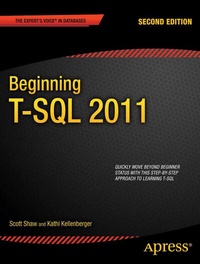
Beginning T-SQL 2012
2nd Edition
Published on 24. July 2012
Book
Paperback/Softback
XXI, 456 pages
978-1-4302-3704-4 (ISBN)
Description
Beginning T-SQL 2012 is the first step toward learning the T-SQL language that underlies Microsoft's SQL Server database engine. T-SQL is essential in writing SQL statements to get data into and out of a database. T-SQL is the foundation for business logic embedded in the database in the form of stored procedures and functions. Beginning T-SQL 2012 starts you on the path to mastering T-SQL, with an emphasis on best practices and sound coding techniques.
Beginning T-SQL 2012 begins with an introduction to databases, normalization, and to SQL Server Management Studio. Each subsequent chapter teaches an aspect of T-SQL, building on the skills learned in previous chapters. Exercises in each chapter give readers an opportunity for the hands-on practice that leads to true learning and distinguishes the competent professional.
Imparts best practices for writing T-SQL
Helps you avoid common errors
Shows how to write scalable code for good performance
More details
Edition
Second Edition
Language
English
Place of publication
Berkeley
United States
Target group
Popular/general
Product notice
Paperback (trade)
Unsewn / adhesive bound
Illustrations
XXI, 456 p.
Dimensions
Height: 233 mm
Width: 190 mm
Thickness: 28 mm
Weight
814 gr
ISBN-13
978-1-4302-3704-4 (9781430237044)
DOI
10.1007/978-1-4302-3705-1
Schweitzer Classification
Other editions
Additional editions
Kathi Kellenberger | Scott Shaw
Beginning T-SQL 2012
E-Book
09/2012
2nd Edition
APress
€52.99
Available for download
Persons
strongKathi Kellenberger/strong is a consultant with Linchpin People. She enjoys writing and speaking on SQL Server topics, having written over two dozen articles, contributed to four books, and presented at many SQL Server events. In her spare time, Kathi enjoys spending time with family and friends, singing and cycling.
Content
* Getting Started * Writing Simple SELECT Queries * Using Functions and Expressions * Querying Multiple Tables * Grouping and Summarizing Data * Manipulating Data * Understanding T-SQL Programming Logic * Working with XML * Moving Logic to the Database * Working with Data Types * Writing Advanced Queries * Where to Go Next?