

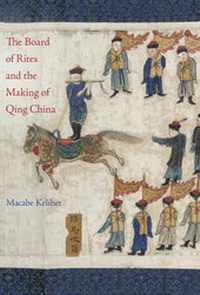
The Board of Rites and the Making of Qing China
1st Edition
Will be published approx. on 15. October 2019
Book
Hardback
288 pages
978-0-520-30029-3 (ISBN)
Description
The Board of Rites and the Making of Qing China presents a major new approach in research on the formation of the Qing empire (1636-1912) in early modern China. Focusing on the symbolic practices that structured domination and legitimized authority, the book challenges traditional understandings of state-formation, and argues that in addition to war making and institution building, the disciplining of diverse political actors, and the construction of political order through symbolic acts were essential undertakings in the making of the Qing state. Beginning in 1631 with the establishment of the key disciplinary organization, the Board of Rites, and culminating with the publication of the first administrative code in 1690, Keliher shows that the Qing political environment was premised on sets of intertwined relationships constantly performed through acts such as the New Year's Day ceremony, greeting rites, and sumptuary regulations, or what was referred to as li in Chinese. Drawing on Chinese- and Manchu-language archival sources, this book is the first to demonstrate how Qing state-makers drew on existing practices and made up new ones to reimagine political culture and construct a system of domination that lay the basis for empire.
Reviews / Votes
"[Keliher] has produced an extremely valuable and well-balanced work that will stand the test of time." * China Review International * "The book exists in an intersecting zone of institutional, political, and legal histories of Imperial China while dealing with various primary sources in Manchu and classical Chinese. As he concludes his book while locating the specific Qing institutional history in world history, it will also provide a useful backdrop not only for historians of Imperial China but also for researchers conducting comparative studies of the political system of East Asia." * Journal of East Asian Studies * "For historians of the Qing dynasty . . . this is one of those wonderful books that says something that the moment you read it you know is completely obvious but somehow no one has seen before." * English Historical Review * "By taking seriously his protagonists' preoccupation with li/doro/ritual as recorded in the historical sources, Macabe Keliher has produced an enriching and important work of scholarship that may be appreciated on a number of levels. . . . Specialists in Qing and Chinese history as well as those interested in ritual and the comparative history of dynastic states and imperial formations should find it especially appealing and worthy of a place on their reading lists and bookshelves." * Journal of Chinese History *More details
Edition
First Edition
Language
English
Place of publication
Berkerley
United States
Target group
Professional and scholarly
Product notice
Cloth over boards
Illustrations
14 b-w illustrations, 2 maps, 2 tables
Dimensions
Height: 229 mm
Width: 152 mm
Thickness: 25 mm
Weight
544 gr
ISBN-13
978-0-520-30029-3 (9780520300293)
Copyright in bibliographic data and cover images is held by Nielsen Book Services Limited or by the publishers or by their respective licensors: all rights reserved.
Schweitzer Classification
Other editions
Additional editions
Macabe Keliher
The Board of Rites and the Making of Qing China
E-Book
10/2019
1st Edition
Naval Institute Press
€78.99
Available for download
Person
Macabe Keliher is Assistant Professor of History at Southern Methodist University.
Content
List of Illustrations
Preface
PART ONE. CONTEXT
1. Introduction: Li and the Qing State
2. The Manchu Ascendancy and Struggles for Power
PART TWO. FORMATION, 1631-1651
3. The New Year's Day Ceremony
4. The Institution of the Emperor
5. The Administrative Order and Its Enactment
PART THREE. INSTITUTIONALIZATION, 1651-1690
6. Imperial Relatives in Service of the State
7. Completing the System: The Case of Imperial Dress
8. Codification: The Da Qing Huidian
Conclusion: Li, Qing China, and Early Modern Eurasia
Appendix One: Sons and Grandsons of Nurhaci and Surhaci
Mentioned in the Text
Appendix Two: Banner Lords under Nurhaci and Hong Taiji
Appendix Three: A Note on Sources
Abbreviations
Notes
Bibliography
Index
Preface
PART ONE. CONTEXT
1. Introduction: Li and the Qing State
2. The Manchu Ascendancy and Struggles for Power
PART TWO. FORMATION, 1631-1651
3. The New Year's Day Ceremony
4. The Institution of the Emperor
5. The Administrative Order and Its Enactment
PART THREE. INSTITUTIONALIZATION, 1651-1690
6. Imperial Relatives in Service of the State
7. Completing the System: The Case of Imperial Dress
8. Codification: The Da Qing Huidian
Conclusion: Li, Qing China, and Early Modern Eurasia
Appendix One: Sons and Grandsons of Nurhaci and Surhaci
Mentioned in the Text
Appendix Two: Banner Lords under Nurhaci and Hong Taiji
Appendix Three: A Note on Sources
Abbreviations
Notes
Bibliography
Index