

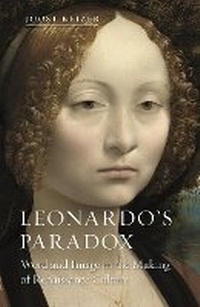
Leonardo's Paradox
Word and Image in the Making of Renaissance Culture
Published on 11. February 2019
Book
Hardback
232 pages
978-1-78914-069-9 (ISBN)
Description
Leonardo da Vinci (1452-1519) was one of the pre-eminent figures of the Italian Renaissance - he was also one of the most paradoxical. He spent an incredible amount of time writing notebooks, perhaps even more time than he ever held a brush, yet at the same time Leonardo was Renaissance culture's most fanatical critic of the word. When Leonardo criticized writing he criticized it as an expert on words; when he was painting, writing remained in the back of his mind.
In this book, Joost Keizer argues that the comparison between word and image fuelled Leonardo's thought. The paradoxes at the heart of Leonardo's ideas and practice also defined some of Renaissance culture's central assumptions about culture and nature: that there is a look to script, that painting offered a path out of culture and back to nature, that the meaning of images emerged in comparison with words, and that the difference between image-making and writing also amounted to a difference in the experience of time.
In this book, Joost Keizer argues that the comparison between word and image fuelled Leonardo's thought. The paradoxes at the heart of Leonardo's ideas and practice also defined some of Renaissance culture's central assumptions about culture and nature: that there is a look to script, that painting offered a path out of culture and back to nature, that the meaning of images emerged in comparison with words, and that the difference between image-making and writing also amounted to a difference in the experience of time.
Reviews / Votes
As a critical approach that also addresses Leonardo's way of thinking, Joost Keizer's Leonardo's Paradox: Word and Image in the Making of Renaissance Culture, examines the interplay of word and image in Leonardo's work. He sees paradoxes as central: for example, a painting can lead to a better understanding of nature, or the meaning of an image can depend on its association with certain words. Though not necessarily part of Leonardo's vocabulary for inventive processes, paradoxes are part of his work. * The Art Newspaper * Keizer focuses on what might be said to be the central problem of Leonardo studies, the relationship between his writings and his art. Keizer's topics are frequently surprising: Leonardo's rebuses and pictograms, his interest in fossils, his avoidance of signatures, the style of his writing. Even the choice of objects is striking: four of the fifteen drawings Keizer discusses in his first two chapters do not appear among Bambach's 1,319 illustrations . . . Keizer writes beautifully * Burlington Magazine * What is so appealing about Keizer's book is the variety of topics he explores with insight and a fresh perspective. The author informs us, for example, that Leonardo once wrote that writing is a kind of drawing, because it matters to the writer what the letters look like. For Leonardo writing originated from image making . . . The fables or tales that one finds in Leonardo's notebooks are never mere fiction. They tell us ever so much. They are, we might say, allegories. It is not surprising that Keizer dedicates more than a few illuminating pages of his book explicitly to Leonardo's allegories. There is much more in Keizer's thoughtful and probing book, which deserves wide currency. * Renaissance Quarterly * [an] elegant, accessible and deeply informed book. * The Sixteenth Century Journal * Keizer's rewarding book is, in essence, an extended investigation of - and meditation on - the interrelation of words and images in Leonardo's notebooks and paintings. Keizer discusses how words, the tools of the art historian, ultimately fail to convey what the images can, and how seemingly explanatory texts can constrain reading of images (Leonardo's included). Basing his discussion on the thousands of pages of writings - with their attendant drawings - in Leonardo's various notebooks, Keizer emphasizes the artist's concern with the "relationship between image and text" not only as an attempt to record accurately what he is depicting (nature in all of its manifestations), but also as something more - an implied motion in the visual forms that expands the limited moment of time stopped in the image but that has a history and a future. Keizer's unfolding of time in Leonardo's work is perhaps the most important part of his discussion, not just for Leonardo, but for the development of Renaissance painting after Leonardo. This is a book to be studied for its revealing insights. Highly recommended. * Choice * Keizer brings descriptive and analytical incisiveness to Leonardo da Vinci, as expressed (often contradictorily) in that artist's output of painting and writing . . . Keizer's study, told with craft and attention to Leonardo's paintings, drawings, letters, and (now) codices, deduces from written and visual evidence how Leonardo worked through pairings of language and pictures, invention and scientific observation, objectivity and subjectivity, nature and human-made; the instant and the enduring . . . The author's language is natural and accessible - so the book fits in well with Reaktion's ever-accelerating list of modest-sized volumes that showcase new thought on focused topics. Even the range of endnotes enclose a garden of delight confirming the author's own sense of wonder, and inspiring curiosity in the reader. * ARLIS/NA Reviews * Keizer's visual investigation of Leonardo's writings - which illustrates that the artist enjoyed using multiple hands, and continuously scratched out, rewrote, and annotated his thoughts - is strong evidence for his case that the artist's dislike of the unalterable and invariable nature of printed text manifested itself in his notebooks . . . Keizer's richly illustrated work does very well to lay bare an artist's attempt to straddle the spheres of originality and artificiality in a world that praised invention and novelty, as modelled on past cultures. * Renaissance and Reformation * What is usefully articulated by Keizer, and innovatively expressed throughout this detailed study, however, is how Leonardo's paradoxical recoiling against the affectedness of human craft and cultural forms actually propelled the ingenuity of his artwork. * Religion and the Arts * This is an intelligent and thought-provoking study of Leonardo's thoughts. Informed by his deep immersion in Leonardo's notebooks, and in the intellectual debates of the late 15th century-early 16th century, the author presents an original, highly personal, and often convincing interpretation of Leonardo's idiosyncratic views on the relationships between word and image, and between Nature and Culture. The text is always learned but never pedantic, and written in an engaging style. If you want insight into what made Leonardo tick, his interests, points of reference, stated views, and thought processes, I would recommend this handsome volume. * Jonathan K. Nelson, Syracuse University, Florence. * Joost Keizer's concise and eminently readable book offers a fresh take on Leonardo's intellectual engagement with the world by evaluating his practice as writer and painter. How do word and image relate? This seemingly simple question opens up perspectives on Renaissance thought and culture - and challenges readers to reconsider their own assumptions about visual and written records of the world around us. * Joachim Homann, Maida and George Abrams Curator of Drawings, Harvard Art Museums *More details
Language
English
Place of publication
London
United Kingdom
Illustrations
65 illustrations, 40 in colour
Dimensions
Height: 240 mm
Width: 156 mm
ISBN-13
978-1-78914-069-9 (9781789140699)
Copyright in bibliographic data and cover images is held by Nielsen Book Services Limited or by the publishers or by their respective licensors: all rights reserved.
Schweitzer Classification
Other editions
Additional editions
E-Book
02/2019
Reaktion Books
€25.49
Available for download
Person
Joost Keizer is Senior Lecturer in Art History at the University of Groningen. His previous books include The Realism of Piero della Francesca (2017), The Transformation of Vernacular Expression in Early Modern Arts (co-edited with Todd Richardson, 2011), and a book for young adults, This Is Leonardo da Vinci, with the illustrator Christina Christoforou (2016).