

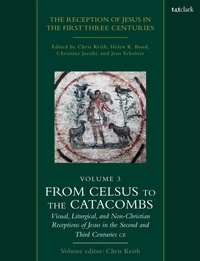
The Reception of Jesus in the First Three Centuries: Volume 3
From Celsus to the Catacombs: Visual, Liturgical, and Non-Christian Receptions of Jesus in the Second and Third Centuries CE
Published on 20. February 2025
Book
Paperback/Softback
520 pages
978-0-567-71690-3 (ISBN)
Description
The first three centuries were the formative period of Christianity. The developments during this time led to the distinction of canonical and non-canonical writings, to organizational structures of the Christian church, and to the establishment of the Christian creed.
In The Reception of the Jesus in the First Three Centuries Chris Keith, Helen K. Bond, Christine Jacobi and Jens Schroeter have collated a methodologically sophisticated resource. These volumes focus upon the diversity of reception of the Jesus tradition in this time period, highlighting the complex interactions between the inherited past and the present in which it is received. Rather than address texts specifically as canonical or non-canonical, the volumes show the more complex reality of attitudes towards and within early Christianity. Core literary texts such as Gospels and other early Christian writings are discussed in detail, but the volumes also highlight the importance of Jesus tradition in literary and non-literary contexts outside the gospel genre; including the Apostolic Fathers, patristic writers, traditions such as the Abgar Legend, and modifications to the gospel genre such as the Diatesseron. Evidence from material culture, such as pictographic representations of Jesus in the staurogram and Alexamenos Graffito, as well as visual presentations of gospel tradition in sarcophagi carvings, are also included in order to fully reflect the transmission and reception of the Jesus tradition.
Volume 3 examines visual, liturgical and non-Christian receptions of Jesus in the second and third centuries, across 24 chapters.
Methodologically the volumes draw on new approaches to history, memory, and tradition, to provide a cutting-edge approach that focuses upon reception-history rather than the putative actual past. This cutting-edge reference resource provides a fresh and comprehensive account of the complex development of early Christian thought about Jesus. It will fuel future discussions of early Christian history, the historical Jesus, the development of the New Testament canon, and non-canonical Jesus traditions for years to come.
In The Reception of the Jesus in the First Three Centuries Chris Keith, Helen K. Bond, Christine Jacobi and Jens Schroeter have collated a methodologically sophisticated resource. These volumes focus upon the diversity of reception of the Jesus tradition in this time period, highlighting the complex interactions between the inherited past and the present in which it is received. Rather than address texts specifically as canonical or non-canonical, the volumes show the more complex reality of attitudes towards and within early Christianity. Core literary texts such as Gospels and other early Christian writings are discussed in detail, but the volumes also highlight the importance of Jesus tradition in literary and non-literary contexts outside the gospel genre; including the Apostolic Fathers, patristic writers, traditions such as the Abgar Legend, and modifications to the gospel genre such as the Diatesseron. Evidence from material culture, such as pictographic representations of Jesus in the staurogram and Alexamenos Graffito, as well as visual presentations of gospel tradition in sarcophagi carvings, are also included in order to fully reflect the transmission and reception of the Jesus tradition.
Volume 3 examines visual, liturgical and non-Christian receptions of Jesus in the second and third centuries, across 24 chapters.
Methodologically the volumes draw on new approaches to history, memory, and tradition, to provide a cutting-edge approach that focuses upon reception-history rather than the putative actual past. This cutting-edge reference resource provides a fresh and comprehensive account of the complex development of early Christian thought about Jesus. It will fuel future discussions of early Christian history, the historical Jesus, the development of the New Testament canon, and non-canonical Jesus traditions for years to come.
More details
Language
English
Place of publication
Edinburgh
United Kingdom
Publishing group
Bloomsbury Publishing PLC
Target group
Professional and scholarly
Illustrations
70 b&w illustrations
Dimensions
Height: 189 mm
Width: 247 mm
Thickness: 31 mm
Weight
992 gr
ISBN-13
978-0-567-71690-3 (9780567716903)
Copyright in bibliographic data and cover images is held by Nielsen Book Services Limited or by the publishers or by their respective licensors: all rights reserved.
Schweitzer Classification
Persons
Chris Keith is Professor of New Testament and Early Christianity and Director of the Centre for the Social-Scientific Study of the Bible at St. Mary's University College, UK.
Helen K. Bond is Professor in Christian Origins with Specialisation in New Testament and Head of the School of Divinity at the University of Edinburgh, UK.
Christine Jacobi is Scientific Associate at Humboldt University in Berlin, Germany.
Jens Schroeter is Professor for Exegesis and Theology of the New Testament and New Testament Apocrypha at the Faculty of Theology at the Humboldt-University in Berlin, Germany.
Helen K. Bond is Professor in Christian Origins with Specialisation in New Testament and Head of the School of Divinity at the University of Edinburgh, UK.
Christine Jacobi is Scientific Associate at Humboldt University in Berlin, Germany.
Jens Schroeter is Professor for Exegesis and Theology of the New Testament and New Testament Apocrypha at the Faculty of Theology at the Humboldt-University in Berlin, Germany.
Content
Introduction to Volume Three - Chris Keith, St. Mary's University, UK
Non-Christian Literary Receptions of Jesus in the Second and Third Centuries CE
1. Celsus - John Granger Cook, LaGrange College, USA
2. Lucian - Margaret Wiliams, University of Edinburgh, UK
3. Pliny the Younger - Margaret Wiliams, University of Edinburgh, UK
4. Suetonius - Margaret Wiliams, University of Edinburgh, UK
5. Tacitus - Margaret Wiliams, University of Edinburgh, UK
6. Mara bar Serapion - Kathleen McVey, Princeton Theological Seminary, USA
7. Talmudim - Christian M. M. Brady, University of Kentucky, USA
Visual Receptions of Jesus
8. Alexamenos Graffito - Felicity Harley-McGowan, Yale Divinity School, USA
9. Amulets - Brice C. Jones, Louisiana Delta Community College, USA
10. Art and Architecture at Capernaum, Kefar 'Othnay, and Dura Europos - Anders Runesson, University of Oslo, Norway, and Wally V. Cirafesi, University of Oslo, Norway
11. Catacombs - William "Chip" Gruen, Muhlenberg College, USA
12. Christograms - Thomas J. Kraus, University of Zuerich and University of the Free State, Switzerland
13. Cross Symbol - Bruce W. Longenecker, Baylor University, USA, with Chris Keith, St. mary's University, UK
14. Epitaph of Abercius - Allen Brent, King's College London, UK
15. Fish Symbol - Robin M. Jensen, University of Notre Dame, USA
16. Nomina Sacra - Larry W. Hurtado, University of Edinburgh, UK
17. Petrogram - Thomas J. Kraus, University of Zuerich and University of the Free State, Switzerland
18. Sarcophagi - Catherine C. Taylor, Brigham Young University, UK
19. Sculptural Images of Jesus - Joan E. Taylor, King's College London, UK
20. Staurogram - Dieter T. Roth, Johannes Gutenberg Universitaet-Mainz, Germany
Liturgical Receptions of Jesus
21. Baptism - Rafael Rodriguez, Johnson University, USA
22. Eucharist - Andrew McGowan, Yale Divinity School, USA
23. Prayer - Heather Gorman, Johnson University, USA
24. Public Reading of the Gospels - Chris Keith, St. Mary's University, UK
Index
Non-Christian Literary Receptions of Jesus in the Second and Third Centuries CE
1. Celsus - John Granger Cook, LaGrange College, USA
2. Lucian - Margaret Wiliams, University of Edinburgh, UK
3. Pliny the Younger - Margaret Wiliams, University of Edinburgh, UK
4. Suetonius - Margaret Wiliams, University of Edinburgh, UK
5. Tacitus - Margaret Wiliams, University of Edinburgh, UK
6. Mara bar Serapion - Kathleen McVey, Princeton Theological Seminary, USA
7. Talmudim - Christian M. M. Brady, University of Kentucky, USA
Visual Receptions of Jesus
8. Alexamenos Graffito - Felicity Harley-McGowan, Yale Divinity School, USA
9. Amulets - Brice C. Jones, Louisiana Delta Community College, USA
10. Art and Architecture at Capernaum, Kefar 'Othnay, and Dura Europos - Anders Runesson, University of Oslo, Norway, and Wally V. Cirafesi, University of Oslo, Norway
11. Catacombs - William "Chip" Gruen, Muhlenberg College, USA
12. Christograms - Thomas J. Kraus, University of Zuerich and University of the Free State, Switzerland
13. Cross Symbol - Bruce W. Longenecker, Baylor University, USA, with Chris Keith, St. mary's University, UK
14. Epitaph of Abercius - Allen Brent, King's College London, UK
15. Fish Symbol - Robin M. Jensen, University of Notre Dame, USA
16. Nomina Sacra - Larry W. Hurtado, University of Edinburgh, UK
17. Petrogram - Thomas J. Kraus, University of Zuerich and University of the Free State, Switzerland
18. Sarcophagi - Catherine C. Taylor, Brigham Young University, UK
19. Sculptural Images of Jesus - Joan E. Taylor, King's College London, UK
20. Staurogram - Dieter T. Roth, Johannes Gutenberg Universitaet-Mainz, Germany
Liturgical Receptions of Jesus
21. Baptism - Rafael Rodriguez, Johnson University, USA
22. Eucharist - Andrew McGowan, Yale Divinity School, USA
23. Prayer - Heather Gorman, Johnson University, USA
24. Public Reading of the Gospels - Chris Keith, St. Mary's University, UK
Index