

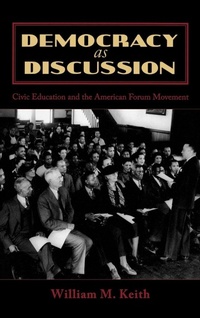
Democracy as Discussion
Civic Education and the American Forum Movement
Published on 12. February 2007
Book
Hardback
376 pages
978-0-7391-1507-7 (ISBN)
Description
As Americans worry ever more about the effects of media on the quality of public deliberation, they have developed a renewed interest in public discussion, especially face-to-face public discussion. Over a century ago, public forums-organized and widespread-provided a place where citizens could discuss the political issues of the day, and they became a means of adult civic education. William M. Keith documents the college course developed by the new field of Speech to teach the skills of discussion, as well as the forum movement, which culminated in the Federal Forum Project. Using primary sources from archives around the country, Democracy as Discussion traces the early history of the Speech field, the development of discussion as an alternative to debate, and the Deweyan Progressive philosophy of discussion that swept the U.S. For the first time the structure and details of the Federal Forum project in the context of the forum movement and adult civic education in the U.S. are recounted and analyzed, making this book a valuable resource in the study of political communication and history.
Reviews / Votes
A wonderful book, making visible how early scholarship in Speech drew from and contributed to a larger American discussion about democracy's meaning. To understand the tensions among discussion, debate, and argumentation in American life, Democracy as Discussion is essential reading, as it offers a vision for how to reconnect current group communication scholarship with its normative, civic-minded roots. -- Karen Tracy, University of Colorado As Keith says, "Democracy is governance through talk." Keith's work makes clear precisely what kind of talk makes American democracy tick. Long before it became fashionable to speak of "deliberative democracy," Keith discovers how it became fashionable to teach discussion and organize public forums. Anyone who practices or preaches modern deliberation should read Keith's work carefully if they hope to understand the cultural forces that giveth-and taketh away-the aspiration for public discussion. Through Keith's book, the reader gets to join a lively discussion about discussion, featuring a mix of political philosophers, speech educators, proto-social scientists, civic reformers, and philanthropists. In Democracy as Discussion, Keith has accomplished something remarkable-bringing to life a full research library's worth of archives. Keith's book brings the discursive past of democracy into the deliberative present. Thanks to his careful and engaging historical account, we can now stand more squarely on the shoulders of this often forgotten generation of deliberative democrats. -- John Gastil, University of WashingtonMore details
Series
Language
English
Place of publication
United States
Publishing group
Bloomsbury Publishing Plc
Dimensions
Height: 235 mm
Width: 157 mm
Thickness: 27 mm
Weight
760 gr
ISBN-13
978-0-7391-1507-7 (9780739115077)
Copyright in bibliographic data and cover images is held by Nielsen Book Services Limited or by the publishers or by their respective licensors: all rights reserved.
Schweitzer Classification
Other editions
Additional editions
E-Book
02/2007
1st Edition
Lexington Books
€55.99
Available for download
Person
William M. Keith is associate professor of communication at the University of Wisconsin-Milwaukee.
Content
Chapter 1 Introduction
Part 2 Teaching Speech, Teaching Democracy
Chapter 3 Origins of Speech Pedagogy
Chapter 4 Contest Debating and Civic Pedagogy
Chapter 5 John Dewey and the Turn to Discussion
Part 6 Teaching Discussion
Chapter 7 The First Wave: Discussion Educators Emerge
Chapter 8 The Second Wave: Discussion Pedagogy Comes of Age
Chapter 9 The Demise of Discussion
Part 10 The Forum Movement
Chapter 11 The Development of the American Forum
Chapter 12 Adult Education and the Civic Mission
Chapter 13 The Federal Forum Project
Chapter 14 Conclusion
Part 2 Teaching Speech, Teaching Democracy
Chapter 3 Origins of Speech Pedagogy
Chapter 4 Contest Debating and Civic Pedagogy
Chapter 5 John Dewey and the Turn to Discussion
Part 6 Teaching Discussion
Chapter 7 The First Wave: Discussion Educators Emerge
Chapter 8 The Second Wave: Discussion Pedagogy Comes of Age
Chapter 9 The Demise of Discussion
Part 10 The Forum Movement
Chapter 11 The Development of the American Forum
Chapter 12 Adult Education and the Civic Mission
Chapter 13 The Federal Forum Project
Chapter 14 Conclusion