

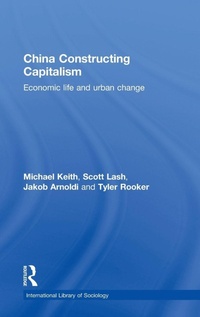
China Constructing Capitalism
Economic Life and Urban Change
1st Edition
Published on 10. September 2013
Book
Hardback
344 pages
978-0-415-49705-3 (ISBN)
Description
China has been growing at over ten per cent annually since 1978, but this has only come to very widespread notice in the past decade. This received wisdom about China has been largely of two types, both of which - more or less - understand China in the context of neoliberalism. The more business- or business studies-oriented literature seems to argue that if China does not adapt the rule of clear and distinct property and contract law - in short, of Western institutions - its economy will stall. The second set of voices is more clearly from the left, arguing that the Chinese economy, and city, is neo-liberal. For them, China does not diverge widely from the Anglo-American model that, from 2008, has brought the world economy to its knees.
China Constructing Capitalism takes issue with these analyses. The authors argue that it is not Western neo-liberalism that is constructing the Chinese economy, but instead that China is constructing its own version of capitalism. The two central theses of their argument are:
economic life - neo-liberal economic life is individualized and disembedded, while the China model is relational and situated
urban change - China has created a form of 'local state capitalism' which stands in contrast to neoliberal versions of the city.
This book analyses China as a 'risk culture', examining among others Chinese firms and political ties, property development, migrant urbanisms and share trading rooms. It scrutinises the ever-present shadow of the risk-averse (yet uncertainty-creating) state. China Constructing Capitalism is a must-read for social scientists, policy makers and investors.
China Constructing Capitalism takes issue with these analyses. The authors argue that it is not Western neo-liberalism that is constructing the Chinese economy, but instead that China is constructing its own version of capitalism. The two central theses of their argument are:
economic life - neo-liberal economic life is individualized and disembedded, while the China model is relational and situated
urban change - China has created a form of 'local state capitalism' which stands in contrast to neoliberal versions of the city.
This book analyses China as a 'risk culture', examining among others Chinese firms and political ties, property development, migrant urbanisms and share trading rooms. It scrutinises the ever-present shadow of the risk-averse (yet uncertainty-creating) state. China Constructing Capitalism is a must-read for social scientists, policy makers and investors.
More details
Series
Language
English
Place of publication
London
United Kingdom
Publishing group
Taylor & Francis Ltd
Target group
College/higher education
Illustrations
16 s/w Tabellen, 39 s/w Abbildungen, 34 s/w Photographien bzw. Rasterbilder, 5 s/w Zeichnungen
16 Tables, black and white; 5 Line drawings, black and white; 34 Halftones, black and white; 39 Illustrations, black and white
Dimensions
Height: 240 mm
Width: 161 mm
Thickness: 23 mm
Weight
684 gr
ISBN-13
978-0-415-49705-3 (9780415497053)
Copyright in bibliographic data and cover images is held by Nielsen Book Services Limited or by the publishers or by their respective licensors: all rights reserved.
Schweitzer Classification
Other editions
Additional editions
Michael Keith | Scott Lash | Jakob Arnoldi
China Constructing Capitalism
Economic Life and Urban Change
E-Book
09/2013
1st Edition
Routledge
€78.99
Available for download
Michael Keith | Scott Lash | Jakob Arnoldi
China Constructing Capitalism
Economic Life and Urban Change
E-Book
09/2013
1st Edition
Routledge
€78.99
Available for download
Michael Keith | Scott Lash | Jakob Arnoldi
China Constructing Capitalism
Economic Life and Urban Change
Book
08/2013
1st Edition
Routledge
€86.30
Shipment within 15-20 days
Persons
Michael Keith is Director of the Centre on Migration, Policy and Society and holds a personal chair in the Department of Anthropology at the University of Oxford.
Scott Lash is Director of the Centre for Cultural Studies at Goldsmiths, University of London.
Jakob Arnoldi is Professor in the Department of Business Administration at Aarhus University.
Tyler Rooker is Lecturer in Contemporary Chinese Studies at the University of Nottingham.
Scott Lash is Director of the Centre for Cultural Studies at Goldsmiths, University of London.
Jakob Arnoldi is Professor in the Department of Business Administration at Aarhus University.
Tyler Rooker is Lecturer in Contemporary Chinese Studies at the University of Nottingham.
Content
Introduction 1. Chinese Thought, Cultural Theory 2. Connections, Networks, Culture: The Institutions of Chinese Capitalism 3. Relational Property and Urban Temporality: China's Urbanisms in the City of Experts 4. Local State Capitalism? From Urban Hierarchy to City Markets 5. Chinese Firms and Political Ties 6. Property Development: Markets and Districts 7. Trading Room Ethnography: Stuck in China 8. Knowing but Not Doing: The Financial Sector in China and Institutional Reform 9. Risk Cultures: Urban Biographies 10. Shenzhen Dwelling: Arrival and Migrant Urbanisms. Bibliography