

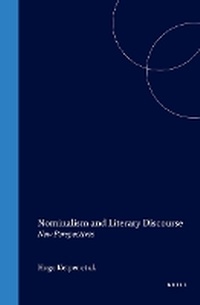
Nominalism and Literary Discourse
New Perspectives
Published on 1. January 1997
Book
Hardback
376 pages
978-90-420-0288-3 (ISBN)
Description
Influential accounts of European cultural history variously suggest that the rise of nominalism and its ultimate victory over realist orientations were highly implemental factors in the formation of Modern Europe since the later Middle Ages, but particularly the Reformation. Quite probably, this is a simplification of a state of affairs that is in fact more complex, indeed ambiguous. However, if there is any truth in such propositions - which have, after all, been made by many prominent commentators, such as Panofsky, Heer, Blumenberg, Foucault, Eco, Kristeva - we may no doubt assume that literary texts will have responded and in turn contributed, in a variety of ways, to these processes of cultural transformation. It seems of considerable interest, therefore, to take a close look at the complex, precarious position which literature, as basically a symbolic mode of signification, held in the perennial struggles and discursive negotiations between the semiotic 'twin paradigms' of nominalism and realism.
This collection of essays (many of them by leading scholars in the field) is a first comprehensive attempt to tackle such issues - by analyzing representative literary texts in terms of their underlying semiotic orientations, specifically of nominalism, but also by studying pertinent historical, theoretical and discursive co(n)texts of such developments in their relation to literary discourse. At the same time, since 'literary nominalism' and 'realism' are conceived as fundamentally aesthetic phenomena instantiating a genuinely 'literary debate over universals', consistent emphasis is placed on the discursive dimension of the texts scrutinized, in an endeavour to re-orient and consolidate an emergent research paradigm which promises to open up entirely new perspectives for the study of literary semiotics, as well as of aesthetics in general. Historical focus is provided by concentrating on the English situation in the era of transition from late medieval to early modern (c. 1350-1650), but readers will also find contributions on Chretien de Troyes and Rabelais, as well as on the 'aftermath' of the earlier debates - as exemplified in studies of Locke and (post)modern critical altercations, respectively, which serve to point up the continuing relevance of the issues involved. A substantial introductory essay seeks to develop an overarching theoretical framework for the study of nominalism and literary discourse, in addition to offering an in-depth exploration of the 'nominalism/realism-complex' in its relation to literature. An extensive bibliography and index are further features of interest to both specialists and general readers.
This collection of essays (many of them by leading scholars in the field) is a first comprehensive attempt to tackle such issues - by analyzing representative literary texts in terms of their underlying semiotic orientations, specifically of nominalism, but also by studying pertinent historical, theoretical and discursive co(n)texts of such developments in their relation to literary discourse. At the same time, since 'literary nominalism' and 'realism' are conceived as fundamentally aesthetic phenomena instantiating a genuinely 'literary debate over universals', consistent emphasis is placed on the discursive dimension of the texts scrutinized, in an endeavour to re-orient and consolidate an emergent research paradigm which promises to open up entirely new perspectives for the study of literary semiotics, as well as of aesthetics in general. Historical focus is provided by concentrating on the English situation in the era of transition from late medieval to early modern (c. 1350-1650), but readers will also find contributions on Chretien de Troyes and Rabelais, as well as on the 'aftermath' of the earlier debates - as exemplified in studies of Locke and (post)modern critical altercations, respectively, which serve to point up the continuing relevance of the issues involved. A substantial introductory essay seeks to develop an overarching theoretical framework for the study of nominalism and literary discourse, in addition to offering an in-depth exploration of the 'nominalism/realism-complex' in its relation to literature. An extensive bibliography and index are further features of interest to both specialists and general readers.
Reviews / Votes
"En presence d'une telle richesse et d'une telle lucidite on ne peut qu'encourager tous [...] a lire cet ouvrage d'une utilite et d'une valeur incontestables." - in: Le Moyen Age, Tome CVIII, 3-4 (2002)"...an impressive contribution to the Critical Studies series..." - in: Prolepsis, 19.1.1999
More details
Series
Language
English
Place of publication
Leiden
Netherlands
Publishing group
Brill
Target group
Professional and scholarly
Dimensions
Height: 230 mm
Width: 155 mm
Weight
826 gr
ISBN-13
978-90-420-0288-3 (9789042002883)
Copyright in bibliographic data and cover images is held by Nielsen Book Services Limited or by the publishers or by their respective licensors: all rights reserved.
Schweitzer Classification
Other editions
Additional editions
Book
01/1997
Rodopi
€72.44
Article exhausted; check different version
Content
Acknowledgements. Preface. Hugo KEIPER: Introductory Essay: A Literary 'Debate over Universals'? New Perspectives on the Relationships between Nominalism, Realism, and Literary Discourse. Gerald SEAMAN: Signs of a New Literary Paradigm: The 'Christian' Figures of Chretien de Troyes. William J. COURTENAY: The Dialectic of Divine Omnipotence in the Age of Chaucer: A Reconsideration. Richard J. UTZ: 'As Writ Myn Auctour Called Lollius': Divine and Authorial Omnipotence in Chaucer's Troielus and Criseyde. William H. WATTS: Chaucer's Clerks and the Value of Philosophy. Stephen PENN: Literary Nominalism and Medieval Sign Theory: Problems and Perspectives. William F. MUNSON: Self, Action, and Sign in the Towneley and York Plays on the Baptism of Christ and in Ockhamist Salvation Theology. Ullrich LANGER: Charity and the Singular: The Object of Love in Rabelais. William C. CARROLL: Semiotic Slippage: Identity and Authority in the English Renaissance. James R. SIEMON: Sign, Cause or General Habit? Towards an 'Historicist Ontology' of Character on the Early Modern Stage. Andreas MAHLER: Don Quixote, Hamlet, Foucault - Language, 'Literature', and the Losses of Analogism. Susanne FENDLER: The Emancipation of the Sign: The Changing Significance of Beauty in Some English Renaissance Romances. Nicholas HUDSON: John Locke and the Tradition of Nominalism. Christoph BODE: A Modern Debate over Universals? Critical Theory vs. 'Essentialism'. Bibliography. Contributors. Index of Major References (Compiled by Hugo and Anita Keiper)