

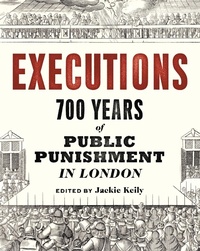
Executions
700 Years of Public Punishment in London
Published on 13. October 2022
Book
Paperback/Softback
144 pages
978-1-78130-108-1 (ISBN)
Description
A fascinating record of how London and Londoners were shaped by nearly 700 years of public executions.
More frequent in London than in any other city or town in Britain, these morbid spectacles often attracted tens of thousands of onlookers at locations across the capital and were a major part of Londoners' lives for centuries. From Smithfield to Kennington, Tyburn to Newgate Prison, public executions became embedded in London's landscape and people's lives. Even today, hints of this dark chapter in London's history can still be seen across the city.
Featuring the lives and legacies of those who died or who witnessed public executions first hand from 1196 to 1868, this book tells the rarely told and often tragic human stories behind these events. It includes a range of fascinating objects, paintings and documents, many from the Museum of London's collections, such as the vest said to have been worn by King Charles I when he was executed, portraits of 'celebrity criminals', and last letters of the condemned.
From the sites of execution to the thriving 'gallows' economy, the book reveals the role that Londoners played as both spectators and participants in this most public demonstration of state power over the life and death of its citizens.
More frequent in London than in any other city or town in Britain, these morbid spectacles often attracted tens of thousands of onlookers at locations across the capital and were a major part of Londoners' lives for centuries. From Smithfield to Kennington, Tyburn to Newgate Prison, public executions became embedded in London's landscape and people's lives. Even today, hints of this dark chapter in London's history can still be seen across the city.
Featuring the lives and legacies of those who died or who witnessed public executions first hand from 1196 to 1868, this book tells the rarely told and often tragic human stories behind these events. It includes a range of fascinating objects, paintings and documents, many from the Museum of London's collections, such as the vest said to have been worn by King Charles I when he was executed, portraits of 'celebrity criminals', and last letters of the condemned.
From the sites of execution to the thriving 'gallows' economy, the book reveals the role that Londoners played as both spectators and participants in this most public demonstration of state power over the life and death of its citizens.
Reviews / Votes
It's a fantastic new book in its own right and well worth checking out. * History Answers *More details
Language
English
Place of publication
London
United Kingdom
Illustrations
Fully illustrated throughout with exclusive museum archives such as documents and paintings
Dimensions
Height: 255 mm
Width: 196 mm
Thickness: 14 mm
Weight
578 gr
ISBN-13
978-1-78130-108-1 (9781781301081)
Copyright in bibliographic data and cover images is held by Nielsen Book Services Limited or by the publishers or by their respective licensors: all rights reserved.
Schweitzer Classification
Persons
Jackie Keily is a freelance museum curator specialising in exhibition curation and the history of London.
Thomas Ardill is a curator of paintings, prints and drawings at the Museum of London.
Beverley Cook is a curator of social and working history (19th-21st Century) at the Museum of London
Meriel Jeater is a curator of archaeology at the Museum of London.
Thomas Ardill is a curator of paintings, prints and drawings at the Museum of London.
Beverley Cook is a curator of social and working history (19th-21st Century) at the Museum of London
Meriel Jeater is a curator of archaeology at the Museum of London.
Content
Introduction
1. Condemned to a public death
2. City of gallows
3. Preparing for execution
4. The day of execution
5. The executed body
6. Ending the spectacle
Conclusion: Executions move inside
Index
1. Condemned to a public death
2. City of gallows
3. Preparing for execution
4. The day of execution
5. The executed body
6. Ending the spectacle
Conclusion: Executions move inside
Index