

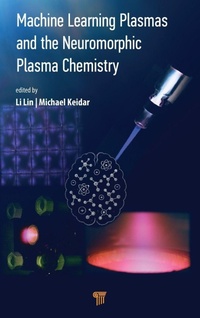
Machine Learning Plasmas and the Neuromorphic Plasma Chemistry
1st Edition
Published on 20. October 2025
Book
Hardback
172 pages
978-981-5129-84-7 (ISBN)
Description
Plasma chemistry, a foundational science driving advancements in the engineering of
biomedicine, space propulsion, and semiconductor manufacturing, is currently increasingly
relying on AI to diagnose and control chemical compositions and reaction rates in plasmas.
This book presents a groundbreaking aspect of fundamental plasma chemistry that integrates
modern ML and neuromorphic systems and is the first book to introduce such a unique theory.
It explores these topics in depth and introduces the revolutionary concept of chemical systems
that can function as molecule-based programmable intelligent materials, proposing a new
form of AI that operates without digital computers but by using chemical pathway networks.
biomedicine, space propulsion, and semiconductor manufacturing, is currently increasingly
relying on AI to diagnose and control chemical compositions and reaction rates in plasmas.
This book presents a groundbreaking aspect of fundamental plasma chemistry that integrates
modern ML and neuromorphic systems and is the first book to introduce such a unique theory.
It explores these topics in depth and introduces the revolutionary concept of chemical systems
that can function as molecule-based programmable intelligent materials, proposing a new
form of AI that operates without digital computers but by using chemical pathway networks.
More details
Language
English
Place of publication
Singapore
Target group
College/higher education
Professional and scholarly
Academic and Postgraduate
Illustrations
11 s/w Abbildungen, 24 farbige Abbildungen, 11 s/w Zeichnungen, 24 farbige Zeichnungen, 6 s/w Tabellen
6 Tables, black and white; 24 Line drawings, color; 11 Line drawings, black and white; 24 Illustrations, color; 11 Illustrations, black and white
Dimensions
Height: 235 mm
Width: 157 mm
Thickness: 15 mm
Weight
426 gr
ISBN-13
978-981-5129-84-7 (9789815129847)
Copyright in bibliographic data and cover images is held by Nielsen Book Services Limited or by the publishers or by their respective licensors: all rights reserved.
Schweitzer Classification
Other editions
Additional editions
Michael Keidar | Li Lin
Machine Learning Plasmas and the Neuromorphic Plasma Chemistry
E-Book
10/2025
Taylor & Francis
€153.99
Available for download
Michael Keidar | Li Lin
Machine Learning Plasmas and the Neuromorphic Plasma Chemistry
E-Book
10/2025
Taylor & Francis
€153.99
Available for download
Persons
Li Lin is a research scientist at the School of Engineering and Applied Science,
George Washington University, USA. He specializes in low-temperature plasma
physics, and his research focuses on chemical pathways and adaptive plasma
control applied to biomedical and environmental sciences. His work also
bridges machine learning, neuromorphic concepts, numerical simulations, and
plasma diagnostics. Dr Lin is an honorary member of the National Academy
of Inventors (NAI) and serves on the editorial boards of various reputed journals, including
Scientific Reports and Frontiers in Physics. He has also been awarded for his contributions to IOP
journals.
Michael Keidar is an A. James Clark Professor of Engineering at the School
of Engineering and Applied Science, George Washington University,
USA. His expertise spans advanced spacecraft propulsion, plasma-based
nanotechnology, and plasma medicine. Dr Keidar has authored over 250 journal
articles and a textbook on plasma engineering. He was named the AIAA National
Capital Section Engineer of 2016 and is a recipient of the 2017 Davidson Award
in plasma physics. He is a fellow of the APS, AIAA, and the National Academy of Inventors and
serves as an editor in leading academic journals.
George Washington University, USA. He specializes in low-temperature plasma
physics, and his research focuses on chemical pathways and adaptive plasma
control applied to biomedical and environmental sciences. His work also
bridges machine learning, neuromorphic concepts, numerical simulations, and
plasma diagnostics. Dr Lin is an honorary member of the National Academy
of Inventors (NAI) and serves on the editorial boards of various reputed journals, including
Scientific Reports and Frontiers in Physics. He has also been awarded for his contributions to IOP
journals.
Michael Keidar is an A. James Clark Professor of Engineering at the School
of Engineering and Applied Science, George Washington University,
USA. His expertise spans advanced spacecraft propulsion, plasma-based
nanotechnology, and plasma medicine. Dr Keidar has authored over 250 journal
articles and a textbook on plasma engineering. He was named the AIAA National
Capital Section Engineer of 2016 and is a recipient of the 2017 Davidson Award
in plasma physics. He is a fellow of the APS, AIAA, and the National Academy of Inventors and
serves as an editor in leading academic journals.
Content
1. Modern Plasma Engineering and Applications. 2. Plasma Diagnostics and Controls Using Machine Learning. 3. Collisions in Plasmas. 4. The Intelligent Plasma. Appendices.