

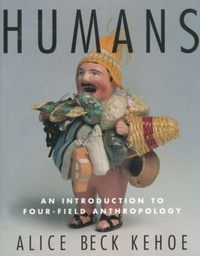
Humans
An Introduction to Four-Field Anthropology
1st Edition
Published on 20. May 1998
Book
Paperback/Softback
258 pages
978-0-415-91985-2 (ISBN)
Description
First Published in 1998. Routledge is an imprint of Taylor & Francis, an informa company.
More details
Language
English
Place of publication
London
United Kingdom
Publishing group
Taylor & Francis Ltd
Target group
College/higher education
Dimensions
Height: 229 mm
Width: 178 mm
Weight
480 gr
ISBN-13
978-0-415-91985-2 (9780415919852)
Copyright in bibliographic data and cover images is held by Nielsen Book Services Limited or by the publishers or by their respective licensors: all rights reserved.
Schweitzer Classification
Other editions
New editions

Book
12/2022
2nd Edition
Routledge
€57.40
Shipment within 10-20 days
Additional editions

Book
05/1998
1st Edition
Routledge
€78.17
Article exhausted; check for reprint
Person
Alice Beck Kehoe is Professor of Anthropology at Marquette University. She is the author of The Land of Prehistory:A Critical History of American Archaeology (Routledge, 1998), The Ghost Dance: Ethnohistory and Revitalization (1989) and North American Indians: A ComprehensiveAccount (1992).
Content
1. Anthropology -- A General Introduction
(lays out four fields and defines "humans" and "culture")
2. Basic Principles
(cultural relativism; popular culture may provide "false knowledge" countered by anthropological research)
3. Humans as Biological Species
(characteristics of organisms; of mammals; principles of evolutionary biology)
4. The Primates
(survey of evolution and diversity of primates)
5. Development of the Genus Homo
(hominid evolution)
6. Variation in Homo Sapiens
("race," human geographical populations, genetic drift)
7. Prehistory
Part I: The Paleolithi
Part II: The Neolithic and Urbanization
(survey of human prehistory and methods of discovering it)
8. Communicating -- Anthropological Linguistics
(basic linguistics, Sapir-Whorf and George Lakoff; Linton's distinction of form/function/use/meaning)
9. Analyzing Societies: (I) Cultural Ecology
(holistic perspectives; includes concept of habitus as praxis of society and environment)
10. Analyzing Societies: (II) Economies
(emphasizes informal economy, value creation)
11. Analyzing Societies: (III) Regulation Societies
Part I: Social Organization and Power
Part II: Kinship Structures
(presents law, politics, religion and kinship as multiple interlocking means of regulating behavior within societies; emphasis is on dynamics rather than stati "structures")
12. Analyzing Societies: (IV) Religion (religion as social charter; revitalization as process of culture change)
13. Conclusion: Looking Us Over
(lays out four fields and defines "humans" and "culture")
2. Basic Principles
(cultural relativism; popular culture may provide "false knowledge" countered by anthropological research)
3. Humans as Biological Species
(characteristics of organisms; of mammals; principles of evolutionary biology)
4. The Primates
(survey of evolution and diversity of primates)
5. Development of the Genus Homo
(hominid evolution)
6. Variation in Homo Sapiens
("race," human geographical populations, genetic drift)
7. Prehistory
Part I: The Paleolithi
Part II: The Neolithic and Urbanization
(survey of human prehistory and methods of discovering it)
8. Communicating -- Anthropological Linguistics
(basic linguistics, Sapir-Whorf and George Lakoff; Linton's distinction of form/function/use/meaning)
9. Analyzing Societies: (I) Cultural Ecology
(holistic perspectives; includes concept of habitus as praxis of society and environment)
10. Analyzing Societies: (II) Economies
(emphasizes informal economy, value creation)
11. Analyzing Societies: (III) Regulation Societies
Part I: Social Organization and Power
Part II: Kinship Structures
(presents law, politics, religion and kinship as multiple interlocking means of regulating behavior within societies; emphasis is on dynamics rather than stati "structures")
12. Analyzing Societies: (IV) Religion (religion as social charter; revitalization as process of culture change)
13. Conclusion: Looking Us Over