

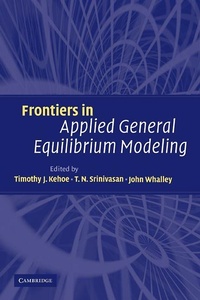
Frontiers in Applied General Equilibrium Modeling
In Honor of Herbert Scarf
Published on 24. June 2010
Book
Paperback/Softback
450 pages
978-0-521-15373-7 (ISBN)
Description
This 2005 volume brings together twelve papers by many of the most prominent applied general equilibrium modelers honoring Herbert Scarf, the father of equilibrium computation in economics. It deals with developments in applied general equilibrium, a field which has broadened greatly since the 1980s. The contributors discuss some traditional as well as some modern topics in the field, including non-convexities in economy-wide models, tax policy, developmental modeling and energy modeling. The book also covers a range of distinct approaches, conceptual issues and computational algorithms, such as calibration and areas of application such as macroeconomics of real business cycles and finance. An introductory chapter written by the editors maps out issues and scenarios for the future evolution of applied general equilibrium.
Reviews / Votes
Review of the hardback: 'The list of contributors to this book is impressive (including the two Nobel prize winners Arrow and Heckman) and the range of topics is broad ... The title of the book covers its content very well: the book is clearly aimed at readers interested in the frontiers of applied research in the field of general equilibrium models.' De EconomistMore details
Language
English
Place of publication
Cambridge
United Kingdom
Target group
Professional and scholarly
Product notice
Paperback (trade)
Illustrations
Worked examples or Exercises
Dimensions
Height: 229 mm
Width: 152 mm
Thickness: 26 mm
Weight
726 gr
ISBN-13
978-0-521-15373-7 (9780521153737)
Copyright in bibliographic data and cover images is held by Nielsen Book Services Limited or by the publishers or by their respective licensors: all rights reserved.
Schweitzer Classification
Other editions
Additional editions
Timothy J. Kehoe | T. N. Srinivasan | John Whalley
Frontiers in Applied General Equilibrium Modeling
In Honor of Herbert Scarf
E-Book
07/2005
1st Edition
Cambridge University Press
€42.99
Available for download
Persons
Content
List of contributors; Acknowledgements; Introduction Timothy J. Kehoe, T. N. Srinivasan and John Whalley; Part I. General Equilibrium Theory: 1. Personal reflections on applied general equilibrium models Kenneth J. Arrow; 2. Uniqueness of equilibrium in the multi-country Ricardo model Herbert Scarf and Charles A. Wilson; Part II. Computational Methods: 3. Solving dynamic stochastic competitive general equilibrium models Kenneth L. Judd; 4. Mathematical programs with equilibrium constraints: automatic reformulation and solution via constrained optimization Michael C. Ferris, Steven P. Dirske and Alexander Meeraus; Part III. Macroeconomics and Finance: 5. Nonconvexities in quantitative general equilibrium studies of business cycles Edward C. Prescott; 6. Lotteries for consumers versus lotteries for firms Lard Ljungqvist and Thomas J. Sargent; 7. Default and aggregate fluctuations in storage economies Makoto Nakajima and Jose Victor Rios-Rull; 8. New applications of general equilibrium to finance: default and collateral Aloisio Araujo and Mario Pascoa; Part IV. Public Finance, Development and Climate Change: 9. Efficient taxation of income Dale W. Jorgenson and Kun-Young Yun; 10. Representative versus real households in the macroeconomic modeling of inequality Francois Bourguignon, Anne-Sophie Robilliard and Sherman Robinson; 11. General equilibrium modeling for global climate change Alan S. Manne; Part V. General Equilibrium Restrictions and Estimation of Hedonic Models: 12. Simulation and estimation of hedonic models James Heckman, Rosa Matzkin and Lars Nesheim; Part VI. Policy Uses and Performance of AGE Models: 13. An evaluation of the performance of applied general equilibrium models of the impact of NAFTA Timothy J. Kehoe; 14. Decompositional analysis using numerical equilibrium models: illustrations from trade literature Lisandro Abrego and John Whalley; 15. The influence of computable general equilibrium models on policy Shantayanan Devarajan and Sherman Robinson; Index.