

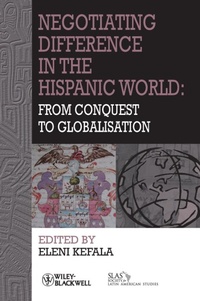
Negotiating Difference in the Hispanic World
From Conquest to Globalisation
1st Edition
Published on 13. May 2011
Book
Paperback/Softback
212 pages
978-1-4443-3907-9 (ISBN)
Description
Negotiating Difference in the Hispanic World invites us to rethink the complex dialogical process of identity formation and self-definition in Latin America from the Conquest to the present day. Essays from an international scholarship provide an important theoretical contribution to debates on identity.
Explores the various instances of cultural encounters in Latin America from the Conquest to the present day
This volume is singularly wide in its breadth, covering sixteenth-century Aztec heraldry and Sahagun's Universal History of the Things of New Spain, to eighteenth-century notions of culture, nineteenth-century theatre, turn-of-the-century degeneration theory, and contemporary literature and culture.
The book's interdisciplinary approach combines literary and cultural studies, cultural history, art history, translation studies and cultural anthropology
A broad geographical scope covers Mexico, Colombia, Chile, Argentina, Spain, Cuba and the United States.
The book makes an important theoretical contribution to the debates on identity through its innovative approaches, maintaining a fine balance between theoretical argument and empirical study
The essays are written by specialists of different nationalities based in the United Kingdom, the United States, Norway and Argentina, providing an international cutting-edge scholarship
Explores the various instances of cultural encounters in Latin America from the Conquest to the present day
This volume is singularly wide in its breadth, covering sixteenth-century Aztec heraldry and Sahagun's Universal History of the Things of New Spain, to eighteenth-century notions of culture, nineteenth-century theatre, turn-of-the-century degeneration theory, and contemporary literature and culture.
The book's interdisciplinary approach combines literary and cultural studies, cultural history, art history, translation studies and cultural anthropology
A broad geographical scope covers Mexico, Colombia, Chile, Argentina, Spain, Cuba and the United States.
The book makes an important theoretical contribution to the debates on identity through its innovative approaches, maintaining a fine balance between theoretical argument and empirical study
The essays are written by specialists of different nationalities based in the United Kingdom, the United States, Norway and Argentina, providing an international cutting-edge scholarship
More details
Series
Language
English
Place of publication
Hoboken
United Kingdom
Publishing group
John Wiley and Sons Ltd
Target group
Professional and scholarly
Product notice
Paperback (trade)
Unsewn / adhesive bound
Dimensions
Height: 226 mm
Width: 152 mm
Thickness: 10 mm
Weight
295 gr
ISBN-13
978-1-4443-3907-9 (9781444339079)
Copyright in bibliographic data and cover images is held by Nielsen Book Services Limited or by the publishers or by their respective licensors: all rights reserved.
Schweitzer Classification
Person
Eleni Kefala is a lecturer in Latin American literature and culture at the University of St Andrews. She received her Ph.D. from the University of Cambridge and subsequently held a Mellon Postdoctoral Fellowship in the Humanities at the University of Pennsylvania. She is the author of Peripheral (Post) Modernity: The Syncretist Aesthetics of Borges, Piglia, Kalokyris and Kyriakidis (2007), and of numerous articles on Latin American and comparative literature and culture.
Content
Notes on Contributors.
Introduction (Eleni Kefala).
Part I: Found in Translation
1. Translating the Nahuas: Fray Bernardino de Sahagun's Parallel Texts in the Construction of Universal History of the Things of New Spain (Victoria Rios Castano).
2. Genealogies and Analogies of 'Culture' in the History of Cultural Translation - on Boturini's Translation of Tlaloc and Vico in Idea of a New General History of Northern America (John Odemark).
3. The 'Acculturation' of the Translating Language: Gregory Rabassa and Gabriel Garcia Marquez's Chronicle of a Death Foretold (Anna Fochi).
Part II: Appropriations and the Rhetoric of Self-Definition
4. Claiming Ancestry and Lordship: Heraldic Language and Indigenous Identity in Post-Conquest Mexico (Monica Dominguez Torres).
5. The Role of Degeneration Theory in Spanish American Public Discourse at the Fin de Siecle: Raza Latina and Immigration in Chile and Argentina (Michela Coletta).
6. (Mis)appropriating Europe: the Argentine Gaze in Ricardo Piglia's Artificial Respiration (Emilse Hidalgo).
Part III: Liminality and the Politics of Identity
7. Transatlantic Crossings: Don Alvaro as a Threshold (Christina Karageorgou-Bastea).
8. Transatlantic Deficits; or, Alberto Vilar at the Royal Opera House (Roberto Ignacio Diaz).
9. A European Enclave in an Alien Continent? Enduring Fictions of European Civilisation and Indigenous Barbarism in Argentina Today (Leslie Ray).
10. McOndo, Magical Neoliberalism and Latin American Identity (Rory O'Bryen).
Index.
Introduction (Eleni Kefala).
Part I: Found in Translation
1. Translating the Nahuas: Fray Bernardino de Sahagun's Parallel Texts in the Construction of Universal History of the Things of New Spain (Victoria Rios Castano).
2. Genealogies and Analogies of 'Culture' in the History of Cultural Translation - on Boturini's Translation of Tlaloc and Vico in Idea of a New General History of Northern America (John Odemark).
3. The 'Acculturation' of the Translating Language: Gregory Rabassa and Gabriel Garcia Marquez's Chronicle of a Death Foretold (Anna Fochi).
Part II: Appropriations and the Rhetoric of Self-Definition
4. Claiming Ancestry and Lordship: Heraldic Language and Indigenous Identity in Post-Conquest Mexico (Monica Dominguez Torres).
5. The Role of Degeneration Theory in Spanish American Public Discourse at the Fin de Siecle: Raza Latina and Immigration in Chile and Argentina (Michela Coletta).
6. (Mis)appropriating Europe: the Argentine Gaze in Ricardo Piglia's Artificial Respiration (Emilse Hidalgo).
Part III: Liminality and the Politics of Identity
7. Transatlantic Crossings: Don Alvaro as a Threshold (Christina Karageorgou-Bastea).
8. Transatlantic Deficits; or, Alberto Vilar at the Royal Opera House (Roberto Ignacio Diaz).
9. A European Enclave in an Alien Continent? Enduring Fictions of European Civilisation and Indigenous Barbarism in Argentina Today (Leslie Ray).
10. McOndo, Magical Neoliberalism and Latin American Identity (Rory O'Bryen).
Index.