

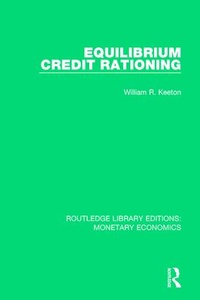
Equilibrium Credit Rationing
1st Edition
Published on 6. November 2018
Book
Paperback/Softback
305 pages
978-1-138-63365-0 (ISBN)
Description
This study, first published in 1979, examines and contrasts two concepts of credit rationing. The first concept takes the relevant price of credit to be the explicit interest rate on the loan and defines the demand for credit as the amount an individual borrower would like to receive at that rate. Under the alternative definition, the price of credit consists of the complete set of loan terms confronting a class of borrowers with given characteristics, while the demand for credit equals the total number of loan which members of the class would like to receive at those terms. This title will be of interest to students of monetary economics.
More details
Series
Language
English
Place of publication
London
United Kingdom
Publishing group
Taylor & Francis Ltd
Target group
College/higher education
Dimensions
Height: 234 mm
Width: 156 mm
Weight
453 gr
ISBN-13
978-1-138-63365-0 (9781138633650)
Copyright in bibliographic data and cover images is held by Nielsen Book Services Limited or by the publishers or by their respective licensors: all rights reserved.
Schweitzer Classification
Other editions
Additional editions
William R. Keeton
Equilibrium Credit Rationing
Book
04/2017
1st Edition
Routledge
€193.13
Shipment within 10-20 days
Person
William Keeton was born in Houston, Texas on November 22, 1947. In 1964 he graduated from Winchester High School in Winchester, Massachusetts. He attended Yale University from 1964 to 1968, receiving a B.A. in Political Science and Economics and an M.A. in Economics. From 1968 to 1970 he served as a Peace Corps Volunteer in Colombia and from 1970 to 1972 he worked at the Council of Economic Advisers.
Content
Preface; Abstract: Equilibrium Credit Rationing, William R. Keeton; Chapter 1 Competitive Markets for Nonhomogeneous Goods: An Application to the Theory of Credit Rationing; Chapter 2 An Analysis of Loan Rate Ceilings; Chapter 3 Moral Hazard and Equilibrium Credit Rationing;