

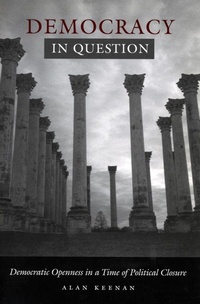
Democracy in Question
Democratic Openness in a Time of Political Closure
Published on 21. February 2003
Book
Paperback/Softback
256 pages
978-0-8047-3865-1 (ISBN)
Description
This book explores the theoretical paradoxes and practical dilemmas that flow from the still radical idea that in a democracy it is the people who rule, and argues that accepting the open and uncertain character of democratic politics can lead to more sustainable and widespread forms of democratic engagement.
The author engages theorists from a range of democratic thought-Rousseau, Arendt, Benhabib, Sandel, Laclau, and Mouffe-to show how each either ignores or downplays the difficulties that democratic principles pose. Though there can be no entirely valid solution to the paradoxes that plague democracy, the author nonetheless argues that democratic politics-particularly under contemporary conditions of social fragmentation and insecurity-urgently requires new practical and rhetorical strategies. The book concludes by addressing the American context, elaborating the need for a language of democratic engagement less ensnared in the anti-political logic of moralism and resentment that now characterizes the American political spectrum.
The author engages theorists from a range of democratic thought-Rousseau, Arendt, Benhabib, Sandel, Laclau, and Mouffe-to show how each either ignores or downplays the difficulties that democratic principles pose. Though there can be no entirely valid solution to the paradoxes that plague democracy, the author nonetheless argues that democratic politics-particularly under contemporary conditions of social fragmentation and insecurity-urgently requires new practical and rhetorical strategies. The book concludes by addressing the American context, elaborating the need for a language of democratic engagement less ensnared in the anti-political logic of moralism and resentment that now characterizes the American political spectrum.
Reviews / Votes
"The very features of democracy that make it attractive-its openness, reflexivity, and fluidity-also generates objectionable qualities. Even at its best, democracy generates serial resolutions, each of which brings into existence new closures, manifest in the new and serial 'we's' constituted by democratic procedures. In this fine book, Alan Keenan argues that democrats must understand that these objectionable features are essential to what democracy is. Examining a number of contemporary democratic theories committed to openness and inclusion, Keenan shows how often strategies for grounding democratic openness edge toward closure, and do so while failing to acknowledge the basic risks of democratic experience. What if, Keenan asks, the search for unquestionable grounds for democratic openness turns out to undermine democracy, not because of the substance of the grounds, but because of the nature of the search? Would it be possible to transform the objectionable features of democracy into a source of a democratic ethos? Keenan suggests that the risks of democracy might be affirmed as a shared fate in ways that support openness, providing an ethical complement to more traditional approaches to democratic theory and practice. Whether or not they agree with his solution, it will be hard for democratic theorists to ignore Keenan's powerful formulation of the problem." -Professor Mark E. Warren,Georgetown University "There is a paradox at the heart of the idea of democracy a product of its commitment to freedom combined with its need to found that freedom in a foundation that constrains. Democracy, devoted to freedom, is always, ineluctably implicated in sovereignty, violence and rule. This paradox is ignored or resolved by most democratic theorists, but not by Alan Keenan. In Democracy in Question, Keenan relentlessly tracks the mischief worked by democracyis fundamental paradox in the thinking of Castoriadis, Rousseau, Arendt, Laclau and Mouffe, and Sandel. Keenanis readings of all these thinkers are masterful. On Arendt, in particular, he is brilliant. This book, rigorous, penetrating and clearly written, is no less than a must-read for everyone interested in democratic theory and the politics of freedom and legitimation." -Bonnie Honig,Northwestern University & The American Bar Foundation "Democracy makes possible popular sovereignty yet seems to presuppose the very people that it makes. Keenan's rich account of this and other contradictions in theory concludes with an arresting, if somewhat paradoxical, suggestion for the improvement of democratic practice-that the key to a more robust political future is the cultivation of more modest democratic virtues, such as capacity for self-limitation in support of democracy always in question. Profoundly radical and eminently sober at the same time, this book is democratic theory at its best." -Jeffrey K. Tulis,University of Texas at AustinMore details
Edition
New edition
Language
English
Place of publication
Palo Alto
United States
Target group
College/higher education
Professional and scholarly
Edition type
New edition
Product notice
Paperback (trade)
Dimensions
Height: 228 mm
Width: 155 mm
Thickness: 14 mm
Weight
340 gr
ISBN-13
978-0-8047-3865-1 (9780804738651)
Copyright in bibliographic data and cover images is held by Nielsen Book Services Limited or by the publishers or by their respective licensors: all rights reserved.
Schweitzer Classification
Person
Alan Keenan is a Mellon Postdoctoral Fellow in Peace and Conflict Studies at Bryn Mawr College, where he teaches classes in the Political Science department. He spent most of the preceding three years in Sri Lanka conducting research on the politics of human rights and the role of local civil society organizations in peace and conflict dynamics. He received his PhD in political theory from Johns Hopkins University and has taught at various institutions across the country. He is currently working on a book manuscript tentatively entitled "Between the Devil and the Deep Blue Sea: On the Politics of Human Rights and Civil Society Building in Sri Lanka."