

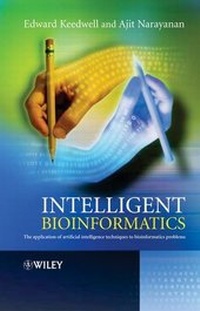
Intelligent Bioinformatics
The Application of Artificial Intelligence Techniques to Bioinformatics Problems
Will be published approx. on 22. April 2005
Book
Hardback
294 pages
978-0-470-02175-0 (ISBN)
Description
Bioinformatics is contributing to some of the most important advances in medicine and biology. At the forefront of this exciting new subject are techniques known as artificial intelligence which are inspired by the way in which nature solves the problems it faces. This book provides a unique insight into the complex problems of bioinformatics and the innovative solutions which make up 'intelligent bioinformatics'.
Intelligent Bioinformatics requires only rudimentary knowledge of biology, bioinformatics or computer science and is aimed at interested readers regardless of discipline. Three introductory chapters on biology, bioinformatics and the complexities of search and optimisation equip the reader with the necessary knowledge to proceed through the remaining eight chapters, each of which is dedicated to an intelligent technique in bioinformatics.
The book also contains many links to software and information available on the internet, in academic journals and beyond, making it an indispensable reference for the 'intelligent bioinformatician'.
Intelligent Bioinformatics will appeal to all postgraduate students and researchers in bioinformatics and genomics as well as to computer scientists interested in these disciplines, and all natural scientists with large data sets to analyse.
Reviews / Votes
"... coverage of problems and techniques are such that more advanced practitioners' might clearly find interest in parts of this book." (Genetic Programming in Evolvable Machinery, Oct 2006)More details
Product info
gebunden
Edition
1. Auflage
Language
English
Place of publication
New York
United States
Target group
Professional and scholarly
Product notice
sewn/stitched
Cloth over boards
Dimensions
Height: 235 mm
Width: 155 mm
Thickness: 21 mm
Weight
553 gr
ISBN-13
978-0-470-02175-0 (9780470021750)
Schweitzer Classification
Other editions
Additional editions
Edward Keedwell | Ajit Narayanan
Intelligent Bioinformatics
The Application of Artificial Intelligence Techniques to Bioinformatics Problems
E-Book
12/2005
Wiley
€131.99
Available for download
Persons
Edward Keedwell is an Associate Professor in Computer Science. He joined the Computer Science discipline in 2006 having previously been a Research Fellow in the Centre for Water Systems and was appointed as a lecturer in Computer Science in 2009.
Ajit Narayanan is the inventor of FreeSpeech, a picture language with a deep grammatical structure. He's also the inventor of Avaz, India's first Augmentative and Alternative Communication device for children with disabilities.
Ajit Narayanan is the inventor of FreeSpeech, a picture language with a deep grammatical structure. He's also the inventor of Avaz, India's first Augmentative and Alternative Communication device for children with disabilities.
Content
Preface.
Part 1 Introduction.
1 Introduction to the Basics of Molecular Biology.
1.1 Basic cell architecture.
1.2 The structure, content and scale of deoxyribonucleic acid (DNA).
1.3 History of the human genome.
1.4 Genes and proteins.
1.5 Current knowledge and the 'central dogma'.
1.6 Why proteins are important.
1.7 Gene and cell regulation.
1.8 When cell regulation goes wrong.
1.9 So, what is bioinformatics?
1.10 Summary of chapter.
1.11 Further reading.
2 Introduction to Problems and Challenges in Bioinformatics.
2.1 Introduction.
2.2 Genome.
2.3 Transcriptome.
2.4 Proteome.
2.5 Interference technology, viruses and the immune system.
2.6 Summary of chapter.
2.7 Further reading.
3 Introduction to Artificial Intelligence and Computer Science.
3.1 Introduction to search.
3.2 Search algorithms.
3.3 Heuristic search methods.
3.4 Optimal search strategies.
3.5 Problems with search techniques.
3.6 Complexity of search.
3.7 Use of graphs in bioinformatics.
3.8 Grammars, languages and automata.
3.9 Classes of problems.
3.10 Summary of chapter.
3.11 Further reading.
Part 2 Current Techniques.
4 Probabilistic Approaches.
4.1 Introduction to probability.
4.2 Bayes' Theorem.
4.3 Bayesian networks.
4.4 Markov networks.
4.5 References.
5 Nearest Neighbour and Clustering Approaches.
5.1 Introduction.
5.2 Nearest neighbour method.
5.3 Nearest neighbour approach for secondary structure protein folding prediction.
5.4 Clustering.
5.5 Advanced clustering techniques.
5.6 Application guidelines.
5.7 Summary of chapter.
5.8 References.
6 Identification (Decision) Trees.
6.1 Method.
6.2 Gain criterion.
6.3 Over fitting and pruning.
6.4 Application guidelines.
6.5 Bioinformatics applications.
6.6 Background.
6.7 Summary of chapter.
6.8 References.
7 Neural Networks.
7.1 Method.
7.2 Application guidelines.
7.3 Bioinformatics applications.
7.4 Background.
7.5 Summary of chapter.
7.6 References.
8 Genetic Algorithms.
8.1 Single-objective genetic algorithms - method.
8.2 Single-objective genetic algorithms - example.
8.3 Multi-objective genetic algorithms - method.
8.4 Application guidelines.
8.5 Genetic algorithms - bioinformatics applications.
8.6 Summary of chapter.
8.7 References and Further Reading.
Part 3 Future Techniques.
9 Genetic Programming.
9.1 Method.
9.2 Application guidelines.
9.3 Bioinformatics applications.
9.4 Background.
9.5 Summary of chapter.
9.6 References.
10 Cellular Automata.
10.1 Method.
10.2 Application guidelines.
10.3 Bioinformatics applications.
10.4 Background.
10.5 Summary of chapter.
10.6 References and Further Reading.
11 Hybrid Methods.
11.1 Method.
11.2 Neural-genetic algorithm for analyzing gene expression data.
11.3 Genetic algorithm and k nearest neighbour hybrid for biochemistry solvation.
11.4 Genetic programming neural networks for determining gene-gene interactions in epidemiology.
11.5 Application guidelines.
11.6 Conclusions.
11.7 Summary of chapter.
References and Further Reading.
Index.