

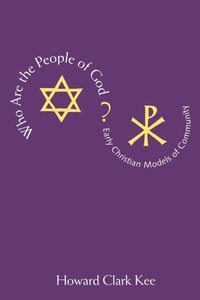
Who Are the People of God?
Early Christian Models of Community
Will be published approx. on 3. March 1997
Book
Paperback/Softback
288 pages
978-0-300-07063-7 (ISBN)
Description
In this provocative book, an eminent scholar examines the complex factors that shaped Judaism and early Christianity, analyzing cardinal Judaic and Christian texts and the cultural worlds in which they were written. Howard Clark Kee's sociocultural approach emphasizes the diversity of viewpoint and belief present in Judaism and in early Christianity, as well as the many ways in which the two religions reacted to each other and to the changing circumstances of the first two centuries of the Common Era.
According to Kee's interpretation of Jewish documents of the period, Jews began to adopt various models of community to bring into focus their group identity, to show their special relation to God, and to articulate their responsibilities within the community and toward the wider culture. The models they adopted-the community of the wise, the law-abiding community, the community of mystical participation, the city or temple model, and the ethnically and culturally inclusive community-were the means by which they responded to the challenges and opportunities for reinstating themselves as God's people. These models in turn influenced early Christian behavior and writing, becoming means for Christians to define their type of community, to understand the role of Jesus as God's agent in establishing the community, and to outline what their moral life and group structure, as well as their relations with the wider Jewish and Greco-Roman culture, ought to be.
According to Kee's interpretation of Jewish documents of the period, Jews began to adopt various models of community to bring into focus their group identity, to show their special relation to God, and to articulate their responsibilities within the community and toward the wider culture. The models they adopted-the community of the wise, the law-abiding community, the community of mystical participation, the city or temple model, and the ethnically and culturally inclusive community-were the means by which they responded to the challenges and opportunities for reinstating themselves as God's people. These models in turn influenced early Christian behavior and writing, becoming means for Christians to define their type of community, to understand the role of Jesus as God's agent in establishing the community, and to outline what their moral life and group structure, as well as their relations with the wider Jewish and Greco-Roman culture, ought to be.
More details
Language
English
Place of publication
United States
Target group
College/higher education
Professional and scholarly
Product notice
Paperback (trade)
Dimensions
Height: 234 mm
Width: 156 mm
Thickness: 15 mm
Weight
408 gr
ISBN-13
978-0-300-07063-7 (9780300070637)
Copyright in bibliographic data and cover images is held by Nielsen Book Services Limited or by the publishers or by their respective licensors: all rights reserved.
Schweitzer Classification
Content
Introduction - ancient history and contemporary historiography; models of community in the literature of postexilic Judaism; the community of the wise; the law-abiding community; the community where God dwells among his people; the community of mystical participation; the ethnically and culturally inclusive community; the community models in the post-New Testament period; critical note - priority in the gospel tradition.