

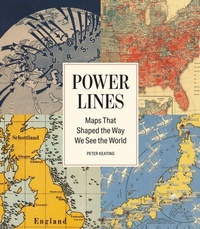
Power Lines
Maps That Shaped the Way We See the World
Published on 21. May 2026
Book
Hardback
296 pages
978-1-57965-877-9 (ISBN)
Description
A collection of the greatest political maps in history and how these images have an unmatched power to influence our thinking-and our world.
In a world where Google Maps has largely taken over utilitarian functions like finding destinations and providing directions, printed maps still stir our imaginations. In this book, award-winning journalist Peter Keating assembles nearly 100 of the most impactful examples in history, across continents and centuries. There is the map featuring the Treaty of Tordesillas meridian, which Pope Alexander VI used to divide the whole of the western hemisphere between Spanish and Portuguese explorers in 1494. Maps from the Cold War, showing Communist threats closing in on the US from all sides. And even a map outlining the territories under gang control in Chicago in the midst of Prohibition. Accompanying each of these incredible pieces of art-cum-propaganda, Keating reveals the compelling stories of how they came to be, what they were up to, and why they still matter today.
This richly illustrated and deeply informative book will demonstrate the power maps have to shape how we see the world-and will be the perfect gift for politicos, history buffs, and map lovers alike.
In a world where Google Maps has largely taken over utilitarian functions like finding destinations and providing directions, printed maps still stir our imaginations. In this book, award-winning journalist Peter Keating assembles nearly 100 of the most impactful examples in history, across continents and centuries. There is the map featuring the Treaty of Tordesillas meridian, which Pope Alexander VI used to divide the whole of the western hemisphere between Spanish and Portuguese explorers in 1494. Maps from the Cold War, showing Communist threats closing in on the US from all sides. And even a map outlining the territories under gang control in Chicago in the midst of Prohibition. Accompanying each of these incredible pieces of art-cum-propaganda, Keating reveals the compelling stories of how they came to be, what they were up to, and why they still matter today.
This richly illustrated and deeply informative book will demonstrate the power maps have to shape how we see the world-and will be the perfect gift for politicos, history buffs, and map lovers alike.
More details
Language
English
Place of publication
United States
Publishing group
Workman Publishing
Product notice
Trade binding
Illustrations
100
Dimensions
Height: 235 mm
Width: 203 mm
Thickness: 16 mm
Weight
1132 gr
ISBN-13
978-1-57965-877-9 (9781579658779)
Copyright in bibliographic data and cover images is held by Nielsen Book Services Limited or by the publishers or by their respective licensors: all rights reserved.
Schweitzer Classification
Person
Peter Keating is a narrative journalist whose wide-ranging stories about politics, history and finance have been featured in publications such as GQ, Mother Jones, National Geographic and Politico. He has written four national columns, including "Numbers" for ESPN, where he was part of teams that won three National Magazine Awards. He was a founding member of ESPN's Investigative Unit, where his longform projects included pieces that exposed for the first time how the NFL dealt with brain injuries. Keating has co-hosted the Underdogs podcast since 2022, and is the author of Dingers! A Short History of the Long Ball, a biography of the home run. He lives in Montclair, New Jersey, with his wife, Karen, their daughters, Ellie and Samantha, and their dog, Otis. Follow him on Twitter at @PeterKeatingNJ.
Content
Introduction
Part I: Dominion
Part II: Exploration & National Definition
Part III: Partitions
Part IV: Social & Ideological Movements
Part V: Persuasion & War
Part VI: New Directions
Afterword
Further Reading
Art Credits
Acknowledgements
Index
Part I: Dominion
Part II: Exploration & National Definition
Part III: Partitions
Part IV: Social & Ideological Movements
Part V: Persuasion & War
Part VI: New Directions
Afterword
Further Reading
Art Credits
Acknowledgements
Index