

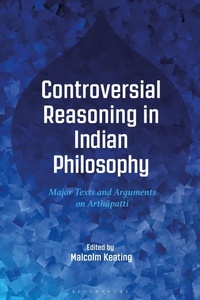
Controversial Reasoning in Indian Philosophy
Major Texts and Arguments on Arthapatti
Published on 23. March 2023
Book
Paperback/Softback
400 pages
978-1-350-41196-8 (ISBN)
Description
Arthapatti is a pervasive form of reasoning investigated by Indian philosophers in order to think about unseen causes and interpret ordinary and religious language. Its nature is a point of controversy among Mimamsa, Nyaya, and Buddhist philosophers, yet, to date, it has received less attention than perception, inference, and testimony.
This collection presents a one-of-a-kind reference resource for understanding this form of reasoning studied in Indian philosophy. Assembling translations of central primary texts together with newly-commissioned essays on research topics, it features a significant introductory essay. Readable translations of Sanskrit works are accompanied by critical notes that introduce arthapatti, offer historical context, and clarify the philosophical debates surrounding it.
Showing how arthapatti is used as a way to reason about the basic unseen causes driving language use, cause-and-effect relationships, as well as to interpret ambiguous or figurative texts, this book demonstrates the importance of this epistemic instrument in both contemporary Anglo-analytic and classical Indian epistemology, language, and logic.
This collection presents a one-of-a-kind reference resource for understanding this form of reasoning studied in Indian philosophy. Assembling translations of central primary texts together with newly-commissioned essays on research topics, it features a significant introductory essay. Readable translations of Sanskrit works are accompanied by critical notes that introduce arthapatti, offer historical context, and clarify the philosophical debates surrounding it.
Showing how arthapatti is used as a way to reason about the basic unseen causes driving language use, cause-and-effect relationships, as well as to interpret ambiguous or figurative texts, this book demonstrates the importance of this epistemic instrument in both contemporary Anglo-analytic and classical Indian epistemology, language, and logic.
Reviews / Votes
This book provides an incredible set of resources for anyone who wants to think with Indian philosophers about the kinds of reasoning practices that yield knowledge. But it also provides an accessible introduction, for those who are just beginning to explore these rich Indian debates. I recommend this book strongly! * Bryce Huebner, Provost's Distinguished Associate Professor, Department of Philosophy, Georgetown University, USA * This fine volume on the neglected topic of the epistemological status of arthapatti, a contested form of ampliative reasoning in Indian philosophy, brings together both Sanskrit primary sources in new translations and original philosophical essays. It is a first-rate contribution to the philosophical history of Indian philosophy. * Roy W. Perrett, Visiting Professor of Philosophy, Ashoka University, India * This volume is a most welcome addition to the contemporary scholarship of Classical Indian epistemology. The source materials and the philosophical papers collected here bring into focus distinctive debates about arthapatti (postulation or presumption) and why they should matter to anyone interested in theory of knowledge and philosophy of language. * Monima Chadha, Senior Lecturer of Philosophy, Monash University, Australia *More details
Language
English
Place of publication
London
United Kingdom
Publishing group
Bloomsbury Publishing PLC
Target group
College/higher education
Dimensions
Height: 234 mm
Width: 156 mm
Thickness: 19 mm
Weight
547 gr
ISBN-13
978-1-350-41196-8 (9781350411968)
Copyright in bibliographic data and cover images is held by Nielsen Book Services Limited or by the publishers or by their respective licensors: all rights reserved.
Schweitzer Classification
Person
Malcolm Keating is Associate Professor of Philosophy at Yale-NUS College, Singapore.
Content
List of Figures
List of Tables
List of Contributors
Preface
Acknowledgments
A Note on Transliteration Conventions and Pronunciation
List of Abbreviations
Introduction
1. Kumarila Bhatta's Explanation in Verse. Andrew Ollett and Elisa Freschi
2. Prabhakara's Long Explanation. Andrew Ollett and Elisa Freschi
3. Salikanatha's Straightforward and Lucid Gloss; Comprehensive Survey of the Epistemic Instruments. Andrew Ollett and Elisa Freschi
4. Narayana Bhatta's Elucidation of Epistemic Instruments and Their Objects. Malcolm Keating
5. Aksapada Gautama's Nyaya-sutra with early commentaries. Malcolm Keating
6. Udayana Acarya's The Flower-Offering of Reason. Nilanjan Das
7. Jayanta Bhatta's Flowers of Reasoning. Alessandro Graheli
8. Gangesa Upadhyaya's Jewel of Reflection on the Truth. Stephen Phillips
9. The Physical Existence of a Living Being and Kumarila's Theory of Arthapatti. Kiyotaka Yoshimizu
10. Raghunatha on Arthapatti. Nilanjan Das
11. Against Reducing Arthapatti. Mark Siderits
12. Arthapatti: An Anglo-Indo-Analytic Attempt at Cross-Cultural Conceptual Engineering. Anand Vaidya
Table of Important Figures, Dates, and Works
English-Sanskrit Glossary
Sanskrit-English Glossary
Index
List of Tables
List of Contributors
Preface
Acknowledgments
A Note on Transliteration Conventions and Pronunciation
List of Abbreviations
Introduction
1. Kumarila Bhatta's Explanation in Verse. Andrew Ollett and Elisa Freschi
2. Prabhakara's Long Explanation. Andrew Ollett and Elisa Freschi
3. Salikanatha's Straightforward and Lucid Gloss; Comprehensive Survey of the Epistemic Instruments. Andrew Ollett and Elisa Freschi
4. Narayana Bhatta's Elucidation of Epistemic Instruments and Their Objects. Malcolm Keating
5. Aksapada Gautama's Nyaya-sutra with early commentaries. Malcolm Keating
6. Udayana Acarya's The Flower-Offering of Reason. Nilanjan Das
7. Jayanta Bhatta's Flowers of Reasoning. Alessandro Graheli
8. Gangesa Upadhyaya's Jewel of Reflection on the Truth. Stephen Phillips
9. The Physical Existence of a Living Being and Kumarila's Theory of Arthapatti. Kiyotaka Yoshimizu
10. Raghunatha on Arthapatti. Nilanjan Das
11. Against Reducing Arthapatti. Mark Siderits
12. Arthapatti: An Anglo-Indo-Analytic Attempt at Cross-Cultural Conceptual Engineering. Anand Vaidya
Table of Important Figures, Dates, and Works
English-Sanskrit Glossary
Sanskrit-English Glossary
Index