

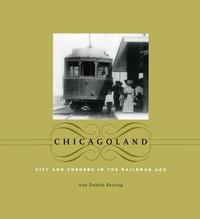
Chicagoland
City and Suburbs in the Railroad Age
Published on 1. November 2005
Book
Hardback
296 pages
978-0-226-42879-6 (ISBN)
Description
Formed by images of crowded city streets and towering skyscrapers, our understanding of nineteenth-century Chicago completely neglects the fact that the city itself was only the center of a web of neighborhoods, farm communities, and industrial towns - many connected to the city by the railroad. Farmers used trains to transport produce into the city daily; businessmen rode the rails home to their commuter suburbs; and families took vacations mere miles outside of the Loop. Historian and coeditor of the acclaimed "Encyclopedia of Chicago", Ann Durkin Keating resurrects for us here the bustling network that defined greater Chicagoland. Taking an entirely new approach to the history of the city, Keating shifts the focus away from the city to the landscapes and built environments of the entire metropolitan region. Organized by four categories of settlements - farm centers, industrial towns, commuter suburbs, and recreational and institutional centers - that framed the city, "Chicagoland" offers the collective histories of 230 neighborhoods and communities, the people who built them, and the structures they left behind that still stand today.
Keating reanimates nineteenth-century Chicagoland with more than a hundred photographs and maps; we find here the taverns, depots, and way stations that were the hubs of the region's vibrant, mobile life. Keating also includes an appendix of driving tours so readers can see this history for themselves. "Chicagoland" takes us into the buildings and sites that are still part of our landscape and repopulates them with the stories and characters behind their creation. The result is a wide-angle historical view of Chicago, an entirely new way to understand the region.
Keating reanimates nineteenth-century Chicagoland with more than a hundred photographs and maps; we find here the taverns, depots, and way stations that were the hubs of the region's vibrant, mobile life. Keating also includes an appendix of driving tours so readers can see this history for themselves. "Chicagoland" takes us into the buildings and sites that are still part of our landscape and repopulates them with the stories and characters behind their creation. The result is a wide-angle historical view of Chicago, an entirely new way to understand the region.
Reviews / Votes
"In our ideal reference world there would be an encyclopedia like this one for every great American city. This is a superb ready-reference work on Chicago, a good starting point for students doing research, and a wonderful book to browse through." - Booklist"More details
Series
Language
English
Place of publication
Chicago
United States
Publishing group
The University of Chicago Press
Target group
Professional and scholarly
Illustrations
23 maps, 132halftones
Dimensions
Height: 240 mm
Width: 220 mm
Weight
778 gr
ISBN-13
978-0-226-42879-6 (9780226428796)
Copyright in bibliographic data and cover images is held by Nielsen Book Services Limited or by the publishers or by their respective licensors: all rights reserved.
Schweitzer Classification
Person
Ann Durkin Keating is professor of history at North Central College in Naperville, Illinois. She is coeditor of The Encyclopedia of Chicago and author of Building Chicago: Suburban Developers and the Creation of a Divided Metropolis and Invisible Networks: Exploring the History of Local Utilities and Public Works.