

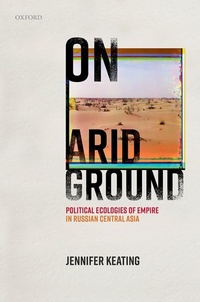
On Arid Ground
Political Ecologies of Empire in Russian Central Asia
Published on 14. April 2022
Book
Hardback
268 pages
978-0-19-285525-1 (ISBN)
Description
On Arid Ground focuses on the relationships between empire and environment in Central Asia, using environmental history to examine the practice of Russian imperialism in Turkestan at the end of empire, from the 1860s until 1916. It reveals for the first time a comprehensive assessment of the environmental imprint of Russian colonisation, and shows how local ecologies fitted into broader repertoires of imperial rule, accommodation, and resistance. Ranging widely above and below the surface in Turkestan, from the deserts of Transcaspia to the highlands and lowlands of rural Fergana and Semirech'e, Jennifer Keating explores infrastructure development, migrant settlement, land reclamation and dispossession, the commodification of nature, and environmental violence to reveal the ways in which ecological change was central to the building and breaking of empire. Attentive to connections, synchronicities and scale, On Arid Ground makes the case for looking beyond cotton and water in Central Asian context, for the powerful material role played by animals and plants, sand, silt, and salt in human histories, and for the less visible relationships between far-flung people and things within and beyond Turkestan's borders. Laying bare the political roots and repercussions of environmental change, the volume brings fresh perspectives both to the history of Central Asia and to that of the wider Russian empire across Eurasia.
Reviews / Votes
Jennifer Keating's On Arid Ground s a path-breaking study of the way empire and environment interacted in Central Asia through the 19th and early 20th centuries. This book innovates on a number of fronts, not least by showing the importance of ecology and environment in forcing the Russian Empire to adapt its long-term geopolitical strategy. It significantly changes the way we think of Russian Empire-building and outlines a fascinating picture of land reclamation, settlement and commodity development, while often putting to the fore actors beyond the human, from sandstorms to termites. Inspiring and important, it will be influential for historians working on other imperial contexts, and above all for our thinking about environment and human social and political organisation today. * 2023 Gladstone Book Prize Judges' Citation * In this excellent work, Jennifer Keating shows that paying close attention to seemingly little things like sand, saxaul, termites, and apples, in addition to more traditional big topics like cotton and irrigation, is crucial to our understanding of the Russian Empire in Turkestan...Keating's book draws heavily on archives in St. Petersburg, Moscow, and Almaty. It also engages deeply with the historiography of Russian Central Asia and places it in the context of new global histories of empire and the environment. This makes it a welcome addition to several fields, and of interest to historians not only of Russia or Central Asia but also of imperialism and the environment. * John B. Seitz, Russian Review * Excellent book * Sarah Cameron, Slavonic and East European Review *More details
Series
Language
English
Place of publication
Oxford
United Kingdom
Target group
College/higher education
Illustrations
20 black and white figures/illustrations
Dimensions
Height: 240 mm
Width: 164 mm
Thickness: 23 mm
Weight
612 gr
ISBN-13
978-0-19-285525-1 (9780192855251)
Copyright in bibliographic data and cover images is held by Nielsen Book Services Limited or by the publishers or by their respective licensors: all rights reserved.
Schweitzer Classification
Other editions
Additional editions
E-Book
04/2022
1st Edition
OUP eBook
€62.99
Available for download
E-Book
03/2022
1st Edition
OUP eBook
€62.99
Available for download
Person
Following a PhD at the School of Slavonic & East European Studies (University College London), Jennifer Keating was awarded a two-year Past & Present Postdoctoral Fellowship at the Institute of Historical Research, London, and then a one-year teaching post in Russian and Soviet History at the University of Cambridge. She then took up a permanent lectureship in History at University College Dublin. Prior to taking up the post in Dublin, she taught at University College London, the University of Cambridge, and the London School of Economics.
Content
Introduction: Towards a political ecology of aridity 1: The magical iron band 2: (Re)claiming shade, roots, water 3: Rural settlement and the question of surplus 4: Ecological afterlives and natural tribute 5: Revisiting the commodity frontier 6: Ecologies of war and revolt Conclusion: Central Asian environments in the age of empire