

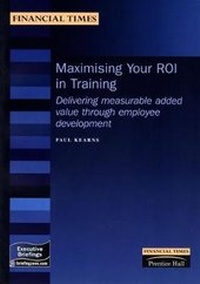
Maximising your ROI in Training
Measure the Value Added by Employee Development
Published on 6. October 2000
Book
Paperback/Softback
160 pages
978-0-273-65262-5 (ISBN)
Description
All too often HR and training has been exempt from performance measurement, yet in today's climate of accountability, HR departments are now coming under increasing pressure to deliver value. They are seen to be value-sapping without making a discernible impact on profitability. What is needed is an effective evaluation methodology to calculate and improve their return on investment.
Written for busy executives who need to grasp every opportunity to add value to their business, this briefing proves that employee performance can be effectively measured and describes the measures you need to take to maximise its contribution to the bottom line. Through this clear and concise briefing, leading HR evaluation authority Paul Kearns shows you how focused training and development could be the best business investment you ever make.
Contents include:
What is added value?
Getting a good return on your people investment
Identifying the value adders
Setting added value objectives
Using evaluation to maximise the ROI on training and development
A more advanced approach to developing people for maximum value
Plus a practical toolkit for building evaluation into your training and development programmes
Written for busy executives who need to grasp every opportunity to add value to their business, this briefing proves that employee performance can be effectively measured and describes the measures you need to take to maximise its contribution to the bottom line. Through this clear and concise briefing, leading HR evaluation authority Paul Kearns shows you how focused training and development could be the best business investment you ever make.
Contents include:
What is added value?
Getting a good return on your people investment
Identifying the value adders
Setting added value objectives
Using evaluation to maximise the ROI on training and development
A more advanced approach to developing people for maximum value
Plus a practical toolkit for building evaluation into your training and development programmes
More details
Series
Language
English
Place of publication
Harlow
United Kingdom
Publishing group
Pearson Education Limited
Target group
Professional and scholarly
Dimensions
Height: 297 mm
Width: 211 mm
Thickness: 14 mm
Weight
700 gr
ISBN-13
978-0-273-65262-5 (9780273652625)
Copyright in bibliographic data and cover images is held by Nielsen Book Services Limited or by the publishers or by their respective licensors: all rights reserved.
Schweitzer Classification
Person
Paul Kearns is widely recognised as a leading authority in the field of employee performance measurement and evaluation. With over 20 years' experience as a business-focused, human resource management professional he has developed a unique capability which makes direct connections between people and business performance. He founded the Personnel Works Partnership in 1990, specialising in improving individual and organisational performance through business-linked HR strategies. He has a reputation for being able to write about complex subjects in a clear and concise way. This book combines and updates two earlier volumes which were best sellers in the Financial Times Management HR briefing series (Measuring HR and the Impact on the Bottom Line, 1995 and Measuring the Impact of Training and Development on the Bottom Line, 1996). His most recent title in this series was Measuring and Managing Employee Performance which was featured as their book of the month when published earlier in 2000.
His ground-breaking measurement and evaluation methodology has provided a foundation for the establishment of three corporate universities in the UK and Europe and is also extensively used in many major blue-chip companies and public sector organisations. He is a key contributor to the TD2000 Campaign run by Training Magazine in conjunction with the Industrial Society and is a judge for the TD2000 Award for the Top UK Training Function. He has also helped many organisations achieve Investor in People status by helping them to evaluate their training effort.
Paul is a regular conference speaker on the subjects of HR strategy, measurement and evaluation. As a thought-provoking, outspoken critic of the modern management addiction to fads and fashions Paul prefers pragmatic solutions to complex business problems. He firmly believes that all business issues can be addressed in a simple, 'down-to-earth' way but he has found this common-sense approach to be so rare that he now refers to it as 'leading-edge common sense'.
His ground-breaking measurement and evaluation methodology has provided a foundation for the establishment of three corporate universities in the UK and Europe and is also extensively used in many major blue-chip companies and public sector organisations. He is a key contributor to the TD2000 Campaign run by Training Magazine in conjunction with the Industrial Society and is a judge for the TD2000 Award for the Top UK Training Function. He has also helped many organisations achieve Investor in People status by helping them to evaluate their training effort.
Paul is a regular conference speaker on the subjects of HR strategy, measurement and evaluation. As a thought-provoking, outspoken critic of the modern management addiction to fads and fashions Paul prefers pragmatic solutions to complex business problems. He firmly believes that all business issues can be addressed in a simple, 'down-to-earth' way but he has found this common-sense approach to be so rare that he now refers to it as 'leading-edge common sense'.
Content
Preface
Introduction
Executive summary
PART ONE UNDERSTANDING THE REAL VALUE OF YOUR HUMAN RESOURCE
First understand what added value is
What is added value?
Short- and long-term value
Getting a good return on your people investment
People inputs and outputs
Productivity, efficiency and effectiveness
Using added value to measure people
People data and information collection
A simple people information checklist
Performance indicators
Calculating the return on your human investment
Who are the ones who really add value?
What comes first, personal career development or the needs of the business?
Identifying the value adders
Added value process chains
Process flows - making people part of the business process
A simple process - the sales process
Activity based costing and valuing
Payback periods on employing people
Managing and developing people systematically
Let's be clear about our objectives
Soft and hard objectives
Setting added value objectives
Asking the right questions
Questions that find the root cause
Linking all human activity to the bottom line
Using the bottom line to manage people better
PART TWO USING EVALUATION TO MAXIMISE THE RETURN ON TRAINING AND DEVELOPMENT
Don't just throw money at training
What is 'training and development'?
Is training and development a good thing?
Stop thinking all training is good
Can bad training actually damage the business?
'Training as a cost' versus 'training as adding value'
Where are you on the training and development scale?
A statement of purpose for training and development
Time to get rid of your training function?
Evaluation is simple if you keep it simple
The general principles of evaluation
Choosing an evaluation model
The part evaluation plays in Investors in People
The baseline AVE (added value evaluation) model
Working backwards from the bottom line
Evaluation will actually add value
Ten golden rules for ensuring training and development achieves measurable improvements
Evaluation - from the bottom line backwards?
What's the difference between a business need and a training need?
Convincing trainers about real added value
Analysing training and development needs
Using bottom line measurement in training needs identification and analysis
Evaluation as an aid to training design
A summary of why evaluation is so important
Linking training directly to business needs
Strategic training and development - what is it?
Using a business framework for training
Evaluating existing training and development
Basic versus added value training and development
Why validation is also important
Added value becomes basic in the long term
Applying nominal evaluation measures
Evaluating focused and unfocused training and development
Building evaluation into training and development
The paradoxes of evaluation - summing up
PART 3 A MORE ADVANCED APPROACH TO
DEVELOPING PEOPLE FOR MAXIMUM VALUE
The advanced AVE model
The advanced ten-step AVE model
Business-focused training needs analysis
Competencies
What are competencies?
Should you give competencies a miss?
Business fundamentals, buzzwords and b*******
Why trying to attribute specific profit to specific training can be a red herring
Learning is much more important than training
When is a buzzword a fundamental?
Involvement, empowerment and self-development
Corporate universities, lifelong learning and the learning organisation
APPENDICES
Introduction
Executive summary
PART ONE UNDERSTANDING THE REAL VALUE OF YOUR HUMAN RESOURCE
First understand what added value is
What is added value?
Short- and long-term value
Getting a good return on your people investment
People inputs and outputs
Productivity, efficiency and effectiveness
Using added value to measure people
People data and information collection
A simple people information checklist
Performance indicators
Calculating the return on your human investment
Who are the ones who really add value?
What comes first, personal career development or the needs of the business?
Identifying the value adders
Added value process chains
Process flows - making people part of the business process
A simple process - the sales process
Activity based costing and valuing
Payback periods on employing people
Managing and developing people systematically
Let's be clear about our objectives
Soft and hard objectives
Setting added value objectives
Asking the right questions
Questions that find the root cause
Linking all human activity to the bottom line
Using the bottom line to manage people better
PART TWO USING EVALUATION TO MAXIMISE THE RETURN ON TRAINING AND DEVELOPMENT
Don't just throw money at training
What is 'training and development'?
Is training and development a good thing?
Stop thinking all training is good
Can bad training actually damage the business?
'Training as a cost' versus 'training as adding value'
Where are you on the training and development scale?
A statement of purpose for training and development
Time to get rid of your training function?
Evaluation is simple if you keep it simple
The general principles of evaluation
Choosing an evaluation model
The part evaluation plays in Investors in People
The baseline AVE (added value evaluation) model
Working backwards from the bottom line
Evaluation will actually add value
Ten golden rules for ensuring training and development achieves measurable improvements
Evaluation - from the bottom line backwards?
What's the difference between a business need and a training need?
Convincing trainers about real added value
Analysing training and development needs
Using bottom line measurement in training needs identification and analysis
Evaluation as an aid to training design
A summary of why evaluation is so important
Linking training directly to business needs
Strategic training and development - what is it?
Using a business framework for training
Evaluating existing training and development
Basic versus added value training and development
Why validation is also important
Added value becomes basic in the long term
Applying nominal evaluation measures
Evaluating focused and unfocused training and development
Building evaluation into training and development
The paradoxes of evaluation - summing up
PART 3 A MORE ADVANCED APPROACH TO
DEVELOPING PEOPLE FOR MAXIMUM VALUE
The advanced AVE model
The advanced ten-step AVE model
Business-focused training needs analysis
Competencies
What are competencies?
Should you give competencies a miss?
Business fundamentals, buzzwords and b*******
Why trying to attribute specific profit to specific training can be a red herring
Learning is much more important than training
When is a buzzword a fundamental?
Involvement, empowerment and self-development
Corporate universities, lifelong learning and the learning organisation
APPENDICES