

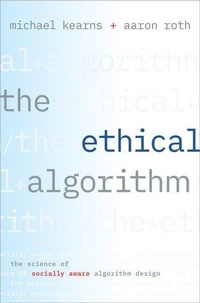
The Ethical Algorithm
The Science of Socially Aware Algorithm Design
Published on 23. January 2020
Book
Hardback
230 pages
978-0-19-094820-7 (ISBN)
Description
Over the course of a generation, algorithms have gone from mathematical abstractions to powerful mediators of daily life. In evolving from static computer programs hand-coded by engineers to the products of machine learning, these technologies have made our lives more efficient, more entertaining, and, sometimes, better informed. At the same time, complex algorithms are increasingly crushing the basic rights of individual citizens. Allegedly anonymized datasets and statistical models routinely leak our most sensitive personal information; applications for everything from loans to college reflect racial and gender bias. Meanwhile, users manipulate algorithms to "game" search engines, spam filters, online reviewing services and navigation apps.
Understanding and improving the science behind the algorithms that run our lives is quickly becoming one of the most pressing issues of this century. Traditional solutions, such as laws, regulations and watchdog groups, have proven woefully inadequate, at best. Derived from the cutting-edge of scientific research, The Ethical Algorithm offers a new approach: a set of principled solutions based on the emerging and exciting science of socially aware algorithm design. Weaving together the science behind algorithm design with stories of citizens, lawyers, scientists, and activists experiencing the trial-and-error of research in real-time, Michael Kearns and Aaron Roth present a strikingly original way forward, showing how we can begin to work together to protect people from the unintended impacts of algorithms--and, sometimes, protect the science that could save us from ourselves.
Understanding and improving the science behind the algorithms that run our lives is quickly becoming one of the most pressing issues of this century. Traditional solutions, such as laws, regulations and watchdog groups, have proven woefully inadequate, at best. Derived from the cutting-edge of scientific research, The Ethical Algorithm offers a new approach: a set of principled solutions based on the emerging and exciting science of socially aware algorithm design. Weaving together the science behind algorithm design with stories of citizens, lawyers, scientists, and activists experiencing the trial-and-error of research in real-time, Michael Kearns and Aaron Roth present a strikingly original way forward, showing how we can begin to work together to protect people from the unintended impacts of algorithms--and, sometimes, protect the science that could save us from ourselves.
Reviews / Votes
...the authors take us on a journey through the main socio-algorithmic problems representing social constraints upon algorithms, their consequences and trade-offs. [T]hey provide concrete technical solutions for the challenges discussed throughout the book's 5 chapters: privacy, fairness, user-data-algorithm feedback loop, data-driven scientific discoveries and (brief) thoughts on the ethical issues (transparency, accountability, morality) yet to be pursued scientifically. * ESSSAT News & Reviews * It is elegantly written, easy to read and full of entertaining examples. * Martin Peterson, Prometheus *More details
Language
English
Place of publication
New York
United States
Illustrations
30 figures
Dimensions
Height: 241 mm
Width: 163 mm
Thickness: 25 mm
Weight
487 gr
ISBN-13
978-0-19-094820-7 (9780190948207)
Copyright in bibliographic data and cover images is held by Nielsen Book Services Limited or by the publishers or by their respective licensors: all rights reserved.
Schweitzer Classification
Other editions
Additional editions
E-Book
10/2019
1st Edition
OUP eBook
€18.49
Available for download
E-Book
10/2019
1st Edition
OUP eBook
€18.49
Available for download
Persons
Michael Kearns is Professor and the National Center Chair in the Computer and Information Science department of the University of Pennsylvania, where he has secondary appointments at Wharton. He has consulted extensively in the finance and technology industries, and on various legal and regulatory matters involving algorithms, data and machine learning.
Aaron Roth is the class of 1940 Bicentennial Term Associate Professor in the Computer and Information Science department at the University of Pennsylvania. He is the recipient of a Presidential Early Career Award for Scientists and Engineers (PECASE), an Alfred P. Sloan Research Fellowship, an NSF CAREER award, a Google Faculty Research Award, and a Yahoo Academic Career Enhancement award.
Aaron Roth is the class of 1940 Bicentennial Term Associate Professor in the Computer and Information Science department at the University of Pennsylvania. He is the recipient of a Presidential Early Career Award for Scientists and Engineers (PECASE), an Alfred P. Sloan Research Fellowship, an NSF CAREER award, a Google Faculty Research Award, and a Yahoo Academic Career Enhancement award.
Author
Professor and the National Center Chair in the Computer and Information Science departmentProfessor and the National Center Chair in the Computer and Information Science department, University of Pennsylvania
Class of 1940 Bicentennial Term Associate ProfessorClass of 1940 Bicentennial Term Associate Professor, University of Pennsylvania
Content
Introduction
Chapter 1: Algorithmic Privacy: The Power of Randomization
Chapter 2: Fairness: Discriminating Algorithms
Chapter 3: Games People Play (With Algorithms)
Chapter 4: Lost in the Garden: Led Astray by Data
Chapter 5: Risky Business: Interpretability, Morality, and the Singularity
Some Concluding Thoughts
Acknowledgements
Notes
Chapter 1: Algorithmic Privacy: The Power of Randomization
Chapter 2: Fairness: Discriminating Algorithms
Chapter 3: Games People Play (With Algorithms)
Chapter 4: Lost in the Garden: Led Astray by Data
Chapter 5: Risky Business: Interpretability, Morality, and the Singularity
Some Concluding Thoughts
Acknowledgements
Notes