

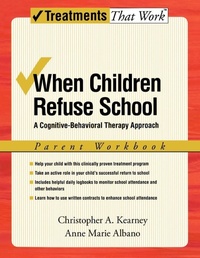
When Children Refuse School
A Cognitive-Behavioral Therapy Approach, Parent Workbook
2nd Edition
Published on 5. April 2007
Book
Paperback/Softback
216 pages
978-0-19-530829-7 (ISBN)
Description
School refusal behaviour is a common and difficult problem facing parents of children and teenagers. It can have severe consequences for a child's academic, social, and psychological well-being. A child's absence from school can also significantly increase family conflict.
This parent Workbook is designed to help parents work with a therapist to resolve the child's school refusal behaviour. It outlines four possible treatment procedures that may be prescribed by a therapist, depending on the child's reasons for refusing school. Scientific evidence has shown these programs to be highly effective in treating 5-17 year old children who exhibit school refusal behaviour.
Regardless of whether the child refuses to attend school to relieve school-related distress, to avoid negative social situations at school, to receive attention from their family members, or to obtain tangible rewards outside of school, the flexible treatments will help overcome school refusal behaviour. The Workbook describes what can be expected during the child's assessment and treatment and provides answers to questions about the process. It also provides instructions for continuing certain
aspects of the program at home, including relaxation and breathing techniques and exposure exercises to decrease anxiety. Instructions are given for completing daily logbooks to track progress, creating a morning routine, and developing written contracts to encourage school attendance.
This parent Workbook is designed to help parents work with a therapist to resolve the child's school refusal behaviour. It outlines four possible treatment procedures that may be prescribed by a therapist, depending on the child's reasons for refusing school. Scientific evidence has shown these programs to be highly effective in treating 5-17 year old children who exhibit school refusal behaviour.
Regardless of whether the child refuses to attend school to relieve school-related distress, to avoid negative social situations at school, to receive attention from their family members, or to obtain tangible rewards outside of school, the flexible treatments will help overcome school refusal behaviour. The Workbook describes what can be expected during the child's assessment and treatment and provides answers to questions about the process. It also provides instructions for continuing certain
aspects of the program at home, including relaxation and breathing techniques and exposure exercises to decrease anxiety. Instructions are given for completing daily logbooks to track progress, creating a morning routine, and developing written contracts to encourage school attendance.
More details
Series
Edition
2nd Revised edition
Language
English
Place of publication
New York
United States
Edition type
Revised edition
Product notice
Paperback (trade)
Dimensions
Height: 218 mm
Width: 275 mm
Thickness: 11 mm
Weight
503 gr
ISBN-13
978-0-19-530829-7 (9780195308297)
Copyright in bibliographic data and cover images is held by Nielsen Book Services Limited or by the publishers or by their respective licensors: all rights reserved.
Schweitzer Classification
Other editions
Additional editions
Christopher A. Kearney | Anne Marie Albano
When Children Refuse School
A Cognitive-Behavioral Therapy Approach
E-Book
03/2007
2nd Edition
OUP eBook
€28.49
Available for download
Previous edition

Christopher Kearney
When Children Refuse School: Parent workbook
A cognitive-behavioral therapy approach
Book
11/2004
Oxford University Press Inc
€19.83
Article exhausted; check for reprint
Persons
Content
1. Introduction ; 2. Assessment ; 3. Consultation Session and General Treatment Session Procedures ; 4. Children Refusing School to Avoid Objects or Situations that Cause General Distress ; 5. Children Refusing School to Escape Painful Social and/or Evaluative Situations ; 6. Children Refusing School for Attention ; 7. Children Refusing School for Tangible Rewards Outside of School ; 8. Preventing Slips and Relapse