

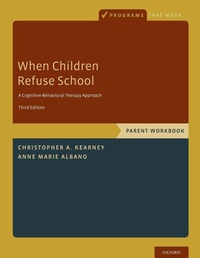
When Children Refuse School
Parent Workbook
3rd Edition
Published on 27. September 2018
Book
Paperback/Softback
216 pages
978-0-19-060408-0 (ISBN)
Description
School refusal behavior is a common and difficult problem facing parents of children and teenagers. The behavior often results in severe academic, social, and psychological problems. A child's absence from school also significantly increases family conflict. If your child experiences anxiety or noncompliance about attending school and has trouble remaining in classes for an entire day, When Children Refuse School, Parent Workbook, and the corresponding Therapist Guide, can help.
The third edition of When Children Refuse School, Parent Workbook, is designed to help you work with a qualified therapist to resolve your child's school refusal behavior. This edition introduces parent involvement strategies, especially with respect to intervention compliance, and offers recommendations regarding consultation with school officials.
Regardless of whether your child refuses school to relieve school-related distress, to avoid negative social situations at school, to receive attention from you or another family member, or to obtain tangible rewards outside of school, the flexible treatments described in this book will help you and your child overcome school refusal behavior. The Workbook describes what you can expect throughout the assessment and treatment of your child and provides answers to questions you may have about the process of therapy. It also provides instructions for continuing certain aspects of the program at home, including relaxation and breathing techniques, as well as exposure exercises to decrease your child's anxiety.
The third edition of When Children Refuse School, Parent Workbook, is designed to help you work with a qualified therapist to resolve your child's school refusal behavior. This edition introduces parent involvement strategies, especially with respect to intervention compliance, and offers recommendations regarding consultation with school officials.
Regardless of whether your child refuses school to relieve school-related distress, to avoid negative social situations at school, to receive attention from you or another family member, or to obtain tangible rewards outside of school, the flexible treatments described in this book will help you and your child overcome school refusal behavior. The Workbook describes what you can expect throughout the assessment and treatment of your child and provides answers to questions you may have about the process of therapy. It also provides instructions for continuing certain aspects of the program at home, including relaxation and breathing techniques, as well as exposure exercises to decrease your child's anxiety.
More details
Series
Edition
3rd Revised edition
Language
English
Place of publication
New York
United States
Target group
College/higher education
Edition type
Revised edition
Dimensions
Height: 280 mm
Width: 216 mm
Thickness: 12 mm
Weight
547 gr
ISBN-13
978-0-19-060408-0 (9780190604080)
Copyright in bibliographic data and cover images is held by Nielsen Book Services Limited or by the publishers or by their respective licensors: all rights reserved.
Schweitzer Classification
Other editions
Additional editions
E-Book
08/2018
3rd Edition
OUP eBook
€31.49
Available for download
E-Book
08/2018
3rd Edition
OUP eBook
€31.49
Available for download
Persons
Dr. Christopher Kearney is a noted authority on school refusal behavior and anxiety in youth. His research interests include school refusal behavior, selective mutism, posttraumatic stress disorder in maltreated youth, perfectionism, and other anxiety-related conditions in children and adolescents as well as issues of quality of life in persons with severe handicaps. He has published several books and numerous book chapters and journal articles on these. Dr. Kearney also conducts workshops for school districts and mental health and other agencies regarding school refusal behavior and selective mutism.
Dr. Anne Marie Albano is an expert in the diagnosis and treatment of anxiety and related disorders in youth. She has published more than 100 articles and chapters and is the co-author of several cognitive behavioral treatment manuals and of the Anxiety Disorders Interview Schedule for Children, all published by Oxford University Press. Dr. Albano served as a Principal Investigator of a
6-site, National Institute of Mental Health-sponsored study entitled "Child/Adolescent Anxiety Multimodal Treatment Study" (CAMS) and the Extended Long Term Follow Up of CAMS (CAMELS) and also was a PI for the Treatments for Adolescents with Depression Study (TADS). Both trials examined the relative efficacy of CBT, medication, combination treatment, and pill placebo in youth.
Dr. Anne Marie Albano is an expert in the diagnosis and treatment of anxiety and related disorders in youth. She has published more than 100 articles and chapters and is the co-author of several cognitive behavioral treatment manuals and of the Anxiety Disorders Interview Schedule for Children, all published by Oxford University Press. Dr. Albano served as a Principal Investigator of a
6-site, National Institute of Mental Health-sponsored study entitled "Child/Adolescent Anxiety Multimodal Treatment Study" (CAMS) and the Extended Long Term Follow Up of CAMS (CAMELS) and also was a PI for the Treatments for Adolescents with Depression Study (TADS). Both trials examined the relative efficacy of CBT, medication, combination treatment, and pill placebo in youth.
Author
Distinguished Professor, Chair of Psychology, & Director of UNLV Child School Refusal and Anxiety Disorders ClinicDistinguished Professor, Chair of Psychology, & Director of UNLV Child School Refusal and Anxiety Disorders Clinic, University of Nevada, Las Vegas
Associate Professor of Clinical Psychology in Psychiatry and Director, Columbia University Clinic for Anxiety and Related DisordersAssociate Professor of Clinical Psychology in Psychiatry and Director, Columbia University Clinic for Anxiety and Related Disorders, Columbia University Medical Center
Content
TABLE OF CONTENTS
CHAPTER 1: Introduction
CHAPTER 2: Assessment
CHAPTER 3: Consultation Session and General Treatment Session Procedures
CHAPTER 4: Children Refusing School to Avoid Objects or Situations that Cause General Distress
CHAPTER 5: Children Refusing School to Escape Anxious Social and/or Evaluative Situations
CHAPTER 6: Children Refusing School for Attention
CHAPTER 7: Children Refusing School for Tangible Rewards Outside of School
CHAPTER 8: Preventing Slips and Relapse
About the Authors
CHAPTER 1: Introduction
CHAPTER 2: Assessment
CHAPTER 3: Consultation Session and General Treatment Session Procedures
CHAPTER 4: Children Refusing School to Avoid Objects or Situations that Cause General Distress
CHAPTER 5: Children Refusing School to Escape Anxious Social and/or Evaluative Situations
CHAPTER 6: Children Refusing School for Attention
CHAPTER 7: Children Refusing School for Tangible Rewards Outside of School
CHAPTER 8: Preventing Slips and Relapse
About the Authors