

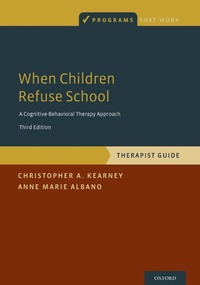
When Children Refuse School
Therapist Gude
3rd Edition
Published on 27. September 2018
Book
Paperback/Softback
320 pages
978-0-19-060405-9 (ISBN)
Description
Many children and teenagers refuse to attend school or have anxiety-related difficulties remaining in classes for an entire day. School refusal behavior can contribute to a child's academic, social, and psychological problems, impact a child's chances for future educational, financial, and personal success, and significantly affect family functioning. Cognitive Behavioral Therapy (CBT) has been shown to be a highly effective treatment for youth who exhibit this behavior.
The third edition of When Children Refuse School, Therapist Guide, provides an updated multi-tiered approach model that can be used to effectively address the main types of school refusal behavior. The Guide introduces new material on very severe and chronic cases of problematic absenteeism, including alternative educational avenues and expansion of manual procedures, for children and adults.
This manual includes tools for assessing a child's reasons for school refusal behavior and is based on a functional, prescriptive model. It presents well-tested techniques arranged by function to tailor treatment to a child's particular characteristics. Each treatment package also contains a detailed discussion of special topics pertinent to treating youths with school refusal behavior, such as medication, panic attacks, and being teased. A corresponding workbook is also available for parents, who often play an important part in a child's recovery. This comprehensive program is an invaluable resource for clinicians treating school refusal behavior.
The third edition of When Children Refuse School, Therapist Guide, provides an updated multi-tiered approach model that can be used to effectively address the main types of school refusal behavior. The Guide introduces new material on very severe and chronic cases of problematic absenteeism, including alternative educational avenues and expansion of manual procedures, for children and adults.
This manual includes tools for assessing a child's reasons for school refusal behavior and is based on a functional, prescriptive model. It presents well-tested techniques arranged by function to tailor treatment to a child's particular characteristics. Each treatment package also contains a detailed discussion of special topics pertinent to treating youths with school refusal behavior, such as medication, panic attacks, and being teased. A corresponding workbook is also available for parents, who often play an important part in a child's recovery. This comprehensive program is an invaluable resource for clinicians treating school refusal behavior.
Reviews / Votes
"Kearney and Albano take the complicated behavior of school refusal, illustrate its differing etiologies, and present proven strategies for each of the different underlying disorders. Consistent with their clinical expertise, the manual not only outlines the interventions but addresses many co-existing issues of family management. Using clear and specific examples, this manual is a must-have for anyone who works with children who are reluctant to go to school."-- Deborah C. Beidel, PhD, ABPP, Professor of Psychiatry, Penn State College of Medicine
More details
Series
Edition
3rd Revised edition
Language
English
Place of publication
New York
United States
Target group
College/higher education
Professional and scholarly
Edition type
Revised edition
Dimensions
Height: 254 mm
Width: 178 mm
Thickness: 17 mm
Weight
605 gr
ISBN-13
978-0-19-060405-9 (9780190604059)
Copyright in bibliographic data and cover images is held by Nielsen Book Services Limited or by the publishers or by their respective licensors: all rights reserved.
Schweitzer Classification
Other editions
Additional editions
E-Book
07/2018
3rd Edition
OUP eBook
€39.49
Available for download
E-Book
07/2018
3rd Edition
OUP eBook
€39.49
Available for download
Persons
Dr. Christopher Kearney is a noted authority on school refusal behavior and anxiety in youth. His research interests include school refusal behavior, selective mutism, posttraumatic stress disorder in maltreated youth, perfectionism, and other anxiety-related conditions in children and adolescents as well as issues of quality of life in persons with severe handicaps. He has published several books and numerous book chapters and journal articles on these. Dr. Kearney also conducts workshops for school districts and mental health and other agencies regarding school refusal behavior and selective mutism.
Dr. Anne Marie Albano is an expert in the diagnosis and treatment of anxiety and related disorders in youth. She has published more than 100 articles and chapters and is the co-author of several cognitive behavioral treatment manuals and of the Anxiety Disorders Interview Schedule for Children, all published by Oxford University Press. Dr. Albano served as a Principal Investigator of a
6-site, National Institute of Mental Health-sponsored study entitled "Child/Adolescent Anxiety Multimodal Treatment Study" (CAMS) and the Extended Long Term Follow Up of CAMS (CAMELS) and also was a PI for the Treatments for Adolescents with Depression Study (TADS). Both trials examined the relative efficacy of CBT, medication, combination treatment, and pill placebo in youth.
Dr. Anne Marie Albano is an expert in the diagnosis and treatment of anxiety and related disorders in youth. She has published more than 100 articles and chapters and is the co-author of several cognitive behavioral treatment manuals and of the Anxiety Disorders Interview Schedule for Children, all published by Oxford University Press. Dr. Albano served as a Principal Investigator of a
6-site, National Institute of Mental Health-sponsored study entitled "Child/Adolescent Anxiety Multimodal Treatment Study" (CAMS) and the Extended Long Term Follow Up of CAMS (CAMELS) and also was a PI for the Treatments for Adolescents with Depression Study (TADS). Both trials examined the relative efficacy of CBT, medication, combination treatment, and pill placebo in youth.
Content
TABLE OF CONTENTS
CHAPTER 1: Introductory Information for Therapists
CHAPTER 2: Assessment
CHAPTER 3: Consultation Session and General Treatment Session Procedures
CHAPTER 4: Children Refusing School to Avoid School-Related Stimuli That Provoke Negative Affectivity
CHAPTER 5: Children Refusing School to Escape Aversive Social and/or Evaluative Situations
CHAPTER 6: Children Refusing School for Attention
CHAPTER 7: Children Refusing School for Tangible Rewards Outside of School
CHAPTER 8: Relapse Prevention and Special Circumstances
CHAPTER 9: Tier 3 Interventions
About the Authors
CHAPTER 1: Introductory Information for Therapists
CHAPTER 2: Assessment
CHAPTER 3: Consultation Session and General Treatment Session Procedures
CHAPTER 4: Children Refusing School to Avoid School-Related Stimuli That Provoke Negative Affectivity
CHAPTER 5: Children Refusing School to Escape Aversive Social and/or Evaluative Situations
CHAPTER 6: Children Refusing School for Attention
CHAPTER 7: Children Refusing School for Tangible Rewards Outside of School
CHAPTER 8: Relapse Prevention and Special Circumstances
CHAPTER 9: Tier 3 Interventions
About the Authors