

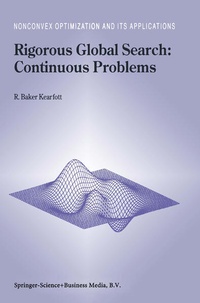
Rigorous Global Search: Continuous Problems
Published on 31. October 1996
Book
Hardback
XVI, 264 pages
978-0-7923-4238-0 (ISBN)
Description
This work grew out of several years of research, graduate seminars and talks on the subject. It was motivated by a desire to make the technology accessible to those who most needed it or could most use it. It is meant to be a self-contained introduction, a reference for the techniques, and a guide to the literature for the underlying theory. It contains pointers to fertile areas for future research. It also serves as introductory documentation for a Fortran 90 software package for nonlinear systems and global optimization. The subject of the monograph is deterministic, automatically verified or r- orous methods. In such methods, directed rounding and computational fix- point theory are combined with exhaustive search (branch and bound) te- niques. Completion of such an algorithm with a list of solutions constitutes a rigorous mathematical proof that all of the solutions within the original search region are within the output list. The monograph is appropriate as an introduction to research and technology in the area, as a desk reference, or as a graduate-level course reference. Kno- edge of calculus, linear algebra, and elementary numerical analysis is assumed.
More details
Series
Edition
1996 ed.
Language
English
Place of publication
New York
United States
Target group
Professional and scholarly
Research
Product notice
sewn/stitched
Cloth over boards
Illustrations
XVI, 264 p.
Dimensions
Height: 241 mm
Width: 160 mm
Thickness: 20 mm
Weight
594 gr
ISBN-13
978-0-7923-4238-0 (9780792342380)
DOI
10.1007/978-1-4757-2495-0
Schweitzer Classification
Other editions
Additional editions
R. Baker Kearfott
Rigorous Global Search: Continuous Problems
Book
12/2010
Springer
€160.49
Shipment within 15-20 days
Content
1 Preliminaries.- 2 Software Environments.- 3 On Preconditioning.- 4 Verified Solution of Nonlinear Systems.- 5 Optimization.- 6 Non-Differentiable Problems.- 7 Use of Intermediate Quantities in THE Expression Values.- References.