

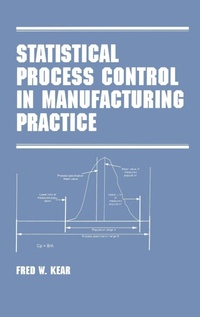
Statistical Process Control in Manufacturing Practice
1st Edition
Published on 10. September 1997
Book
Hardback
240 pages
978-0-8247-0131-4 (ISBN)
Description
Emphasizing the importance of understanding and reducing process variation to achieve quality manufacturing performance, this work establishes how statistical process control (SPC) provides powerful tools for measuring and regulating manufacturing processes. It presents information derived from time-tested applications of SPC techniques at on-site process situations in manufacturing. It is designed to assist manufacturing organizations in explaining and implementing successful SPC programmes.
More details
Series
Language
English
Place of publication
Bosa Roca
United States
Publishing group
Taylor & Francis Inc
Target group
Professional and scholarly
Dimensions
Height: 240 mm
Width: 161 mm
Thickness: 18 mm
Weight
531 gr
ISBN-13
978-0-8247-0131-4 (9780824701314)
Copyright in bibliographic data and cover images is held by Nielsen Book Services Limited or by the publishers or by their respective licensors: all rights reserved.
Schweitzer Classification
Other editions
Additional editions
E-Book
11/2020
1st Edition
CRC Press
€211.99
Available for download
E-Book
11/2020
1st Edition
CRC Press
€211.99
Available for download
Person
Fred W. Kear is a Consultant in Manufacturing Engineering, Albuquerque, New Mexico.
Content
The history and application of statistical process control; measuring manufacturing processes; characterization of manufacturing processes; key aspects of manufacturing process; planning the statistical process control management system; problem solving and corrective action; continuous process improvement; customer satisfaction issues and SPC; how to do statistical process control operations. Appendices: histogram construction; calculating process validation; constructing X-bar and R charts; calculating Cp; calculating Cpk; process metrics associations; determining the number of process opportunities for errors; design and experiment; conducting a problem solving team; constructing and using the frequency chart; glossary of terms; using flow-charts as a manufacturing tool; constructing and using the Pareto chart; using the fishbone diagram for brain storming; constructing and using attribute charts.