

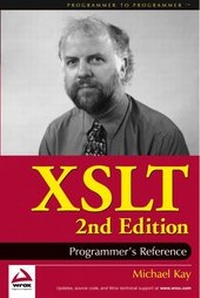
XSLT
Programmer's Reference
2nd Edition
Published on 3. May 2001
Book
Paperback/Softback
992 pages
978-0-7645-4381-4 (ISBN)
Description
Who is this book for?
This book is for programmers who want to learn how to use the XSLT language for developing web applications. The book is in four parts: a detailed introduction to the concepts of the language, a reference section giving comprehensive specifications and working examples of every feature, a development guide giving design advice and case studies for the advanced user, and a product reference detailing the features and usage of the latest versions of Microsoft MSXML, Apache Xalan, Oracle XML, open source Saxon, the TRAX API and other processors and tools.
What does this book cover?
* Explains the rationale behind XSLT: what is it for?
* Describes the XSLT processing model
* Explores design patterns and stylesheet structure
* Provides a full reference to the XPath and XSLT languages
* Demonstrates the use of XSLT with worked examples
* Describes currently available XSLT processors - updated to reflect recent advances in XSLT parser technology
* Includes coverage of proposed specification enhancements
As an experienced developer, you need to get the facts on a new technology fast. Without the marketing hype, without the trivial introduction. That's what Wrox Programmer's References deliver. Hard facts on the newest technologies with practical examples of how to apply new tools to your development projects today.
This book is for programmers who want to learn how to use the XSLT language for developing web applications. The book is in four parts: a detailed introduction to the concepts of the language, a reference section giving comprehensive specifications and working examples of every feature, a development guide giving design advice and case studies for the advanced user, and a product reference detailing the features and usage of the latest versions of Microsoft MSXML, Apache Xalan, Oracle XML, open source Saxon, the TRAX API and other processors and tools.
What does this book cover?
* Explains the rationale behind XSLT: what is it for?
* Describes the XSLT processing model
* Explores design patterns and stylesheet structure
* Provides a full reference to the XPath and XSLT languages
* Demonstrates the use of XSLT with worked examples
* Describes currently available XSLT processors - updated to reflect recent advances in XSLT parser technology
* Includes coverage of proposed specification enhancements
As an experienced developer, you need to get the facts on a new technology fast. Without the marketing hype, without the trivial introduction. That's what Wrox Programmer's References deliver. Hard facts on the newest technologies with practical examples of how to apply new tools to your development projects today.
More details
Edition
2., Aufl.
Language
English
Place of publication
Foster City
United States
Publishing group
John Wiley & Sons Inc
Target group
Professional and scholarly
Edition type
New edition
Illustrations
Illustrations
Dimensions
Height: 22.9 cm
Width: 15.2 cm
Weight
1319 gr
ISBN-13
978-0-7645-4381-4 (9780764543814)
Schweitzer Classification
Other editions
New editions
Michael Kay
XSLT 2.0 Programmer's Reference
Book
08/2004
3rd Edition
Hungry Minds Inc,U.S.
€39.90
Article exhausted; check for reprint
Person
Michael Kay has spent most of his career as a software designer and systems architect, and has recently moved to Software AG, where he is specialising in XML database and transformation technology. He also represents Software AG on the W3C XSL Working Group. Previously he worked on a number of electronic commerce and publishing projects with ICL, the IT services supplier. His background is in database technology: he has worked on the design of network, relational, and object-oriented database software products as well as a text search engine. In the XML world he is known as the developer of the open source Saxon product.
Michael lives in Reading, Berkshire with his wife and daughter. His hobbies, as you might guess from the examples in this book, include genealogy and choral singing.
Michael lives in Reading, Berkshire with his wife and daughter. His hobbies, as you might guess from the examples in this book, include genealogy and choral singing.
Content
Introduction. Chapter 1: XSLT in Context. Chapter 2: The XSLT Processing Model. Chapter 3: Stylesheet Structure. Chapter 4: XSLT Elements. Chapter 5: Expressions. Chapter 6: Patterns. Chapter 7: Functions. Chapter 8: Writing Extension Functions. Chapter 9: Stylesheet Design Patterns. Chapter 10: Worked Examples. Appendix A: Microsoft MSXML3. Appendix B: Oracle. Appendix C: Saxon. Appendix D: Xalan. Appendix E: Other Products. Appendix F: TrAX: The Transformation API for XML. Glossary. Index A -- Elements. Index B -- Functions. Index C -- General.