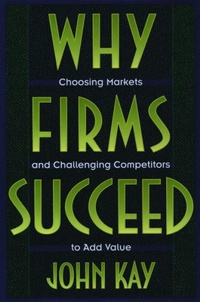
Why Firms Succeed
Choosing Markets and Challenging Competitors to Add Value
Published on 18. January 1996
Book
Hardback
336 pages
978-0-19-508767-3 (ISBN)
Description
Applies modern economic theories to guide managers in creating successful corporate strategies.
This is a book on corporate strategy that uses of the most modern theories in economics to show managers how to succeed in the markets in which they compete. The author takes the position that firms have unique strengths that they must understand and exploit. These strengths will be in four general areas: 1) Their reputation, 2) how well they create innovative new products or services, 3) what special strategic assets, or market position, they may have, and 4) how they are organized and how they operate, or what "architecture" they may have. The book has an international focus in that strategies are applied to firms doing business in different countries. The author's UK book,Foundations of Corporate Success was very successful, and this book is derived from it. For the U.S. edition the author has substituted many American examples, such as Disney, Caterpillar, Walmart, and the Boston Celtics.
This is a book on corporate strategy that uses of the most modern theories in economics to show managers how to succeed in the markets in which they compete. The author takes the position that firms have unique strengths that they must understand and exploit. These strengths will be in four general areas: 1) Their reputation, 2) how well they create innovative new products or services, 3) what special strategic assets, or market position, they may have, and 4) how they are organized and how they operate, or what "architecture" they may have. The book has an international focus in that strategies are applied to firms doing business in different countries. The author's UK book,Foundations of Corporate Success was very successful, and this book is derived from it. For the U.S. edition the author has substituted many American examples, such as Disney, Caterpillar, Walmart, and the Boston Celtics.
Reviews / Votes
"Rich with corporate and industry examples, ...this well-written book is highly recommended not only for US managers involved in strategic management, but also for business and economics academicians."--Choice"A powerfully argued book, which casts a fresh light on a range of practical business challenges."--The Financial Times for the UK edition
"The best management theorist in Britain, bar none....An important book for the future of British management....Explains in blindingly simple terms how business strategies add value. Kay is the ultimate numbers man, but with a feel for operations."--Business Age for the UK edition
"Impressive and readable....The scope and quality of this book put it in the same league as Michael Porter's celebrated volumes on competitive strategy and signal a certain coming of age of business education in Britain."--The Observer for the UK edition
"A fresh and insightful approach...to the links between corporate culture, strategy, and success."--Sir Geoffrey Owen, Director of Business Policy Program, London School of Economics for the UK edition
"In 1993 [Kay] wrote Foundations of Corporate Success, in which he argued that success could be measured as added value or as the difference between the value of a firm's output and the cost of its input....His book was the subject of spirited debate in the British business press....He now offers this slightly revised, shortened, and 'Americanized' version of his earlier book. Such American businesses as WalMart, Caterpillar, and the Boston Celtics (!)
have been added as examples, and a consideration of the way business is transacted internationally is included."--Booklist
"Mr. Kay is well on the way to turning himself into a European Michael Porter, Harvard's top showman."--The Economist
More details
Language
English
Place of publication
New York
United States
Target group
Professional and scholarly
Product notice
sewn/stitched
Cloth over boards
With dust jacket
Illustrations
line figures, tables
Dimensions
Height: 242 mm
Width: 163 mm
Thickness: 31 mm
Weight
667 gr
ISBN-13
978-0-19-508767-3 (9780195087673)
Copyright in bibliographic data and cover images is held by Nielsen Book Services Limited or by the publishers or by their respective licensors: all rights reserved.
Schweitzer Classification
Other editions
Additional editions