

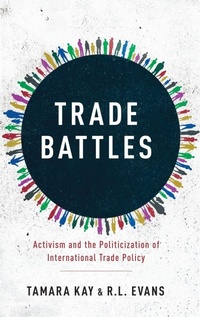
Trade Battles
Activism and the Politicization of International Trade Policy
Published on 4. October 2018
Book
Hardback
264 pages
978-0-19-084743-2 (ISBN)
Description
How did activists create a dynamic broad-based movement during NAFTA negotiations that politicized trade, making it a contentious issue for the first time in history? And how did their NAFTA mobilization influence trade policy and set the stage for future battles over trade? Trade Battles draws on hundreds of in-depth interviews with Mexican, Canadian, and U.S. trade negotiators, labor and environmental activists, and government officials, and an extensive analysis of archival materials to understand the role of civil society in shaping state policy.
Trade Battles shows how activists politicized trade policy by creating a new set of institutionalized and disruptive strategies around trade that leveraged broader cleavages across state and nonstate arenas. Activists exploited these leverage points by mobilizing across them, which enabled them not only to politicize trade policy with legislators and trade policy officials and among the public, but also to influence the content of the agreement itself.
So powerful was activists' pushback against NAFTA that future administrations closed many state institutional channels in order to thwart public opposition, curtailing public access, participation and input. This forced activists to try to kill subsequent trade agreements whole cloth rather than improve them, as they did during the NAFTA struggle.
Trade Battles reveals that the NAFTA battle was less about trade policy than the role of democratic state institutions in policymaking. By exposing the linkages between institutional opportunities and democratic practices, it reveals how critical state institutions are for activists' efforts to shape not only trade policy, but a number of international policies from climate change to migration. When the state closes institutions, it effectively severs policymaking from democratic intervention.
Trade Battles shows how activists politicized trade policy by creating a new set of institutionalized and disruptive strategies around trade that leveraged broader cleavages across state and nonstate arenas. Activists exploited these leverage points by mobilizing across them, which enabled them not only to politicize trade policy with legislators and trade policy officials and among the public, but also to influence the content of the agreement itself.
So powerful was activists' pushback against NAFTA that future administrations closed many state institutional channels in order to thwart public opposition, curtailing public access, participation and input. This forced activists to try to kill subsequent trade agreements whole cloth rather than improve them, as they did during the NAFTA struggle.
Trade Battles reveals that the NAFTA battle was less about trade policy than the role of democratic state institutions in policymaking. By exposing the linkages between institutional opportunities and democratic practices, it reveals how critical state institutions are for activists' efforts to shape not only trade policy, but a number of international policies from climate change to migration. When the state closes institutions, it effectively severs policymaking from democratic intervention.
Reviews / Votes
Trade policy has always been politically contentious In the charged Trump political environment, American trade policy has again been at the center of things, making this a timely book...Summing Up: Highly Recommended. * CHOICE *More details
Language
English
Place of publication
New York
United States
Target group
Professional and scholarly
Illustrations
3 illustrations
Dimensions
Height: 240 mm
Width: 161 mm
Thickness: 19 mm
Weight
558 gr
ISBN-13
978-0-19-084743-2 (9780190847432)
Copyright in bibliographic data and cover images is held by Nielsen Book Services Limited or by the publishers or by their respective licensors: all rights reserved.
Schweitzer Classification
Other editions
Additional editions
Book
09/2018
Oxford University Press Inc
€50.90
Shipment within 15-20 days
E-Book
07/2018
OUP eBook
€62.99
Available for download
E-Book
07/2018
OUP eBook
€62.99
Available for download
Persons
Tamara Kay is Associate Professor of Global Affairs and Sociology at the University of Notre Dame.
R.L. Evans is currently an independent scholar. She was previously Managing Director of Research and Development at The McHenry Group.
R.L. Evans is currently an independent scholar. She was previously Managing Director of Research and Development at The McHenry Group.
Author
Associate Professor of Global Affairs and SociologyAssociate Professor of Global Affairs and Sociology, University of Notre Dame
Independent scholar and former Managing Director of Research and DevelopmentIndependent scholar and former Managing Director of Research and Development, The McHenry Group
Content
List of Figures
Preface
Acknowledgments
List of Abbreviations
1. Introduction: The Impact of Social Movements on International Trade Policy
2. Theorizing Social Movement Influence on the State
3. Trade Politics prior to NAFTA
4. Politicization and Framing: Linking Environmental and Labor Rights
5. Mobilizing Public and Legislative Hostility against NAFTA
6. Using Institutional Leverage to Influence the Side Agreements
7. Pushing Back Against the State: Trade Battles After NAFTA
8. Conclusions: The Implications of Institutional Closure for Democracy and Mobilization
Notes
Bibliography
Index
Preface
Acknowledgments
List of Abbreviations
1. Introduction: The Impact of Social Movements on International Trade Policy
2. Theorizing Social Movement Influence on the State
3. Trade Politics prior to NAFTA
4. Politicization and Framing: Linking Environmental and Labor Rights
5. Mobilizing Public and Legislative Hostility against NAFTA
6. Using Institutional Leverage to Influence the Side Agreements
7. Pushing Back Against the State: Trade Battles After NAFTA
8. Conclusions: The Implications of Institutional Closure for Democracy and Mobilization
Notes
Bibliography
Index