

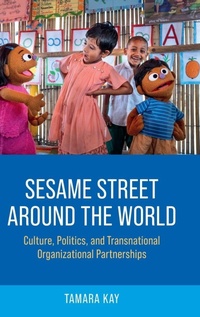
Sesame Street Around the World
Culture, Politics, and Transnational Organizational Partnerships
Published on 19. January 2026
Book
Hardback
240 pages
978-0-19-084429-5 (ISBN)
Description
Given the sometimes extraordinary politicization of culture, it is surprising that Sesame Street has gained acceptance and legitimacy in more than fifty countries. Sesame Street's global success raises two questions. First, how does a US icon like Sesame Street spread around the world, gaining acceptance as a local cultural product? Second, how does the nonprofit that created it, Sesame Workshop, and its partners around the world navigate cultural differences, manage conflicts, and construct shared collective representations to create Sesame Street programs that resonate with local audiences?
Tamara Kay answers these questions using data from seven years of intensive ethnographic fieldwork and 200 in-depth interviews with Sesame Workshop staff and international partners-including their real-time interactions-from seventeen countries within four regions around the world. Kay argues that Sesame Workshop's secret is its engagement in coproduction, meaning it works with partners as a transnational team to create local Sesame Street programs together. Through coproduction, Sesame Workshop and its partners create new collective identities by constructing value to align their interests and exchanging complex cultural knowledge to both customize and build alliances. She traces the successive processes of coproduction, beginning with the imagination of the cultural product, to its disassembly, reconstitution, and dissemination. Coproduction privileges the creation of new knowledge that emerges from transnational interaction, and uses that new knowledge to create a hybrid cultural product. The Sesame Street case grapples with and illuminates culture in transnational interaction, providing insight into a range of other transnational organizational partnerships and different kinds of hybrid cultural products.
Tamara Kay answers these questions using data from seven years of intensive ethnographic fieldwork and 200 in-depth interviews with Sesame Workshop staff and international partners-including their real-time interactions-from seventeen countries within four regions around the world. Kay argues that Sesame Workshop's secret is its engagement in coproduction, meaning it works with partners as a transnational team to create local Sesame Street programs together. Through coproduction, Sesame Workshop and its partners create new collective identities by constructing value to align their interests and exchanging complex cultural knowledge to both customize and build alliances. She traces the successive processes of coproduction, beginning with the imagination of the cultural product, to its disassembly, reconstitution, and dissemination. Coproduction privileges the creation of new knowledge that emerges from transnational interaction, and uses that new knowledge to create a hybrid cultural product. The Sesame Street case grapples with and illuminates culture in transnational interaction, providing insight into a range of other transnational organizational partnerships and different kinds of hybrid cultural products.
More details
Series
Language
English
Place of publication
New York
United States
Target group
College/higher education
Product notice
sewn/stitched
Cloth over boards
Dimensions
Height: 234 mm
Width: 156 mm
Thickness: 18 mm
Weight
517 gr
ISBN-13
978-0-19-084429-5 (9780190844295)
Copyright in bibliographic data and cover images is held by Nielsen Book Services Limited or by the publishers or by their respective licensors: all rights reserved.
Schweitzer Classification
Other editions
Additional editions
Tamara Kay
Sesame Street Around the World
Culture, Politics, and Transnational Organizational Partnerships
Book
approx. 03/2026
Oxford University Press Inc
€30.50
Not yet published
Person
Tamara Kay is the Andrew W. Mellon Chair and Professor of Sociology at the University of Pittsburgh. She works on issues of trade, labor, social movements, globalization, culture, organizations, and global health including reproductive health and rights.
Content
1: Introduction: Coproduction and Sesame Street: Culture in Transnational Interaction 2: Universality and Particularity: Variation and the Sesame Model 3: Disassembling Sesame Street: Constructing Value to Align Interests 4: Reconstituting Sesame Street: Exchanging Cultural Knowledge to Customize 5: Pushing Cultural Boundaries: Authenticity and Social Change 6: Disseminating Sesame Street: Exchanging Cultural Knowledge to Build Alliances 7: Managing and Resolving Conflicts 8: Conclusions 9: Epilogue: The Sesame Model, Sustainability and Scale Appendix I: Data and Methods