

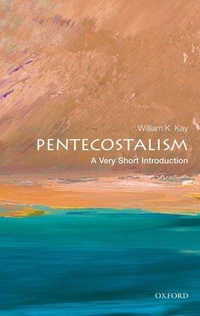
Pentecostalism
A Very Short Introduction
Published on 27. January 2011
Book
Paperback/Softback
160 pages
978-0-19-957515-2 (ISBN)
Description
In religious terms Pentecostalism was probably the most vibrant and rapidly-growing religious movement of the 20th century. Starting as a revivalistic and renewal movement within Christianity, it encircled the globe in less than 25 years and grew in North America and then in those parts of the world with the highest birth-rates. Characterised by speaking in tongues, miracles, television evangelism and megachurches, it is also noted for its small-group meetings, empowerment of individuals, liberation of women and humanitarian concerns.
Without the financial and military support of the state (as was the case with communism), it flourished in almost every conceivable socio-political environment. Even in Europe, where religion most frequently appeared tired and out of date, Pentecostalism might draw large crowds or, within mainline Christian congregations, flourish in a more muted charismatic form. When these two forms are added together, Pentecostalism and neo-Pentecostalism are thought to account for around 450 million people.
William K Kay outlines the origins and growth of Pentecostalism, looking at not only the theological aspects of the movement, but also the sociological influences of its political and humanitarian viewpoints.
ABOUT THE SERIES: The Very Short Introductions series from Oxford University Press contains hundreds of titles in almost every subject area. These pocket-sized books are the perfect way to get ahead in a new subject quickly. Our expert authors combine facts, analysis, perspective, new ideas, and enthusiasm to make interesting and challenging topics highly readable.
Without the financial and military support of the state (as was the case with communism), it flourished in almost every conceivable socio-political environment. Even in Europe, where religion most frequently appeared tired and out of date, Pentecostalism might draw large crowds or, within mainline Christian congregations, flourish in a more muted charismatic form. When these two forms are added together, Pentecostalism and neo-Pentecostalism are thought to account for around 450 million people.
William K Kay outlines the origins and growth of Pentecostalism, looking at not only the theological aspects of the movement, but also the sociological influences of its political and humanitarian viewpoints.
ABOUT THE SERIES: The Very Short Introductions series from Oxford University Press contains hundreds of titles in almost every subject area. These pocket-sized books are the perfect way to get ahead in a new subject quickly. Our expert authors combine facts, analysis, perspective, new ideas, and enthusiasm to make interesting and challenging topics highly readable.
Reviews / Votes
A worthy addition to the series * Methodist Recorder *More details
Series
Language
English
Place of publication
Oxford
United Kingdom
Target group
College/higher education
Illustrations
Approx 15 black and white halftones
Dimensions
Height: 177 mm
Width: 113 mm
Thickness: 17 mm
Weight
134 gr
ISBN-13
978-0-19-957515-2 (9780199575152)
Copyright in bibliographic data and cover images is held by Nielsen Book Services Limited or by the publishers or by their respective licensors: all rights reserved.
Schweitzer Classification
Other editions
Additional editions
E-Book
01/2011
OUP eBook
€5.49
Available for download
Person
William K Kay has written widely on Pentecostalism both from a historical perspective and using empirical and quantitative methods. He published Pentecostals in Britain (Paternoster, 2000), Pentecostal and Charismatic Studies: a reader (edited with Anne Dyer and published by SCM in 2004), Apostolic Networks in Britain (Paternoster, 2007) and Pentecostalism (SCM, 2009). He is editor of the Journal of the European Pentecostal Theological Association. He was founding Director of the Centre for Pentecostal and Charismatic Studies at Bangor University (2001-2009) and is now Professor of Theology at Glyndwr University.
Content
HISTORY; THEOLOGY; SOCIOLOGY; CONCLUSION